A cake shaped by industry
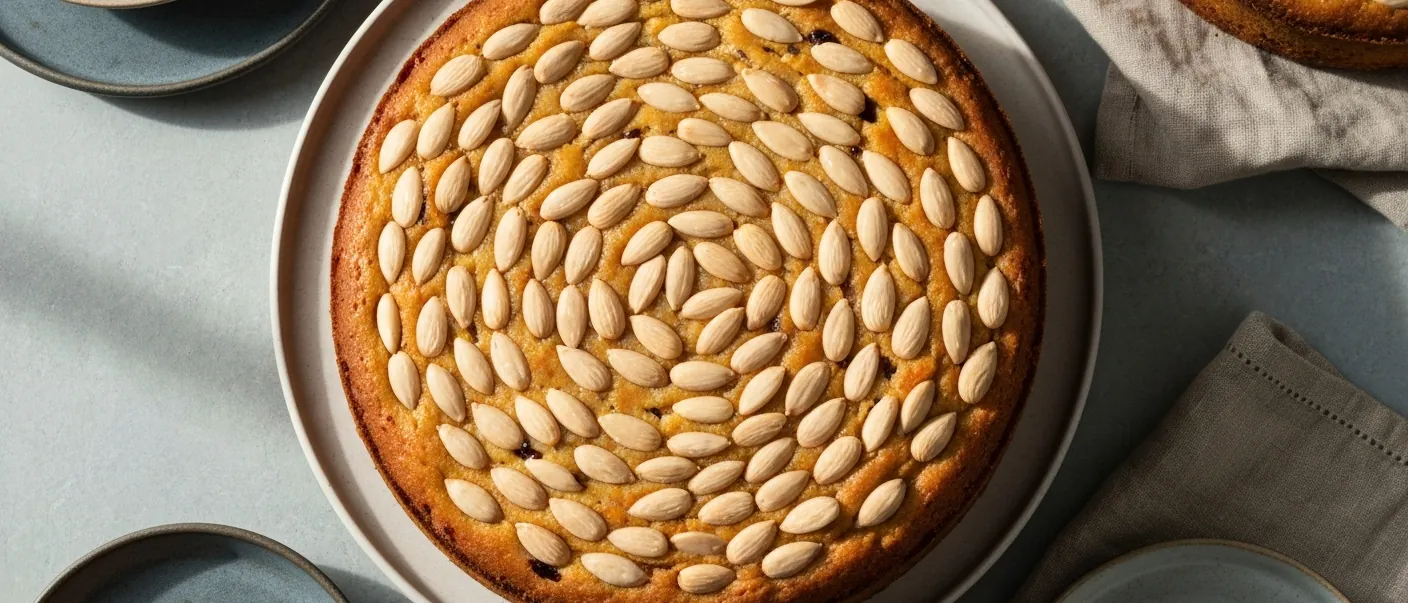
Dundee cake is a rich, dense fruit cake, immediately recognisable by the concentric rings of whole blanched almonds pressed across its surface. That topping is not decoration for decoration's sake — it is the thing that distinguishes it, visually and texturally, from every other fruit cake on a British table. But the more interesting story sits inside the tin, in what the cake contains and, just as pointedly, in what it does not.
The city of Dundee was, for a long time, one of Britain's great centres of marmalade production. Seville oranges — the bitter, thick-skinned variety imported each January from Spain — were processed in large quantities, and the peel left over from that process was abundant. Tradition holds that Dundee cake was built, at least in part, around that surplus: the candied Seville peel gave the cake its distinctive citrus edge, a slightly bitter brightness that sets it apart from a standard mixed-peel fruit cake.
What goes in, and what stays out
The fruit base is familiar enough — sultanas, currants, mixed peel — but the Seville orange peel is what gives the crumb its particular character. The batter itself is buttery and well-spiced without being aggressively so; the cake should taste balanced rather than sweet-heavy, with the citrus cutting through the richness.
No glacé cherries. This is not a minor point. Many British fruit cakes rely on cherries for colour and sweetness, but by firm tradition, Dundee cake excludes them entirely. Whether this is a question of original recipe, regional preference, or simply the fact that cherries would compete with the marmalade peel's role in the cake, the rule holds. A Dundee cake with cherries is, to a purist, simply not a Dundee cake.
The almond crown deserves attention too. The nuts are pressed on in careful rings before baking, and they toast slowly in the oven to a deep gold. They add a gentle crunch to an otherwise soft crumb, and their mild, slightly sweet flavour sits comfortably against the citrus peel beneath.
Protected status and what it means in practice
Dundee cake sits within a broader category of foods associated with a specific British place and the traditions of that place. Unlike Champagne or Stilton, it does not currently carry formal EU or UK geographical indication protection — which means any baker, anywhere, can call their fruit cake a Dundee cake. In practice, this has led to considerable variation in what ends up sold under the name, including versions that include cherries or that use generic mixed peel rather than Seville orange peel specifically.
For those who care about the original, the things to look for are straightforward: the almond topping arranged in rings, no cherries, and ideally a producer who is specific about using Seville orange peel. A cake made in Dundee itself, by a bakery with a genuine connection to the tradition, will generally be more faithful to the original character than a supermarket version produced elsewhere.
How it is traditionally eaten
Dundee cake is a keeping cake — it improves over a few days as the fruit and peel settle into the crumb. It is most commonly served in slices at room temperature, with tea. Traditionally, it appears at Christmas, though it has none of the heavy spicing of a Christmas cake and carries no icing or marzipan layer. Its relative lightness (for a rich fruit cake) makes it more versatile: equally at home on an afternoon table in October as on a festive spread in December.
In Scotland, it is sometimes served with a good sharp cheddar alongside — a pairing that sounds improbable until you consider how well the citrus and fruit notes in the cake work against aged, savoury cheese. The logic is the same as serving Wensleydale with Christmas cake, but the Seville peel in a proper Dundee cake makes the contrast even more interesting.