What a name can tell you
Britain has a long habit of naming food after its origins. With soup, that habit runs particularly deep. A bowl built from whatever was cheap, local and plentiful tends to be honest about where it came from in a way that more elaborate dishes are not. The soups that earned proper names did so because they were distinctive enough to be worth distinguishing from everything else.
Three stand out as genuinely place-rooted: Cullen skink from the Moray coast, cawl from Wales, and London particular from the capital's smokiest era. Each is a small piece of social history you can eat.
Cullen skink and the Moray coast
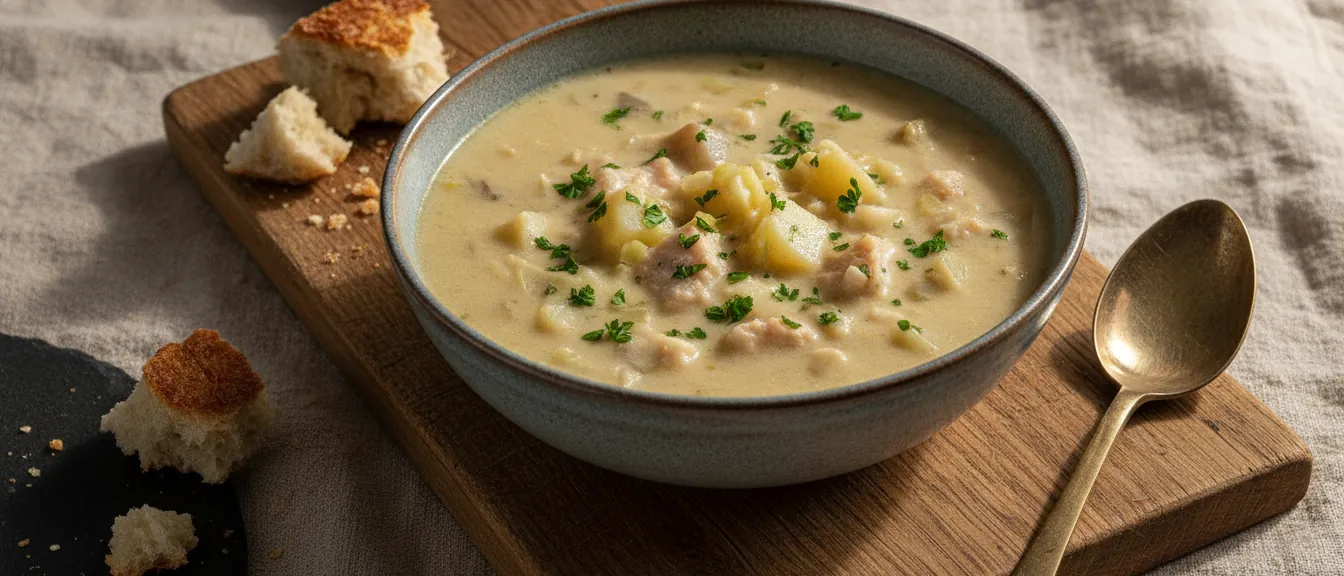
The word skink is the key to this soup. In Scots, it originally referred to a shin or knuckle of beef — a cheap, gelatinous cut used as the base of a broth. Over time, in the fishing town of Cullen on the south shore of the Moray Firth, the word came to describe something quite different: a thick, creamy soup built around smoked haddock, with potato and onion for body.
Cullen sits on a stretch of coastline where smoking fish was a practical necessity rather than a luxury. Before refrigeration, smoking preserved the catch. Finnan haddie — cold-smoked haddock, named for the village of Findon near Aberdeen — was the natural raw material, and the soup that developed around it is deeply savoury, pale gold in colour, and satisfying in the way that food made from genuinely good local ingredients tends to be.
The name stuck because the soup is specific. A good Cullen skink is not simply smoked fish soup; it has a particular richness, a balance between smoke and cream, that marks it as coming from a tradition. You still find it on menus across the north of Scotland, and it remains one of the most recognisable Scottish dishes in any setting.
Cawl and the long Welsh tradition
Cawl is harder to pin down, which is partly the point. The word simply means soup or broth in Welsh, but in practice it refers to a slow-cooked, one-pot dish of lamb and leeks — and sometimes other root vegetables, depending on region and season — that has been central to Welsh cooking for centuries.
Unlike Cullen skink, cawl has no single origin town. It belongs to Wales as a whole: to the hills and smallholdings where lamb was the obvious meat and leeks grew reliably through winter. What makes it distinctly Welsh is not a precise recipe but a set of principles — long cooking, honest ingredients, and a broth substantial enough to serve as a course in its own right before the meat is lifted out.
Traditionally, cawl was eaten over two sittings: broth first, then meat and vegetables. That speaks to the frugality of the households that made it. The wooden spoon used to serve it was sometimes a llwy garu, a carved love spoon, which tells you something about how embedded this dish is in Welsh domestic life. It is farmhouse food that happened to last.
London particular and the pea-souper
London particular is the most literary of the three. The name comes directly from the thick, yellowish fogs that once settled over the capital — so dense and so associated with London that they became known as particulars. The connection to pea soup is obvious the moment you see the colour: a thick, greenish-grey purée of dried peas and ham, murky and satisfying in equal measure.
The fog that inspired the name was not romantic. It was the product of coal fires, industry, and the geography of the Thames valley, and it made London genuinely difficult to navigate. Dickens wrote about it; Conan Doyle wrote about it. That a soup should take its name from something so oppressive is a very British kind of humour — finding appetite in adversity.
The soup itself is straightforward: split peas cooked with a ham hock until they dissolve into the stock, the whole thing thick enough to stand a spoon in. Warming, economical, built from ingredients that kept well — it is also a record of how Londoners ate when London was a city of open fires and working docks.
Why named soups matter
What these three share is that the name functions as a guarantee. Call something Cullen skink and you are committing to smoked haddock, to a dish with a home. The same logic applies to cawl — serve it under that name in Wales and it carries expectations built over generations. London particular is more loosely defined today, but the name still conjures a specific time and a specific city.
Britain has other named soups — cock-a-leekie in Scotland, brown Windsor in England's past, various regional broths that have drifted in and out of fashion — but these three have proven durable because the places and conditions that made them remain legible in the bowls themselves. That is a good reason to pay attention to what a soup is called, and where.