A claim worth taking seriously
The phrase "Britain's oldest named cheese" gets attached to Cheshire regularly, and the evidence usually cited is a mention in the Domesday Book. Food historians are cautious about reading too much into that reference — the documentary record is fragmentary, and naming a cheese in a tax survey is not the same as describing it in a way we'd recognise today. What is beyond reasonable doubt is that Cheshire had a reputation across England centuries before most other regional cheeses found their way into written record. That longevity deserves attention on its own terms.
What the salt seam explains
The character of Cheshire cheese is inseparable from the ground beneath the plain where it's made. The same underground brine deposits that turned Nantwich, Middlewich and Northwich into significant salt towns also leach minerals into the pasture above. Cattle grazing that land produce milk with a distinct mineral quality, and the cheese carries a flavour that is noticeably saltier and more lactic than most. No amount of cheesemaking technique fully replicates it elsewhere — which is exactly why geographically specific food protections exist.
The texture is crumbly in a way that feels almost engineered: it breaks cleanly, doesn't smear, and has a slightly open, granular interior. Eaten young, it is mild and fresh; given more time, it sharpens. Neither version is trying to be anything other than what it is.
London's favourite, then forgotten
At its commercial peak, Cheshire was the dominant cheese in the capital — shipped south in large wheels and sold through London's markets in quantities that made it the country's best-known cheese. The rise of industrialised Cheddar production eventually displaced it, a story familiar to many traditional British foods where consistency and scale won out over character and place.
Cheshire never vanished, but it lost the cultural prominence it once had and for a long stretch was treated as a workaday block in the supermarket chiller. That shift matters not because decline deserves romanticising, but because it explains why the farmhouse versions that survive today feel significant. The cheesemakers keeping the traditional method alive are maintaining a thread back to a time when this was the cheese that defined British taste.
White, red and blue
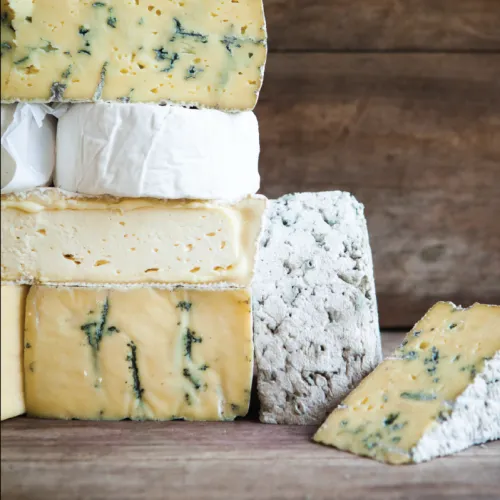
Cheshire comes in three forms, and the differences are more than cosmetic. White Cheshire is the baseline — pale, crumbly, lactic. Red Cheshire is coloured with annatto, the same natural dye used in Red Leicester, giving it a deeper terracotta tone without changing the flavour in any meaningful way. The colouring was historically a way of signalling quality or distinguishing batches; today it is largely traditional habit.
Blue Cheshire is the rarest. It develops its blue-green veining naturally, and the combination of the cheese's crumbly structure with the sharpness of the mould produces something quite different from a Stilton or a Gorgonzola — more mineral-forward, more austere. Finding a good one repays the effort.
Farmhouse versus factory
Most Cheshire sold today is made at scale, and it is perfectly decent. The farmhouse versions — where milk comes from a known herd, the process is largely by hand, and the cheese is allowed to develop properly — carry a depth that is noticeably different. The lactic tang is more pronounced, the crumble more satisfying, and the salt sits within the cheese rather than just on the surface.
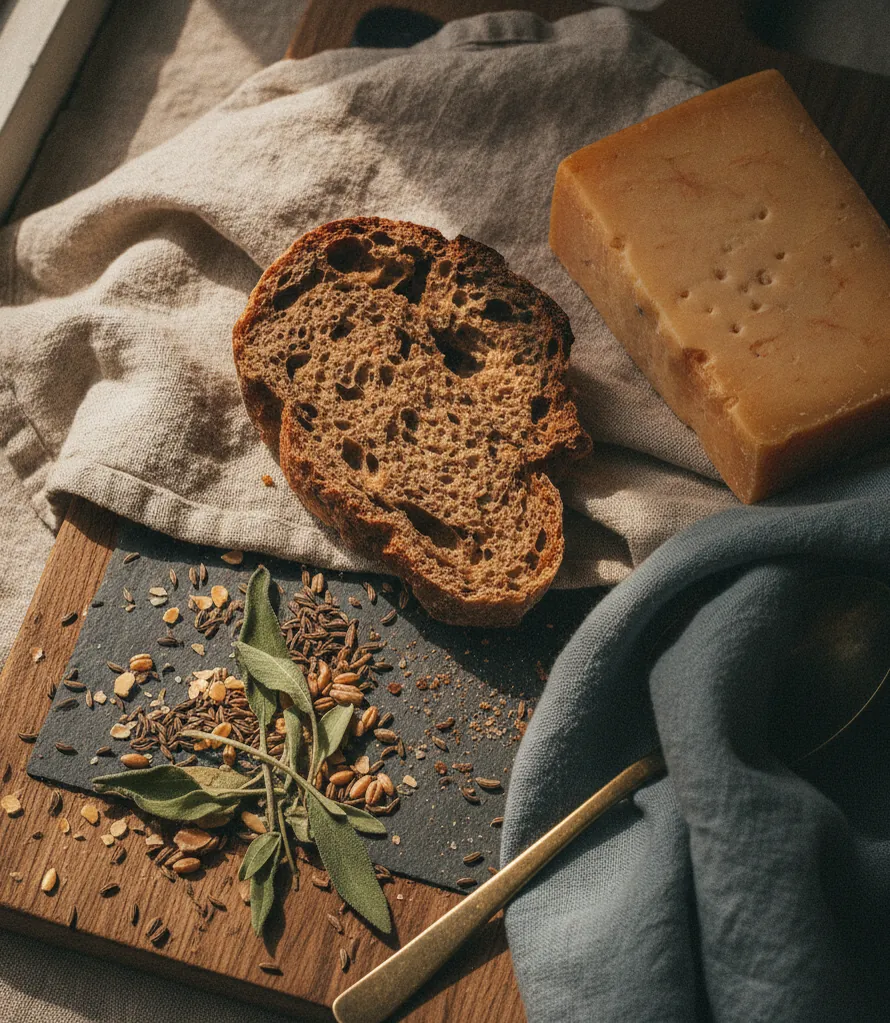
It is the kind of difference that is easier to taste than to describe. If your only experience of Cheshire is the pre-packed supermarket block, a wedge from a farmhouse maker or a good cheesemonger will reframe it entirely. Eaten with good bread, a few pickled walnuts, or alongside a slice of fruitcake in the northern tradition, it needs nothing added to make the point.