What black bun actually is
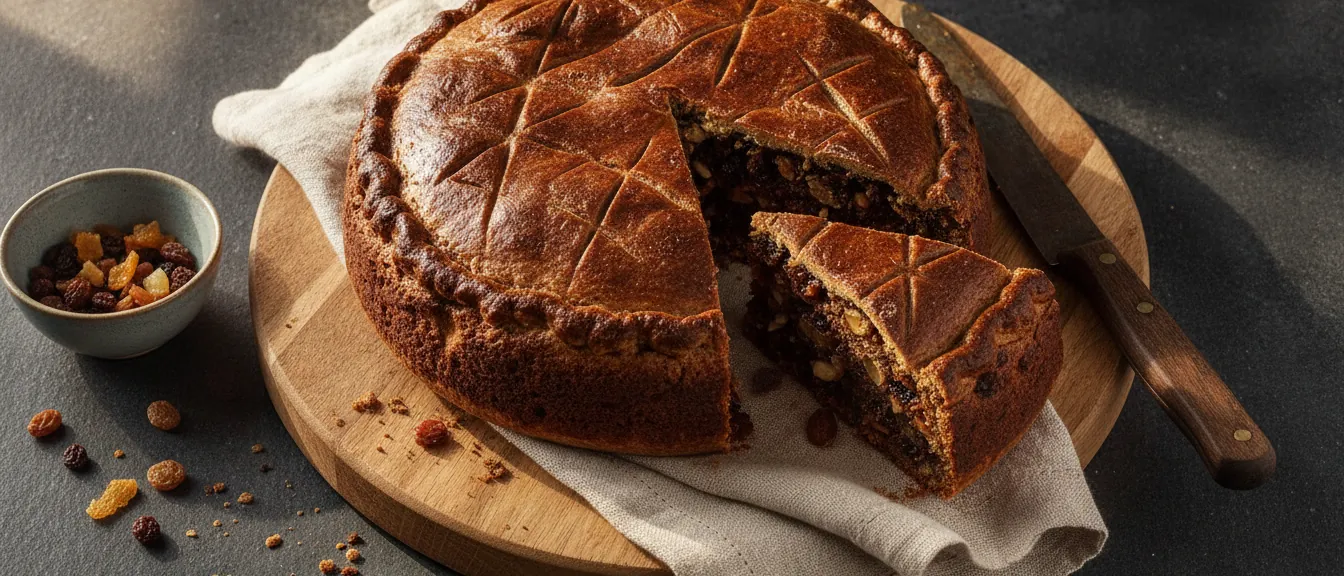
The name misleads. Black bun is not a bun in any soft, pillowy sense — it is a deeply spiced fruit mixture, dense with dried fruit, baked inside a short pastry case that acts as both container and crust. Slice into it and the interior is almost black, hence the name. The pastry is structural: an edible tin that holds everything together and keeps the filling moist.
The spicing and fruit give black bun a flavour quite unlike a standard Christmas cake or clootie dumpling. The pastry exterior creates a sharp contrast between the firm outer shell and the compacted, sticky interior. It is rich, assertive, and made to last — which matters, given its history.
From Twelfth Night to New Year's Eve
Black bun did not begin as a Hogmanay cake. Its origins lie in Twelfth Night, the feast that closes the twelve days of Christmas, when spiced fruit cakes were common celebratory food across Britain and much of Europe. Scotland's version migrated as traditions shifted and the calendar changed, and black bun found its permanent home at New Year.
The reasons are tangled in Scottish religious and social history. The Reformation left its mark on how Scotland observed Christmas, and for a long period the midwinter feast was far less marked there than elsewhere in Britain. Hogmanay became the great celebration instead. Black bun travelled with it.
First-footing and what the cake means
To understand black bun, you need to understand first-footing. The first person to cross the threshold of a home after midnight on New Year's Eve — the first-footer — was believed to set the tone for the household's luck in the coming year. They were expected to arrive bearing gifts: coal, salt, a small dram, perhaps a coin. And black bun.
Each item carried meaning. Coal for warmth, salt for sustenance, whisky for good cheer. Black bun represented food — the hope that the household would never go hungry. Arriving empty-handed was not simply poor form; it was considered genuinely unlucky. The ritual gave the cake a purpose beyond eating. It was currency in a social ceremony.
First-footing is still observed in many Scottish households, and black bun remains part of it. Customs vary by family and region — some first-footers bring the full traditional set of gifts, others arrive with just the whisky and the cake — but the principle holds.
Where to find it and how it is eaten
Outside Scotland, black bun can be difficult to track down. It appears reliably in Scottish bakeries and supermarkets in the weeks before Hogmanay, and a handful of specialist producers make it available by mail order through the year. An independent Scottish deli or a good online food merchant is the best starting point outside that window.
It is traditionally eaten in thin slices — the richness demands restraint — often alongside a glass of whisky. Some people pair it with a wedge of sharp cheese, which cuts through the sweetness much as one might serve fruit cake with a hard, aged cheddar. Serve it cold and firm from the pantry; it needs no warming.
Black bun keeps well, which was once a practical necessity. Made in advance of the New Year, it was carried from house to house, sliced and shared across multiple visits. A cake that crumbled or turned quickly would have been useless for the job.
Why it matters beyond the season
Black bun only makes complete sense in context. Eaten out of season and ceremony, it is an unusual, intensely flavoured fruit cake with an odd pastry shell. Carried through a dark doorway as a gift at midnight on the first of January, it becomes something more. The food and the moment are inseparable.
It also sits within a wider tradition of British spiced fruit cakes that mark the turning of the year: the Twelfth Night cakes it descended from, the wassail foods of the English midwinter, the plum puddings and mincemeat pies of Christmas. Scotland took that tradition and made it specifically, stubbornly its own — relocating it to a different night and wrapping it, quite literally, in pastry. That is the kind of quiet, particular adaptation that makes regional food worth paying attention to.