What a Bath chap actually is
Start with the cheek. A pig's cheek is a hard-working muscle, threaded through with fat and collagen in a way that lean cuts simply aren't. Cure it, cook it long and slow, and that collagen softens into something almost gelatinous — silky rather than stringy, with a depth of flavour earned by the effort the animal put into chewing. It is, by any honest measure, a superior piece of meat.
A Bath chap takes that cheek, cures it with salt, rolls it into a neat cone or cylinder, and finishes it in a coat of golden breadcrumbs. It is served cold, sliced. Traditionally it came from long-jawed breeds — the extended snout gave more meat from the lower jaw — and it was closely associated with the pig-keeping culture around Bristol and Bath. You would have found it on a cold counter in any respectable butcher or provisions shop in the region, ordinary enough to be unremarkable.
That ordinariness is what makes it interesting now. Bath chaps didn't disappear because they fell dramatically out of fashion. They disappeared because the knowledge required to make them — and the confidence required to eat them — quietly eroded over a generation or two.
The honest reason these cuts vanished
Brawn, tongue, trotters, chaps: the cuts that have nearly left British tables share a common characteristic. None of them work without time, skill, or a willingness to engage with something that looks like an animal. Brawn requires a whole pig's head, several hours, and the patience to set a terrine. Trotters need long, slow braising before they give up their gelatine. Tongue must be pressed. None of this is difficult, exactly, but all of it presupposes a household that knows what it's doing at a butcher's counter and isn't frightened of unfamiliar anatomy.
When domestic butchery skills collapsed — rapidly, across the second half of the twentieth century — these cuts went with them. Supermarkets stocked what their customers would confidently pick up and cook without instruction. Cheeks and trotters and ears don't sell themselves the way a fillet does. So they moved to the back of the abattoir, into pet food, or simply stopped being separated out at all.
The loss is practical, not sentimental. These are the cuts that reward patience most generously, and they represent the most honest use of an animal. A pig raised well and slaughtered carefully deserves better than a culture that eats only its loin.
What remains, and where to find it
Bath chaps survive, but only just. A handful of West Country producers still make them — usually small independent curers who treat them as a point of regional pride rather than a commercial calculation. They're easier to find at specialist butchers, good delis, and food markets than they once were. The same shift that brought craft charcuterie to wider attention has encouraged makers to look at what their own tradition had to offer. We've written elsewhere about the broader British charcuterie revival, and Bath chaps fit squarely into that story: producers rediscovering cures that were local and specific rather than borrowed from a French or Italian template.
Brawn and pressed tongue have followed a similar path. Once dismissed as old-fashioned, they now appear on the menus of restaurants that care about sourcing and craft — served in the same spirit as any house-made terrine, which is essentially what brawn is. The ingredients haven't changed. The framing has.
How they're eaten
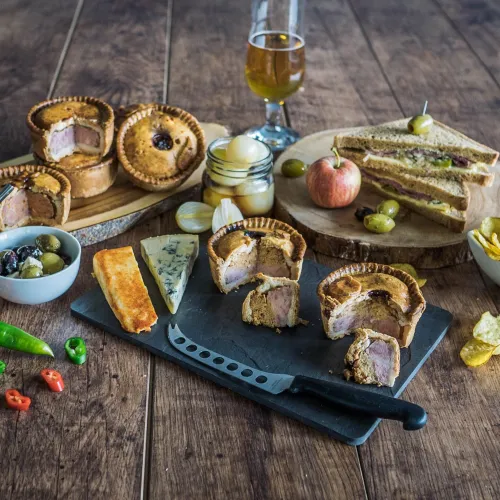
A Bath chap is cold charcuterie in the plainest sense. Sliced and eaten with bread, mustard, and something pickled — a sharp piccalilli or a pickled walnut — it needs almost no intervention. The breadcrumb crust gives texture; the cured meat underneath has a gentle, yielding richness unlike anything else on a British cold table.
Brawn works similarly: sliced cold, eaten with toast or sourdough, sharpened with vinegar or mustard. Tongue, pressed and thinly sliced, has a smooth, fine-grained texture that surprises people who've never tried it. None of these are challenging flavours. The barrier was never taste — it was familiarity, and the slow erosion of the knowledge that made them seem normal.
Why it's worth seeking them out
Eating a Bath chap is a direct line to a version of British food culture that was frugal not as ideology but as a simple matter of course — one in which nothing useful was wasted and the skill of the curer or cook was applied to every part of the animal, not just the easy parts.
Seeking out these cuts is partly about flavour, and that alone justifies it. But it also means supporting the small producers and independent butchers keeping the knowledge alive. The cuts exist. The craft exists. What they need is customers who know to ask.