
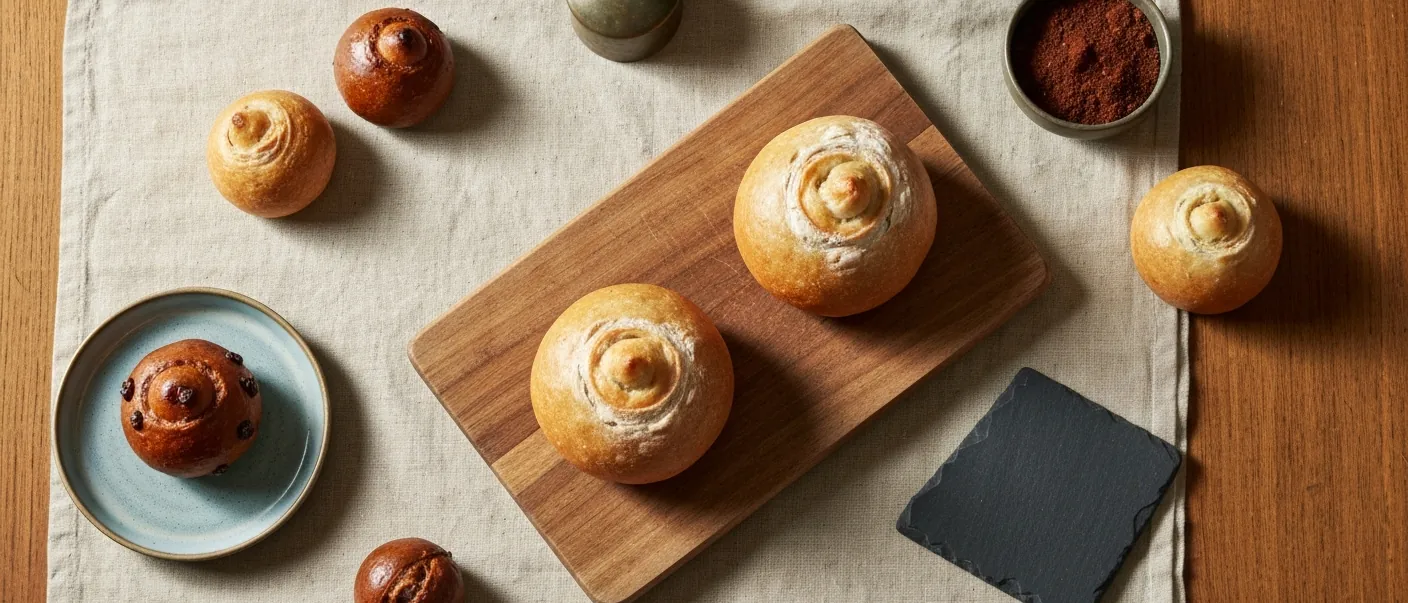
Two buns, one city, a world of difference
Ask someone to picture a Bath bun and they'll likely describe something sticky and sweet, crusted with roughly crushed sugar and plump with dried fruit. Ask about a Sally Lunn and you might get a blank look — or, worse, the same description. The two have been muddled together for so long that even some local menus have blurred the distinction. They are quite different things: different textures, different traditions, different occasions entirely.
Both come from the same Georgian city, both are enriched buns, and both carry old-fashioned charm. Set them side by side, though, and the differences become obvious almost immediately.
The Bath bun
The Bath bun is a small, individual bun — sticky, yielding, and generous with sweetness. Its defining feature is the topping: coarse, crushed sugar pressed into the surface before or after baking, giving a crunchy, crystalline finish that contrasts with the soft crumb beneath. Dried fruit — typically currants or mixed peel — is folded through the dough, adding bursts of sweetness rather than tartness.
It is emphatically a treat, eaten with afternoon tea rather than as part of a considered meal. The sugar topping is not incidentally decorative; it is the point, the textural signature that makes a Bath bun recognisable the moment you bite into one. Without it, you simply have a sweet bun.
Like many regional specialities, the Bath bun has drifted from whatever its original form may have been. Mass-produced versions exist across the country and bear only a passing resemblance to what a good independent baker produces. The sugar softens quickly, and the bun is at its best eaten the day it is baked.
The Sally Lunn
The Sally Lunn is larger, lighter, and far less sweet. It is a generous, domed bun with an open, airy crumb — closer in character to a brioche or a Viennese milk bread than to anything typically found in a British bakery window. Sliced horizontally and served with butter, clotted cream, or savoury toppings, it functions as a bread as much as a bun, versatile enough to carry either sweet or savoury flavours.
The name has attracted speculation for as long as anyone has been writing about it, though the etymology remains genuinely uncertain. What is less contested is where it became famous. The Sally Lunn House in Bath — one of the oldest buildings in the city — still serves the bun, and the recipe used there is kept as a house secret.
Eaten warm, split and generously buttered, a Sally Lunn has a richness that doesn't announce itself the way a Bath bun's sugar crust does. The pleasure is more subtle: a slight sweetness in the crumb, a yielding softness, and a capacity to absorb butter without becoming heavy.
Why the distinction matters
Regional food specificity is easily lost. Once the details that make something particular to a place get smoothed away — by scaling up production, by substituting cheaper ingredients, by conflating two things into one — what remains is a name without substance. The Bath bun's crushed sugar topping and the Sally Lunn's brioche-like crumb are not quirks; they are what each thing is.
Neither bun holds a protected designation in the way that a Cornish pasty or a Melton Mowbray pork pie does, so no legal definition enforces their character. That places the responsibility with producers and eaters alike — knowing what to look for, and seeking out versions made with care rather than convenience.
Visiting the Sally Lunn House and eating a bun there is one of those rare instances where the heritage and the food are genuinely inseparable. Buying a proper Bath bun from a bakery that still finishes it with real crushed sugar — not a sprinkle of granulated white — is a small but worthwhile act of regional loyalty.
_(3)_kfw4-y9_jpgq80.webp)