
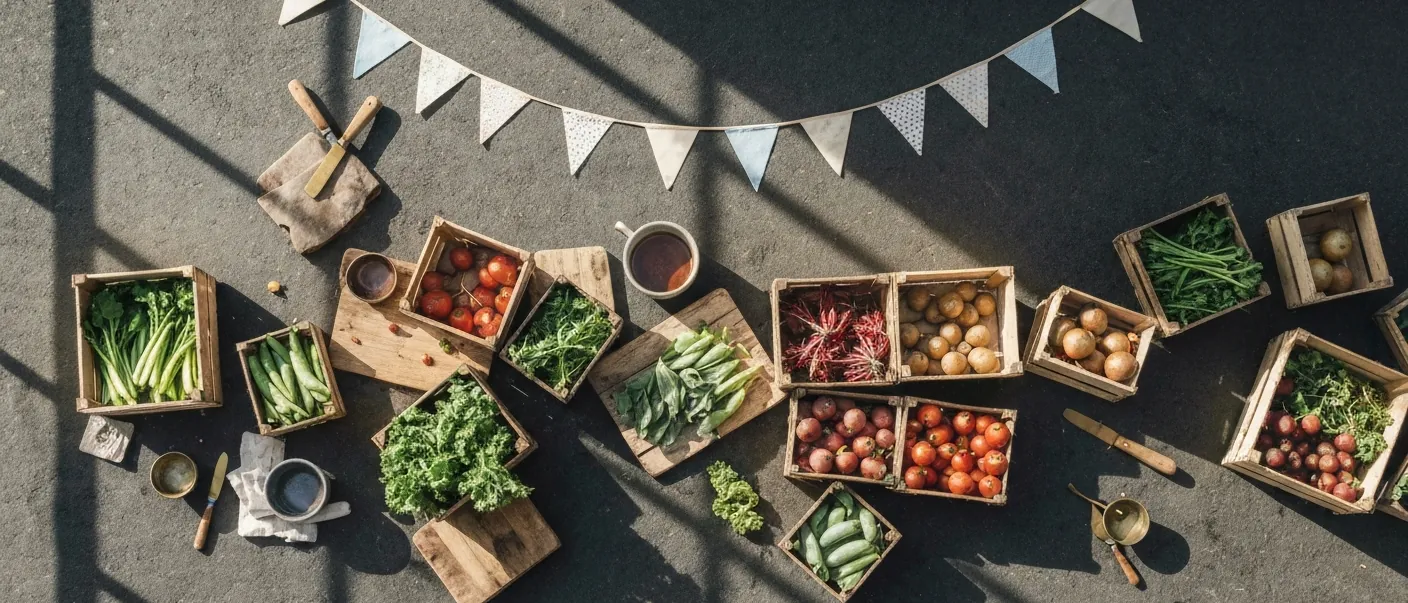
A market that has kept its nerve
St George's Market sits in the heart of Belfast as a working covered market, not a preserved one. The Victorian ironwork and brick shell could easily have become something else — a car park, a shopping centre, a heritage attraction sealed behind glass. Instead, it kept trading. That continuity is what you feel the moment you walk in: the noise, the draughts, the smell of good fish and strong coffee all arriving at once.
It runs across Friday, Saturday and Sunday, though days and hours shift seasonally and for special events, so checking the official Belfast City Council site before you travel is worth the thirty seconds it takes. Each day has its own rhythm and emphasis, but Friday remains the anchor.
Why Friday matters
The Friday fish market is where St George's history is most legible. Northern Ireland's coastal and lough fisheries have long fed into Belfast, and the Friday trading day grew up around exactly that supply chain. Stalls pile up with whole fish, shellfish and smoked product in a way that feels genuinely linked to where the catch came from, not simply assembled from a wholesale catalogue.
Dulse — the dried, deeply savoury seaweed that has been eaten along the Northern Irish coast for centuries — appears here in a way you rarely find in English markets. So does yellow man, the brittle honeycomb toffee associated with the Auld Lammas Fair in Ballycastle. Both are worth seeking out if you haven't come across them before: they are particular to this part of the world in a way that no amount of artisan rebranding has managed to replicate elsewhere.
Northern Ireland's producers in one place
Saturday and Sunday draw a broader spread of stallholders, and this is where St George's functions as something close to a showcase for Northern Irish food and drink more widely. Small cheesemakers, charcuterie producers, bakeries turning out soda bread and wheaten bread alongside sourdough, preserves made from hedgerow and orchard fruit — the range reflects a food culture that has been quietly rebuilding its confidence for a couple of decades.
The bread alone is worth paying attention to. Soda bread in Northern Ireland is its own tradition, distinct from what you find in the Republic and largely absent from English shelves. Made with buttermilk and bicarbonate rather than yeast, it has a close, slightly tender crumb and a flavour that comes from the dairy as much as the flour. Buying a loaf here, from someone who has been making it the same way for years, is a straightforward pleasure.
Coffee traders and street food stalls have grown in number over recent years, which means the market functions well as a place to spend a proper morning rather than a quick pass-through. The hot food offering tends to reflect the produce on sale — chowder built around the Friday catch, that kind of logic — rather than operating as a separate catering layer dropped in from outside.
Getting the most from a visit
St George's is compact enough to navigate without a plan, but arriving with some sense of what you're after saves time. If fish and traditional Ulster produce are the draw, Friday morning is the session to prioritise. For the widest range of craft producers and prepared food, Saturday tends to be the fuller day — though that also means the largest crowds.
The market is central to Belfast and straightforward to reach on foot from the main railway stations and the city centre. Parking nearby is possible but tight on busy mornings. Bringing a proper bag is worth doing; the kind of reusable market bag that folds flat takes up nothing and saves a lot of awkward juggling at the till.
A few stalls are cash-only, which is less common than it once was but still worth knowing. Having some notes available avoids the specific frustration of finding the thing you want and then having to walk away.

_9e2b-71_pngq80.webp)