The site itself is the story
Stand at the bottom of the market and look up. Nearly 200 stalls climb the hill in tight, cobbled alleys, each unit fronted by its own striped canopy — red, white, yellow, green — the whole thing slightly chaotic, very much alive. Above it all sits the castle keep; to one side, the clean civic lines of City Hall. It's a genuinely strange and satisfying collision of centuries, and it's exactly where a market has operated since Norman times. Roughly 900 years of continuous trading on the same ground is the figure Norwich cites, and there's no reason to quibble.
That longevity means the market has outlasted every passing food trend, every out-of-town retail threat, every bout of municipal indifference. Markets that survive that long do so because they remain useful — not because they've been preserved in aspic.
What you actually find there
The traditional stalls are still the backbone: fruit and vegetables, fish, meat — counters where produce turns over fast because the customer base is real and regular, not tourist-dependent. In season, Cromer crab makes its way here from the Norfolk coast, as good a reason as any to time a visit carefully (our separate piece on Cromer crab covers the season and what to look for).
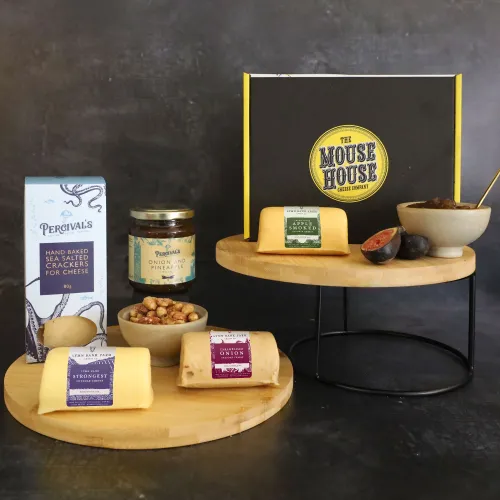
The more recent arrivals are what have shifted the market's reputation among food lovers. The lock-up units — small, practical, slightly cramped — have filled with serious operators: street-food kitchens running short, considered menus; speciality counters stocking proper coffee, independent cheesemakers' stock, preserves and condiments with real provenance. The range doesn't feel assembled for effect. It feels like the natural result of low overheads attracting people who care more about what they're making than about a polished shopfront.
Six days a week, whatever the weather. A market that closes at the first sign of drizzle is a leisure attraction; one that trades through an East Anglian February is something more useful than that.
The logic of the lunch crawl
Norwich Market rewards the slow circuit. The layout — narrow alleys, stalls on both sides — means you're always slightly squeezed, always catching something in your peripheral vision you weren't expecting. The density forces discovery.
The eating strategy that works best is the one that resists committing too early. Walk the full length first. Let the fish-stall smells, the coffee-counter queue and the hand-written specials board on a street-food hatch form a picture before you spend anything. Then double back. A meal assembled from two or three different stalls tends to be more interesting than one thing eaten at a single counter — and at Norwich that's genuinely possible rather than aspirational.
Seating is limited and informal: a fold-out chair at a stall, a bench nearby, the steps up to the surrounding streets. None of it is comfortable in a restaurant sense, and that's entirely the point.
East Anglian produce in its right setting
What a market like this does that a farm shop or food hall can't quite replicate is concentrate regional supply into a single place where competition is literal and immediate. A stall selling local asparagus stands twenty feet from one selling imported asparagus; the difference in quality tends to make itself apparent without anyone needing to make a speech about provenance.
East Anglia is not a region that shouts about its food with quite the volume of, say, Yorkshire or Cornwall, but the raw materials are serious: the North Sea fishery, the flat fertile land, the market-garden tradition that has supplied towns like Norwich for generations. The Cromer crab is the famous example, though it's the everyday fruit-and-veg stalls — busy, no-nonsense, priced for locals — that tell you most about how the region actually eats.
Visiting well
The market runs six days a week; check the official Norwich Market site for current opening hours and any seasonal variation before you travel. Arriving mid-morning gives you the full choice before the lunch rush compresses the alleys further. Cash is useful at some stalls, though card is widely accepted.
The surrounding streets — Gentleman's Walk, the lanes running off the market square — are worth the wander afterwards. But the market itself, with its noise and its stripes and its improbable continuity, tends to be the thing people remember.