What the logos actually mean
Protected food name schemes do one thing: tie a food irrevocably to its place and method of making. A product carrying a PDO — Protected Designation of Origin — must be produced, processed, and prepared entirely within a defined geographical area, using methods the specification demands. PGI, Protected Geographical Indication, is slightly looser: at least one stage of production must take place in the named region, but the link to place is still legally enforced. TSG, Traditional Speciality Guaranteed, works differently — it protects a traditional recipe or method rather than a geography, so the food can be made anywhere, but must follow the defined process to the letter.
These are not marketing badges that producers apply for and then use however they like. They are registered, legally enforceable designations. If a cheese calls itself by a PDO name without meeting the specification, that is a breach of food law, not merely misleading packaging.
Two sets of logos, and how to tell them apart
Since the UK left the EU single market, two parallel schemes run in Britain. The UK GI scheme — administered by the Food Standards Agency and the devolved equivalents — issues its own logos, broadly similar in intent to their European counterparts but distinct in design. They carry the word "UK" alongside the PDO, PGI, or TSG designation. Products sold in Great Britain that hold UK GI status carry these UK logos.
EU logos — the older, better-known roundels in yellow and blue — appear on products imported from EU member states, or on British products that also hold EU registration. Some producers sought recognition under both schemes and retain dual status. If you are buying a French cheese, an Italian cured meat, or a Spanish olive oil in a British shop, the EU roundel is what you will see.
A product carrying either set of logos has been through a rigorous application process, had its specification scrutinised, and is subject to ongoing checks. A product that simply says "traditionally made in Somerset" has not.
Where to look on the pack
Logos tend to appear on the back or side of packaging rather than the front, which is partly why shoppers miss them. On products sold at specialist retailers or farmers' markets, you may find them on a swing tag or producer's own label. Pre-packed supermarket versions of protected foods are required to display the relevant logo, but size and placement vary.
A few things worth checking when you pick up a product:
- Is the protected name used in full? Some products trade on association with a famous name without holding the designation — "Champagne-style" is the classic example, though that particular battle has largely been won.
- Does the logo match the claim? A product labelled PDO should carry the PDO roundel, not the PGI one. The distinctions matter.
- Is it the UK or EU logo? For a British-made product sold in Britain, expect the UK GI logo. An EU roundel on a domestically produced British food would be unusual and worth querying.
Why it matters at the shelf
Protected status is not a quality guarantee in the sense that every bottle of a PDO wine will be exceptional. What it guarantees is authenticity — that the Stilton in your hand was made in one of the three permitted Midlands counties, using pasteurised local milk, following the agreed method. You know what you are buying in a way that no amount of artisan-sounding copy can replicate.
For shoppers who care about provenance, that certainty is the point. A PDO or PGI label means the money you spend goes to producers in a specific place, sustaining specific traditions, rather than to a manufacturer that has appropriated a famous name. It also means the flavour profile you expect — the particular tang of a West Country farmhouse Cheddar with PGI status, say — is one the product is legally required to deliver.
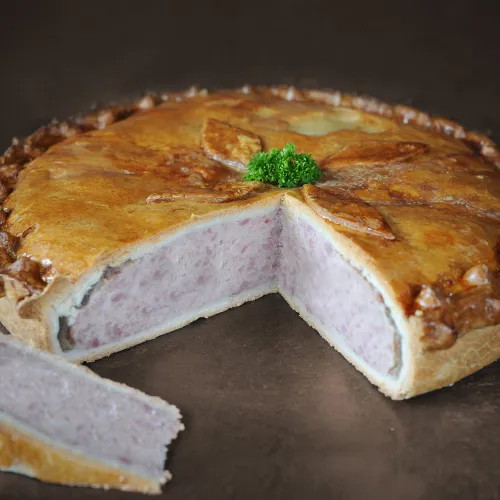
British food has a rich catalogue of protected names: Cornish pasties, Arbroath smokies, Welsh lamb, Yorkshire forced rhubarb, Melton Mowbray pork pies, and many more. Learning to spot the logos is a way of accessing what those designations represent — the accumulated knowledge of people who have been making one thing, in one place, for a very long time.
A note on 'heritage' and similar language
No legal definition governs words like "heritage", "traditional", "artisan", or "handmade" on a British food label. Producers use them in good faith, and often accurately, but they carry no enforceable standard. The GI logos are the only marks on a food label that come with a legal specification behind them. Everything else is, at best, a producer's honest self-description.