Land that feeds itself differently
The Highlands are not farming country in any conventional lowland sense. The terrain — vast, wet, frequently severe — has always dictated what grows, what roams, and what thrives. That constraint produced a food culture of remarkable character: ingredients drawn from river, moor, and sea rather than cultivated field.
Highland food is wild not as a marketing angle but as simple geography.
Venison and the managed deer forest
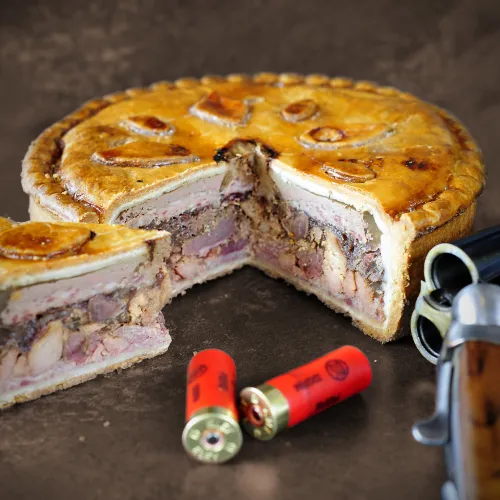
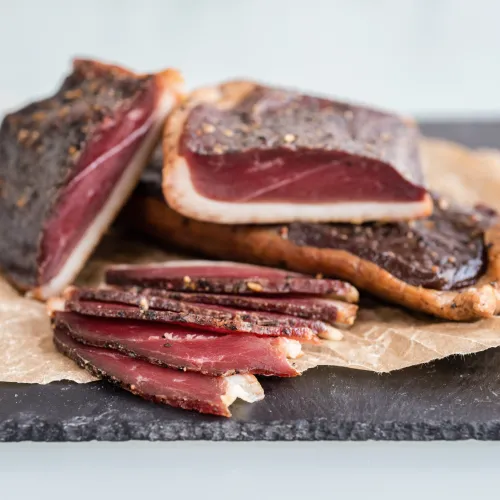
Red deer have grazed the Highland hills longer than any written record, and venison remains one of the region's defining foods. The herds are managed — the landscape could not sustain them otherwise — but the meat retains all the qualities of animals living entirely outdoors on open ground: lean, deeply flavoured, with a minerality that farmed meat rarely achieves.
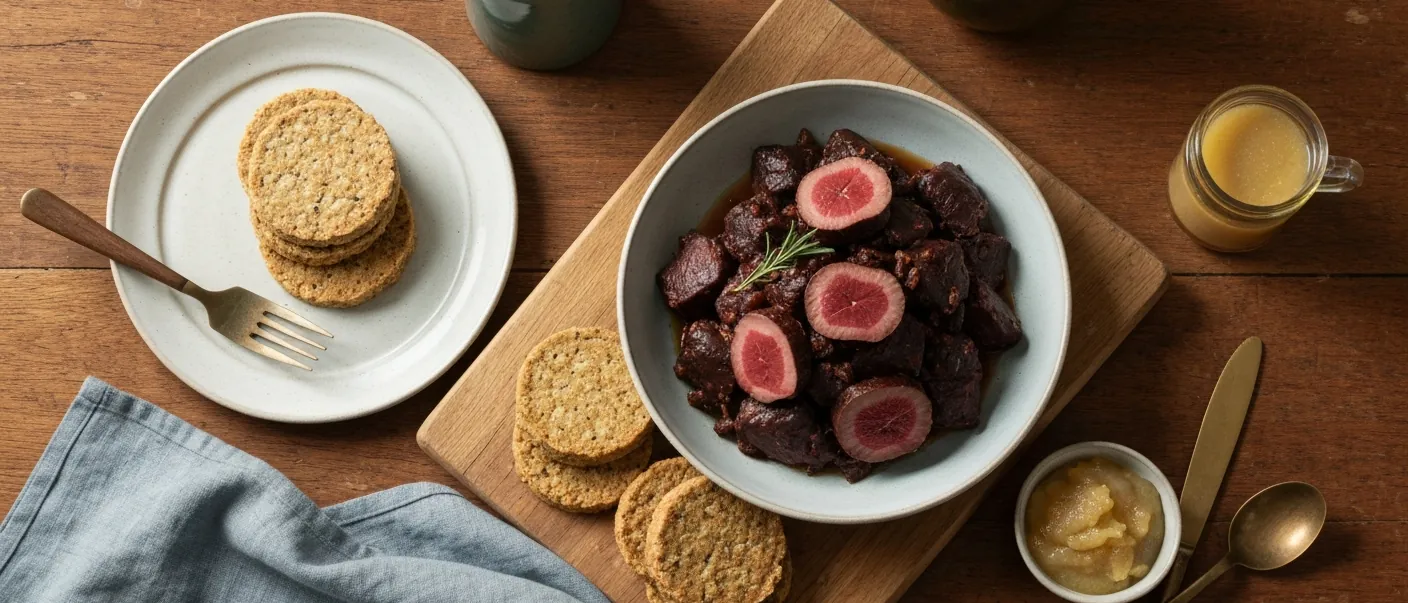
Highland venison is traditionally roasted or braised, the natural richness needing little embellishment. Butchers and estate farm shops across the region sell cuts that supermarkets seldom carry — haunch, saddle, offal — and buying directly from source remains the norm across much of the area.
Wild salmon from Highland rivers
Scotland's salmon rivers are among the most celebrated in the world, and a significant number run through the Highlands. Wild Atlantic salmon returning from the sea to spawn in cold, clear upland water produce fish of an entirely different order from farmed equivalents — firmer in texture, less fatty, with a clean flavour that reflects the water rather than a formulated diet.
Wild salmon is seasonal and, depending on the river, subject to conservation restrictions taken seriously by the communities built around them. Smoked Highland salmon — cold-smoked over hardwood, sometimes oak — is the form most people encounter. A good side carries the faint mineral quality of the river alongside the smoke. Seek out producers who source from specific named rivers; the difference from generic smoked salmon is immediately apparent.
Crowdie: the ancient fresh cheese
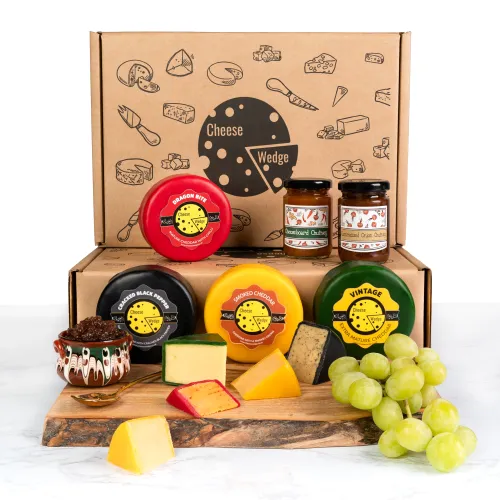
Crowdie is one of Scotland's oldest cheeses, and the Highlands claim it firmly. It is a fresh, unripened curd cheese — soft, slightly grainy, with a clean acidity — made from skimmed or semi-skimmed cow's milk. Historically it was a crofting staple, made at home from the morning's milk after the cream had been taken for butter.
The flavour is mild but distinctly sharp, somewhere between a good fromage frais and a well-made cottage cheese, though the texture is drier and more crumbled than either. It is traditionally eaten spread on oatcakes or alongside smoked fish — a daily cheese rather than a special-occasion one. A small number of Highland producers still make it by hand; their versions tend to have a more pronounced tang than commercial alternatives.
Heather honey and Speyside's edge
Late summer on the Highland moors brings the heather into flower and with it one of Scotland's most distinctive honeys. Heather honey has a thixotropic quality — it sets firm in the jar but loosens when stirred — and a strong, slightly bitter, almost medicinal flavour that marks it out from blended supermarket honey. It is unlike anything else produced in Britain, a direct product of landscape that would otherwise seem inhospitable to food production.
The eastern Highlands sit at the edge of Speyside, the stretch of the River Spey that has given its name to one of the world's great whisky regions. The influence of this terrain — granite water, barley-growing land in the glens, generations of distilling knowledge — runs through the wider Highland food and drink identity. Highland single malts tend towards a broader, sometimes more robust flavour profile than their Speyside neighbours: less floral, more rugged, if generalisations can be permitted about a spirit this various.
Game from the hill, fish from the river, dairy from the croft, honey from the moor, whisky from the glen — these ingredients form a larder with an internal logic most regions can only approximate. They are not expensive imports or fashionable additions. They are simply what this land produces.