A county with an outsized food record
Angus sits between the Tay estuary and the Highland glens — fertile straths, cold clean water, exposed coastal air — and that geography has generated some of Britain's most distinctive food products. The names have travelled far further than the county itself.
None of these specialities are accidental. Each reflects a specific combination of local landscape, animal breed, or long-practised craft.
The breed that changed how the world eats beef
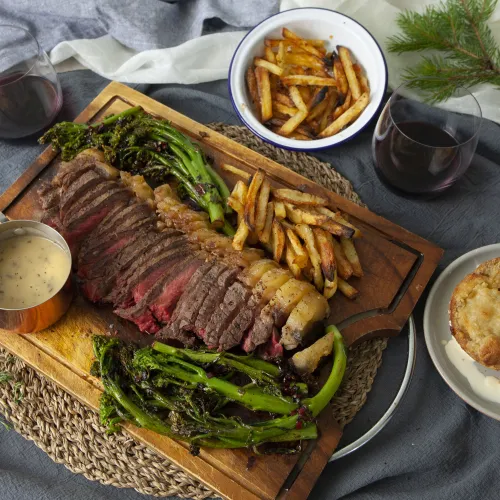
Aberdeen Angus is the most commercially recognised beef name on the planet, stamped onto menus from Tokyo to Texas. The breed was developed in the nineteenth century from the native black cattle of Angus and neighbouring Aberdeenshire — polled, hardy animals suited to the north-east Scottish climate. What made them valuable then and now is the marbling of fat through the muscle, giving the meat its flavour and tenderness.
In its homeland, Aberdeen Angus beef is simply what good beef looks like. Butchers across the county carry it as a matter of course, and the animals grazing the Angus glens belong to the same genetic line — sometimes in pedigree form — that spawned cattle populations across North America, Australia, and South America. Ordering a local steak here carries a quiet historical weight that the international branding rarely conveys.
Arbroath smokies and the craft of the kiln
The Arbroath smokie holds Protected Geographical Indication status, meaning the genuine article can only be made within a defined area around Arbroath. We have covered the smokie in detail elsewhere, but its place in any account of Angus food is fixed. Whole haddock, salted and hot-smoked over hardwood in the traditional barrel-and-hessian method, produce fish with a copper-coloured skin and a moist, bone-white interior that no industrial process has managed to replicate. The smokie is as much about method as ingredient.
The Forfar bridie
Less famous internationally but arguably more specific to Angus, the Forfar bridie is a horseshoe-shaped pasty of minced beef and onion enclosed in shortcrust pastry. It comes from Forfar, the county town, and the shape distinguishes it immediately from a Cornish pasty — the filling is different, the pastry is different, and the history is entirely its own.
Bridies are still made by bakers in Forfar. The best versions use good-quality minced beef — ideally, given what the county produces, local Aberdeen Angus. The pastry should be short and a little flaky rather than tough; the filling well-seasoned but not heavily sauced, so the meat and onion stay distinct. They are eaten warm, usually out of hand, which is probably how they were always intended.
Some bakers offer a plain version without onion, marked by a small hole in the top so customers can tell them apart at a glance — a practical detail that has apparently persisted for generations. The bridie deserves to be as well-known outside Scotland as the Cornish pasty is outside Cornwall. It isn't, quite, but it repays finding one from a baker who takes it seriously.
Strathmore soft fruit and the glens
The broad agricultural vale of Strathmore, running south-west to north-east through the county, is part of Scotland's soft-fruit belt. Strawberries, raspberries, and other berries thrive in the long summer days and relatively dry conditions of this sheltered plain. Roadside farm shops and pick-your-own operations appear through the season. The fruit that stays local rather than heading to jam factories or supermarket supply chains can be very good — particularly the raspberries, which Scotland grows better than almost anywhere in Britain.
The Angus glens — Glen Esk, Glen Clova, Glen Prosen among them — supply roe deer, red grouse, pheasant, and other game from managed moorland and woodland. The coast has never stopped fishing: Arbroath and the smaller harbours along the shoreline land white fish, prawns, and crab that supply local kitchens directly, in a way that has become increasingly rare.
Why food geography is real
The Aberdeen Angus breed was not developed in a laboratory; it came from specific land and specific cattle, shaped over generations. The Arbroath smokie is inseparable from the town's harbourside smokeries and North Sea haddock. The Forfar bridie exists because Forfar had bakers, local beef, and hungry people at a market. Strathmore grows good raspberries because the soil and climate suit them.
That connection makes the food more interesting — and, usually, better.