Calories for the coalface
The food that defines places like Rhondda Cynon Taf and Merthyr Tydfil wasn't designed to be photographed. It was designed to fuel twelve-hour shifts underground, to stretch wages that never quite went far enough, and to be carried in a tin and eaten in the dark. That specific set of pressures produced a cooking tradition that is practical to its core — and surprisingly varied.
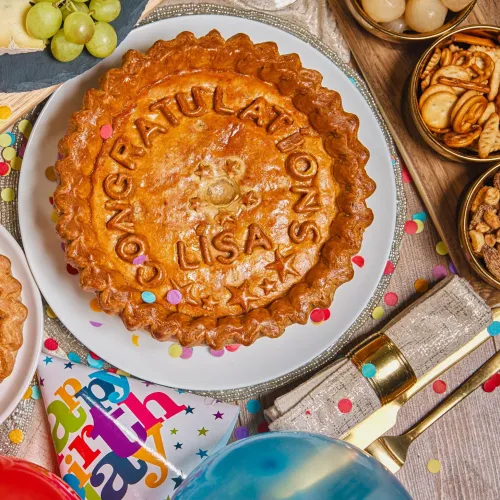
The miner's need for portable, calorie-dense food shaped what went into the lunchbox. Corned beef pie was a staple: cheap tinned meat, shortcrust pastry, solid enough to survive a shift underground. It sits in the same family as the Cornish pasty — a working food rather than a heritage product — though the Valleys version tends to be baked in a tin and cut into squares rather than crimped into a half-moon. The filling varies by household and by what was affordable that week.
Faggots, cawl and the bakestone
At home, the food was just as purposeful. Faggots — seasoned parcels of minced offal and fat, usually pork, wrapped in caul and baked — made use of everything and fed a family for very little. Served with mushy peas and onion gravy, they remain on menus across the valley towns, in chip shops and cafes as often as in domestic kitchens.
Cawl, the slow-cooked broth of lamb and leeks, belongs as much to the Valleys as to the rural west. There's no fixed recipe — it shifts with the season, the cut of meat available, and the cook — but the principle is consistent: a long, low simmer that turns cheap ingredients into something sustaining. We've written about cawl in more depth separately; it deserves the space.
Welsh cakes are the other constant. Cooked directly on a dry bakestone or flat griddle rather than in an oven, they are quick, cheap, and need no special equipment beyond a flat surface and a heat source — which made them practical for households that might share an oven day with a neighbour. The spiced, lightly sweet rounds are still made this way across the region, and the bakestone tradition connects the Valleys to the wider story of Welsh baking in a way that feels genuinely unbroken. We've given Welsh cakes their own piece, because the method alone is worth understanding properly.
The bracchi cafes
What makes the Valleys distinctive in British food history is the Italian cafe tradition. From the late nineteenth century and into the twentieth, Italian families — many from specific villages in the Bardi area of the Emilia-Romagna region — settled across the south Wales valley towns and opened cafes. These became known colloquially as bracchi, a term derived from one of the prominent Italian family names in the area.
What the bracchi offered was remarkable for its time and place: frothy coffee, ice cream made on the premises, a warm room, and a counter open long after other establishments had shut. In towns where the pubs were for men and chapel culture kept a close eye on leisure, the bracchi cafe was somewhere a family could sit together, somewhere young people could meet, somewhere that felt — for the Valleys — genuinely cosmopolitan.
The bracchi families understood hospitality as a business, they were prepared to work the hours the community actually kept, and they brought ingredients and techniques — the espresso machine, the ice cream churn — that were simply not part of existing local provision. Long before Italian coffee culture reached the rest of Britain in any meaningful way, valley towns in Rhondda and Merthyr were already drinking cappuccino at a Formica counter.
Many of these family businesses ran across generations, and some continue today. The tradition is specific enough to be documented by historians of Welsh food and culture, and unusual enough that visitors from outside the region are often surprised by it. A working-class industrial community absorbed an immigrant food tradition so completely that it became indistinguishable from local identity.
What survives and why it matters
Food heritage shaped by poverty and industry tends to get overlooked in favour of the pastoral — the farmhouse cheese, the orchard apple, the named lamb breed. The Valleys tradition has fewer of those markers and more of the kind that food historians sometimes describe as invisible: the dish that was never written down, the method passed between neighbours, the cafe that doesn't appear in any guide.
That's changing, slowly. There's a growing interest in documenting what this region actually ate, rather than what food writing has traditionally found picturesque. The faggot and the corned beef pie are no less worth understanding than a hand-turned farmhouse cheese — they just require a different kind of attention.