A county that earns its food reputation
Cumbria sits in the North West, hemmed in by the Lake District fells, the Pennines and the Solway coast. That geography — wet, upland, demanding — has always dictated what grows and what grazes here. The county's most celebrated foods are not the products of a marketing campaign. They are the result of particular soils, particular breeds and, in some cases, recipes guarded as closely as any family secret.
Cumberland sausage and Herdwick lamb
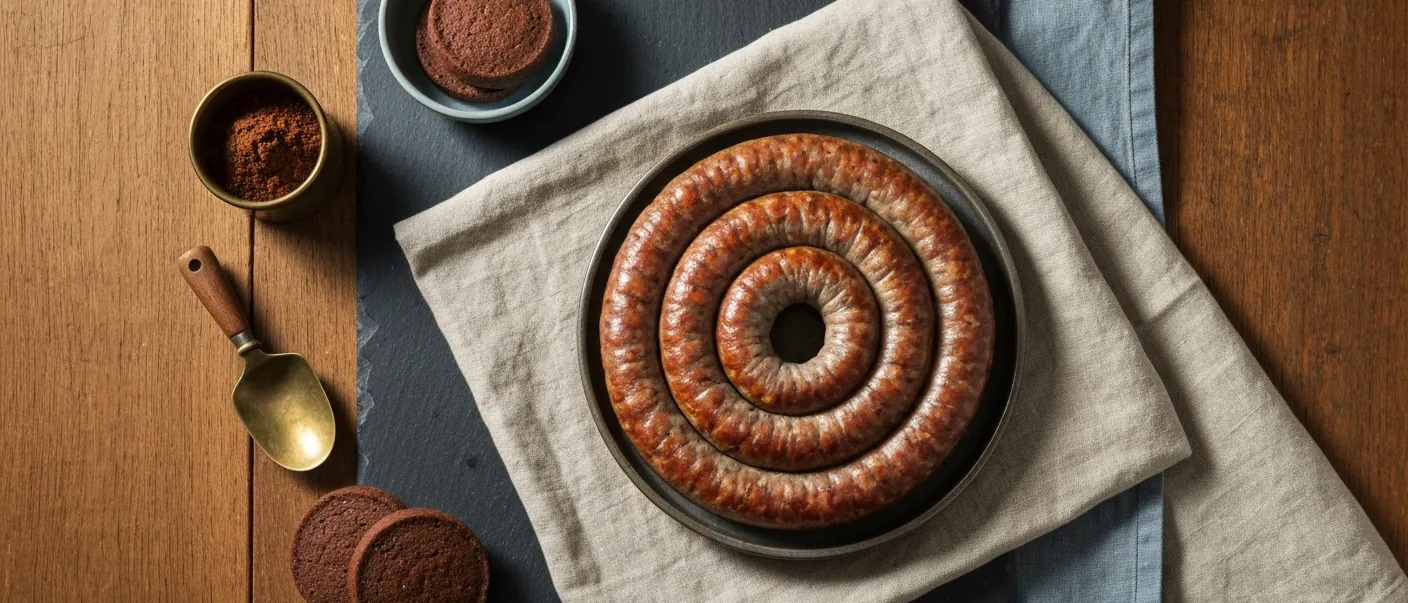
The Cumberland sausage is the county's most recognisable export: coiled rather than linked, seasoned with black pepper and herbs in a ratio that varies fiercely from one butcher to the next. It holds Protected Geographical Indication (PGI) status, tying the name legally to the traditional Cumbrian recipe — a coarse-cut pork filling inside a natural casing, never twisted into links. Ask any local which version is best and you will start an argument that has no resolution.
Herdwick lamb carries Protected Designation of Origin (PDO) status, the highest level of geographical protection in UK law. Herdwicks are the hardy, grey-faced sheep on the higher fells — a breed so bound to their home ground that they are said to be hefted, meaning they know their patch of fell instinctively and return to it without fencing. The meat is darker than commercial lamb, with a depth of flavour that comes directly from what the animals graze: rough upland grass, heather, bog cotton. It is not the sweetest lamb you will ever eat, but it is among the most distinctive.
Grasmere gingerbread and Kendal mint cake
Both are small, dense and almost aggressively portable — which tells you something about the fell-walking culture they grew up alongside. Grasmere gingerbread is made and sold from a tiny cottage in the village of Grasmere, to a recipe kept under lock and key for generations. It is not a soft cake but a firm, slightly crumbly slab, somewhere between a ginger snap and a flapjack in texture, with a spiced warmth that lingers.
Kendal mint cake is harder to categorise. It is not a cake in any conventional sense — more a compressed bar of sugar and glucose, sharply flavoured with peppermint oil. It was taken on Himalayan expeditions, which says everything about its intended purpose: fast, reliable energy in a compact form. As a confection eaten for pleasure it is an acquired taste, but in Cumbria it is a point of pride rather than a curio.
The damsons of the Lyth Valley
Less known outside the county, the damson orchards of the Lyth Valley offer one of Britain's more quietly extraordinary seasonal spectacles. In late spring the valley turns white with damson blossom. The fruit itself is small and intensely tart, harvested in early autumn and used across the county in everything from gin to preserves to cheese accompaniments. Lyth Valley damsons have a particularly rich, almost winey depth that sets them apart from cultivated varieties sold in supermarkets. Local producers sell through farmgate stalls and farmers' markets; the season is short enough to reward planning ahead.
Sticky toffee pudding and Cartmel
Sticky toffee pudding's origins are genuinely contested, and several places in England have pressed a claim. In Cumbria, the village of Cartmel holds a strong tradition — local lore credits the pudding's popularisation to a producer there, and it is now so associated with the village that the name Cartmel appears on sticky toffee puddings sold across the country. Whether or not Cartmel invented it is a question historians enjoy more than they resolve. The pudding made in the village remains a benchmark: dark with dates, dense without being heavy, with a toffee sauce that is less a finishing touch than a structural necessity.
What Cartmel's claim illustrates is how Cumbrian food often works. A place, a producer and a product become inseparable over time, until the geography is doing as much flavour work as the ingredients — specific, rooted and not easily replicated elsewhere.