A county shaped by its landscape
Carmarthenshire is farming country, river country, and coastal country all at once, and its food reflects that. The inland hills carry Welsh Black cattle, a hardy, slow-maturing breed whose beef has a depth of flavour that faster-grown animals cannot match. The rivers Tywi and Taf run to a broad estuary and a southern shore fringed by tidal flats. Each geography has, over centuries, produced something worth knowing about.
What is striking is how many of these traditions remain working practices rather than heritage displays. People still fish, still cure, still gather by hand. That continuity is the reason things taste the way they do.
Carmarthen ham
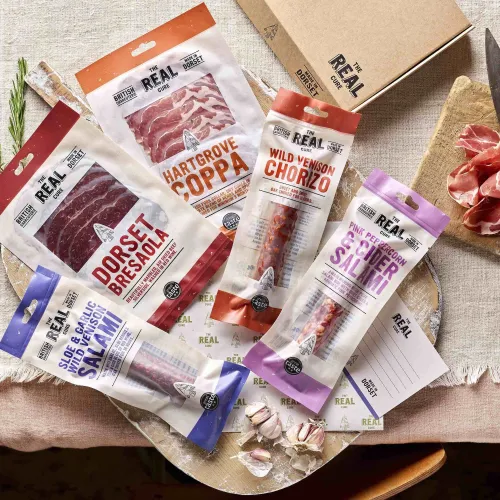
The county's most storied product is its ham — salt-cured and air-dried in a tradition that is, depending on who you ask, extremely old indeed. Local legend holds that the Romans, stationed at Moridunum beneath modern Carmarthen, were so taken with the curing method they encountered here that they carried the idea back to Italy. It cannot be verified and is probably more poetic than historical, but it has been told long enough to carry its own weight.
The cure produces a firm, deeply savoury meat with a dry surface and a concentrated flavour that sets it clearly apart from the wet-cured hams that dominate supermarket shelves. Eaten in thin slices, it needs very little beside it. We have covered Carmarthen ham in more detail in a dedicated article.
Sewin from the coracle fishermen
Sewin is the Welsh name for sea trout. Fish netted from the Tywi and Taf have earned Protected Geographical Indication status, legally tying the name to this specific origin — a recognition that reflects the particular character of these fish, shaped by the clean, fast-running water they migrate through.
The catching method is as notable as the fish. Coracle fishing pairs two fishermen in small, bowl-shaped skin-and-frame boats, stringing a net between them as they drift downstream. It is one of the oldest continuous fishing traditions in Britain; the coracles on the Tywi are direct descendants, in form and method, of boats described by classical writers. Licensed coracle fishermen are few, which makes the tradition both precious and genuinely precarious. Sewin caught this way is available in limited quantities and in season. Our separate sewin article covers where to find it and what to look for, if published.
Cockles from the Burry Inlet
The Burry Inlet, where the county's southern edge meets the sea, is prime cockle habitat: shallow, tidal, rich in the sand and silt that cockles filter for food. Gathering here has continued for as long as people have lived near the water. The method remains unchanged — raked by hand at low tide, then boiled and shelled.
Burry Inlet cockles have a briny sweetness quite different from the vinegary cockles sold at seaside stalls elsewhere. They are traditionally eaten simply: with laverbread (the cooked, puréed seaweed that is a South Wales staple), with bacon, or just with bread, butter, and a little pepper. A good cockle does not need improving.
Carmarthen Market and the living larder
Carmarthen's indoor market has traded since medieval times and remains the practical heart of food in the county. Stalls selling local meat, cheese, salt-marsh lamb, laverbread, and cockle preparations sit alongside bakers and preservers continuing family businesses that span several generations. The stallholder selling Welsh Black beef usually knows the farm it came from.
That directness — producer knowledge passing across the counter — is increasingly rare. Carmarthenshire's market culture has preserved it better than most places in Wales. The market's own website will have current opening days and times.