Valleys food, honestly told
Torfaen and Blaenau Gwent do not appear on the usual maps of British regional food. No famous cheese carries their name; no protected designation marks their produce. What they have instead is more specific: a food culture shaped by industrial labour, the company shop, the Saturday market, and the need to feed large households on modest wages with whatever kept and satisfied.
Pontypool, Blaenavon, Tredegar, Ebbw Vale — these were furnace and pit towns. The calories that kept men working twelve-hour shifts at the ironworks or underground in the collieries were dense, warming and economical. That imperative produced a repertoire still recognisable across south Wales today.
What people actually ate
Faggots and peas is the dish most directly tied to these communities. Made from offal — principally pig's liver, heart and lights — bound with breadcrumbs and wrapped in caul fat, faggots wasted nothing and fed a family cheaply. Served with mushy marrowfat peas and thick gravy, they were sold from market stalls and butchers' counters across the valleys. You can still find them, though the market-stall tradition has thinned considerably.
Cawl — slow-cooked broth of lamb or beef with root vegetables and leek — belongs to the longer Welsh tradition rather than the industrial valleys specifically, but it made obvious sense here: one pot, made the day before, better reheated, requiring no precision. In upland parishes it was built around whatever the smallholder or hill farm could provide. We have written about cawl's wider history separately; it is worth reading alongside this piece to understand how a dish travels across Welsh geography.
Pies of all kinds fed shift workers. Strong, well-stewed tea was less a preference than a practical necessity — hot, cheap, and masking the taste of water that was not always clean. The rhythms of eating in these communities followed shift times rather than any conventional domestic timetable.
Upland grazing and Welsh lamb
Above the valley floors, the landscape changes quickly. The Blorenge — the broad, flat-topped hill rising directly above Blaenavon — and the moorland fringing the Brecon Beacons support upland sheep grazing that feeds into the wider Welsh lamb tradition. The grazing is heather and rough grass, which gives the meat a leaner character and a flavour that richer lowland pastures do not quite replicate.
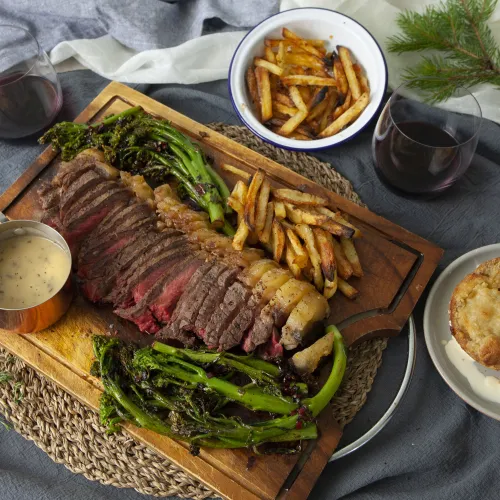
Welsh lamb carries Protected Geographical Indication status, and the flocks running above these valleys contribute to that supply. It connects Torfaen and Blaenau Gwent to a strand of Welsh pastoral food running from Anglesey to the Gower, even if the valley towns themselves are more readily associated with mining than farming. Our piece on Welsh lamb covers breed traditions and what to look for when buying.
Blaenavon's food revival
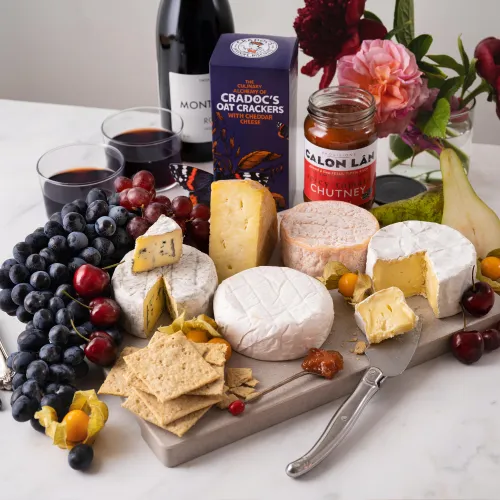
Blaenavon's designation as a World Heritage Site — recognising its largely intact industrial landscape of ironworks, pit-head gear and workers' terraces — has drawn visitors who would not otherwise stop in a small south Wales town. With them has come modest food-tourism infrastructure: a cheese shop, producers oriented towards the visitor economy, a renewed interest in what the area offers beyond the industrial monuments.
It is a small revival, and it would be dishonest to overstate it. But a working cheese shop in a former pit town is not nothing. It signals that these communities are being considered not only as heritage sites to be preserved and explained, but as places with a living food culture worth sustaining. Artisan cheese production in Wales has grown in recent decades, and Blaenavon's place within that is still finding its shape.
What this food heritage means now
Much of what Torfaen and Blaenau Gwent were known for eating has become harder to find in its original form. Markets have contracted, independent butchers have thinned out, and the specific pull of the colliery shift on daily life has gone. What remains lives partly in memory, partly in family cooking, and partly in the broader Welsh food tradition these valleys always fed into.
Faggots are still made commercially across south Wales, though the best versions come from butchers who still bother. Cawl is eaten at home and served in pubs that have understood what visitors want from Welsh food. Upland lamb from the hills above these towns reaches the wider market through Welsh lamb supply chains. None of it announces itself with a geographical label. It just continues — practical, unshowy, and worth knowing about.