A county built for grazing
Powys takes in the Brecon Beacons in the south, the Cambrian Mountains through the middle, and rolling border country stretching north towards Montgomeryshire. Very little of it is flat. That topography makes arable farming marginal; what the land does well is grow grass, and where grass grows well, livestock follow.
Sheep farming is the backbone of the county's food identity. High commons and open moorland suit hardy upland breeds, and lamb from this part of mid-Wales is considered among the best the country produces — grass-fed, slow-grown, with a flavour that reflects the diversity of hill pasture. Cattle are here too, particularly the native Welsh Black, a breed well adapted to wet upland conditions and known for beef with good marbling and a clean finish.
Dairy country in the river valleys
Where the land drops into the valleys — along the Wye, the Severn and the Usk — the grazing softens and dairy farming becomes viable. These lower pockets of Powys have historically supported small dairy herds, and that tradition continues with independent producers making milk, cream, butter and cheese for local and regional markets.
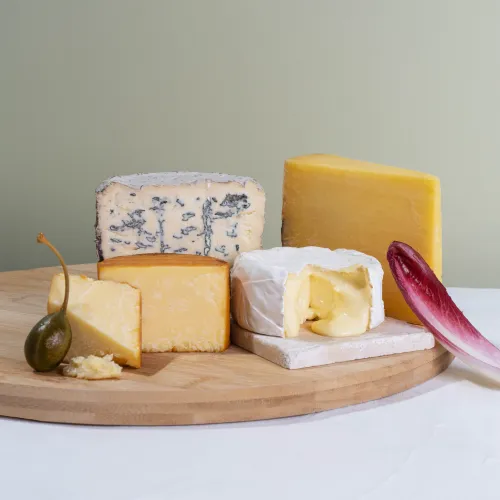
Cheeses from mid-Wales tend to be gentle rather than sharp or assertive, reflecting the milk of pasture-fed cows rather than any industrial process. Small-batch production is the norm. Powys has no large food manufacturing hub; its producers are, almost by definition, working at a human scale.
Market towns and what they tell you
Welshpool, Llandrindod Wells, Brecon, Builth Wells — the market towns of Powys are agricultural service centres first and foremost. Their weekly markets and livestock auctions remain genuinely functional rather than decorative. A farmers' market in Brecon or Welshpool is not a lifestyle event grafted onto a car park; it exists because producers are close by and buyers want direct access to what they grow.
Builth Wells hosts the Royal Welsh Show, one of the largest agricultural shows in Europe. Powys sits at its centre, and the surrounding farms supply many of the animals and goods on display. It is usually held in late July — check the Royal Welsh Agricultural Society's official site for current dates.
What to look for
Visitors are best served by thinking in terms of raw materials rather than finished regional specialities. Powys has no single famous dish or protected product that defines it on a map. What it has instead is:
- Welsh lamb — upland-reared, usually available direct from farm shops or at local markets
- Welsh Black beef — less widely known than the lamb but worth seeking out, particularly from farms in the north of the county
- Farmhouse dairy — small-production cheeses, cultured butters and fresh cream from valley farms
- Honey — the diversity of upland flora, from heather to wildflower meadows, makes Powys honey varied in character depending on the season and the location of the hive
Farm shops are the most reliable route into all of this. They are scattered across the county rather than concentrated in any one place, so a little research before travelling pays off — many post seasonal availability on their own websites or social media.
The wider picture
Powys does not shout about its food. There are no protected designation of origin products unique to the county in the way that Herefordshire has its cider or Yorkshire its forced rhubarb. But that quietness is partly what makes it worth attention. The food here is honest and largely untouched by trend — lamb that tastes of the hill it was raised on, cheese made by someone who also milked the cow. That directness is increasingly rare, and increasingly valued.
For anyone travelling through mid-Wales, the practical advice is simple: stop at farm shops, visit the markets, and ask where things come from. In Powys, the answer is almost always nearby.