A landscape that produces
Lincolnshire is a working county in the most literal sense. Its flat, fertile plains are among the most intensively farmed land in Britain — a patchwork of cereal crops, root vegetables and brassicas that supplies supermarkets and food businesses the length of the country. The Fens in the south and east are particularly productive, their dark peaty soils ideal for growing at scale. Yet scale here does not mean uniformity. Smaller growers and market gardeners operate throughout the county, and independent farm shops are a dependable feature of the rural roads.
Dairy farming has a firm footing in the county too, and with it a tradition of cheese-making and fresh dairy produce. Upland grazing — particularly on the Lincolnshire Wolds, an Area of Outstanding Natural Beauty in the north-east — supports sheep farming, and the lamb from this landscape has a quality that follows directly from its pasture.
The coast and its catch
Lincolnshire's eastern edge meets the North Sea, and towns along that coast have a long history of fishing. The catch has always leaned towards what the North Sea gives readily — cod, haddock, skate — and the tradition of simple, well-fried fish is taken seriously here. Grimsby, the county's largest coastal town, has been a significant fishing port for generations and retains a reputation for smoked fish, particularly smoked haddock, that extends well beyond the region. The cold-smoking methods associated with the town produce a fish that is paler and subtler than the bright yellow dye-smoked product found elsewhere — worth seeking out if you are buying smoked fish in Britain.
Market towns and where to find producers
Lincolnshire has a strong market town culture, and those markets are still the most reliable place to meet producers face to face. Lincoln itself, Louth, Spalding, Boston and Sleaford all hold regular markets where local growers, bakers, cheesemakers and meat producers appear alongside one another. The county's agricultural shows are another natural gathering point — usually held over the summer months, though it is always worth checking locally for current dates.
Farm shops here tend to be well-stocked and genuinely local in character rather than the curated lifestyle offerings found closer to cities. If you are driving through the county, stopping at one is rarely a disappointment.
What the county is known for
Lincolnshire sausages have a clear and specific identity: coarsely cut pork seasoned with sage, the meat bound loosely so the sausage has a distinctly crumbly texture when cooked. They are made by butchers across the county and the style is consistent enough that most people who have tried one would recognise it immediately. Eaten simply — with mustard, with bread, as part of a full breakfast — they do not require elaboration.
Lincolnshire Poacher is a cheese made in the county using unpasteurised milk, aged for a period that develops a firm, complex character somewhere between a mature Cheddar and a harder alpine style. It is produced by a single family farm on the Lincolnshire Wolds and is one of the more distinctive British territorial cheeses available. Look for it at good cheesemongers or via the farm's own channels.
Beyond those two, the county's food reputation rests less on headline names and more on the quality of its raw ingredients — the vegetables, the grain, the livestock — that underpin so much of what is eaten across Britain without Lincolnshire ever receiving the credit.
How to eat it well
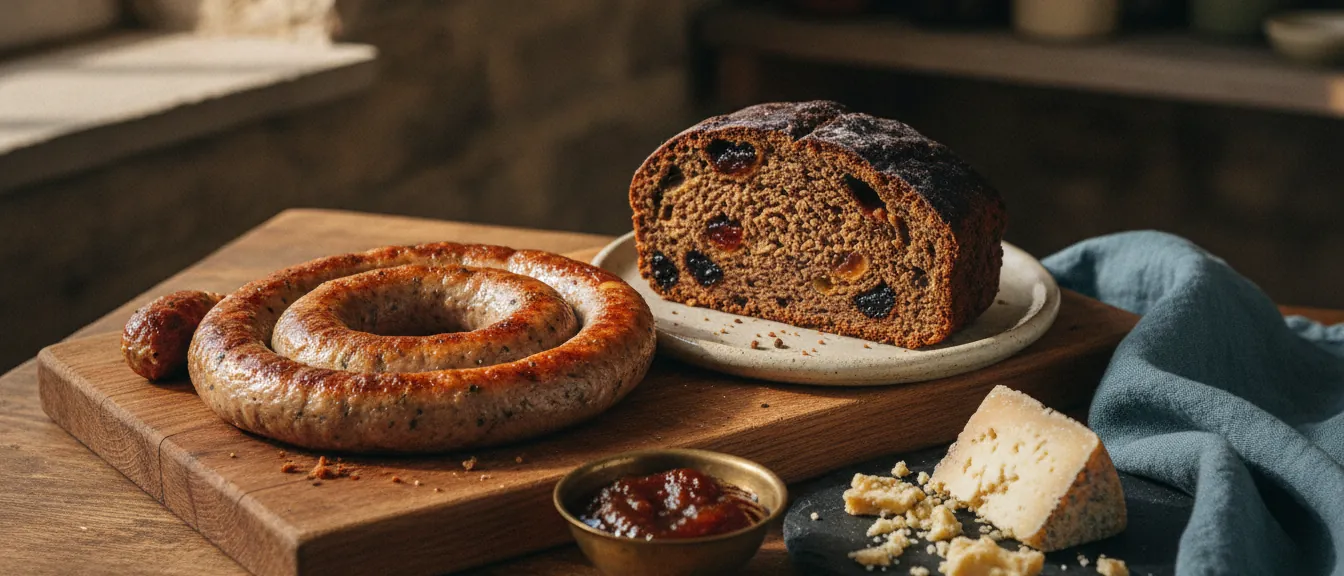
The straightforward approach suits Lincolnshire food. A good sausage from a county butcher, bread from a local baker, a piece of Lincolnshire Poacher with chutney — these are not complicated propositions, and they do not need to be. The county's coastal fish is best treated with equal restraint: fresh, simply cooked, with attention paid to where it came from. If you can buy directly from a farm shop or market, the difference in freshness and provenance is usually immediately apparent.