A city with a larder behind it
Dundee is a compact city on the northern bank of the Tay, but its food story reaches well beyond its boundaries. The fertile farmland of Angus stretches to the north and east, producing soft fruit — raspberries and strawberries in particular — on a scale that has long made this corner of Scotland one of Britain's most productive growing areas. The combination of long summer days, free-draining soils and a relatively dry microclimate suits small fruit exceptionally well. Walk a farmers' market in the city on a summer Saturday and that abundance is hard to miss.
The estuary itself has always mattered too. The Tay is one of Scotland's great salmon rivers, and while commercial wild salmon fishing has contracted significantly across the whole of Britain over the decades, the river remains part of Dundee's food identity in the way that only a landscape feature can be — woven into local memory and still present in the better fishmongers and restaurants of the city.
The cake that everyone knows
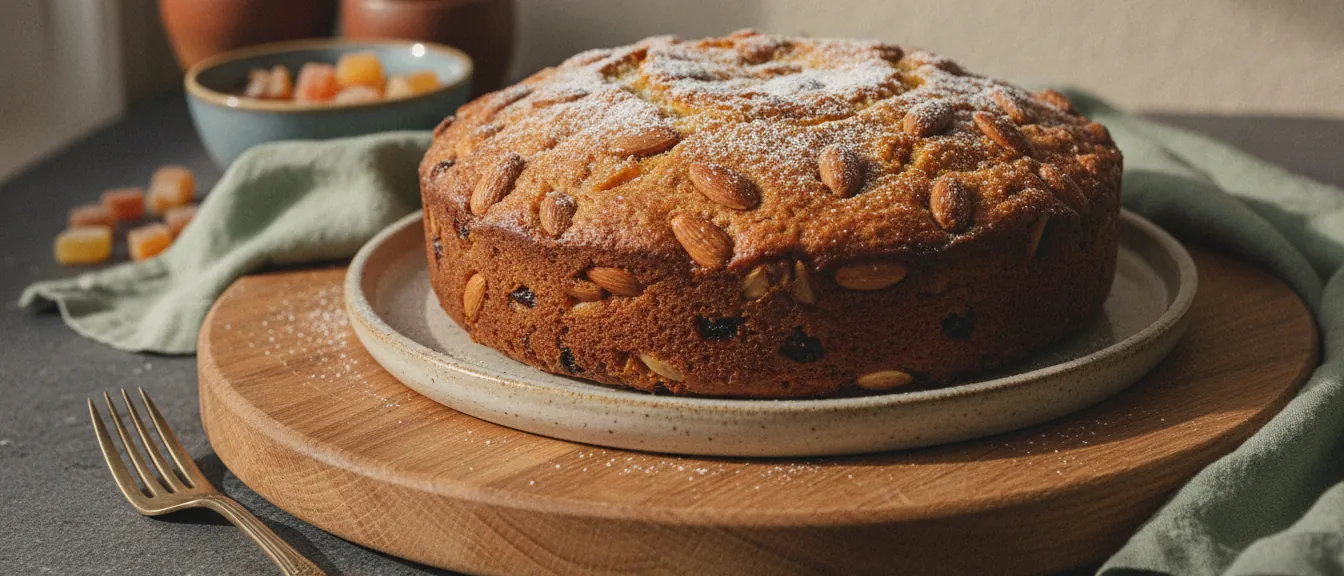
If Dundee is famous for one single food, it is the Dundee cake — a rich, lightly spiced fruit cake finished with a pattern of whole blanched almonds on top. It is one of those products where the association between place and food has become entirely fixed in the public mind, regardless of where any individual cake happens to be baked today. The style is recognisably distinct from other British fruit cakes: less dense than a traditional Christmas cake, less sweet than a commercial fruitcake, with the almonds providing both decoration and a faint nuttiness rather than a marzipan layer.
How the cake became so firmly attached to Dundee is a matter of local tradition rather than documented record, and we would not want to overstate what is known for certain. What is clear is that the name has stuck, the style is consistent, and any serious bakery in the city will have its own version worth trying.
Marmalade and the city's sweet history
Dundee also has a long association with marmalade, and this one is harder to separate from the city's commercial past. The connection centres on the use of Seville oranges and a preserving industry that grew up here, though the precise origins of who made what first are contested in the way that all good food-origin stories tend to be. What remains true is that Dundee-style marmalade — thick-cut, dark, with a pronounced bitter edge — is a recognisable category, and the city's name carries weight on a jar in a way that few British cities can claim for a preserve.
What the surrounding land produces
Beyond soft fruit, the Angus hinterland is good beef country. The upland grazing to the north supports cattle well suited to the Scottish climate, and the broader Angus region has a strong reputation for quality beef that filters into Dundee's butchers and food shops. Dairy farming is present too, though the city's character is more arable and pastoral than purely dairy-focused.
Independent food producers — cheesemakers, bakers, smokeries, preservers — tend to cluster around cities like Dundee in part because a city provides a market and in part because the surrounding countryside provides raw material. The relationship between Dundee and its agricultural hinterland has always worked that way, and the independent food scene in and around the city reflects it.
Finding the food today
For a visitor or a curious local, the best entry point into Dundee's food character is usually a good independent market or deli rather than a restaurant menu. The soft fruit, the local beef, the bakery traditions and whatever the Tay estuary still offers — these things show up most clearly when producers and buyers meet face to face. Dundee is not a large city, but it has enough of a food-conscious population to support the kind of small-batch, place-specific producers that make a city's larder interesting.
The Dundee cake, if you are buying rather than baking, rewards a bit of searching. There is a wide range of quality across supermarket own-labels and genuine bakery versions, and the difference is noticeable — particularly in the fruit-to-crumb ratio and the quality of the almonds on top.