Where the flavour comes from
Shetland sits closer to Bergen than to Edinburgh, and the food reflects that geography with unusual honesty. Centuries under Norse rule left a lasting mark on how islanders cured, dried and preserved — not as a nostalgic nod to the past, but because the techniques worked. Cold winds, peat smoke and clean salt air were the original larder, and the specialities that grew from them have stayed because they are genuinely worth eating.
That Scandinavian influence is most visible in the approach to meat and fish: cure it, hang it, let time and air do the work. It is a philosophy of patience rather than heat.
Reestit mutton
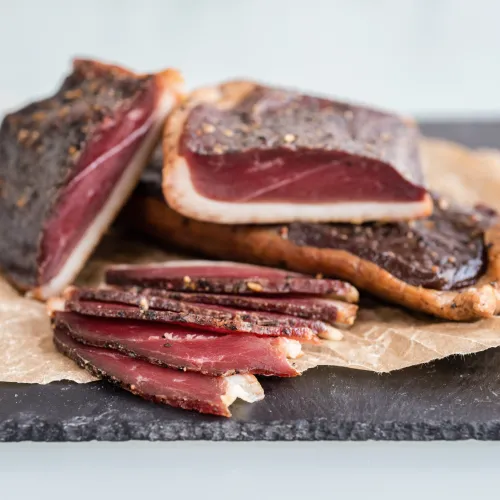
The most singular Shetland speciality is reestit mutton — salt-cured mutton hung to air-dry above the peat fire, absorbing smoke as it slowly loses moisture. It survives nowhere else in Britain in this form. The word reestit comes from the old Norn term for the wooden rack above the hearth, and the technique has been passed down through families rather than codified in any cookbook.
The flavour is deep and intensely savoury, smoky, with a dryness that concentrates everything the animal ate. Traditionally, a piece of reestit mutton goes into a broth with tatties and neeps — simultaneously austere and extraordinarily satisfying. Nothing about it is delicate, and that is exactly the point. It is winter food built for a place where winters are serious.
Finding reestit mutton outside Shetland is difficult. The occasional deli or online supplier carries it, but it remains essentially a local product, which is part of what makes it worth seeking out.
Shetland lamb and the land it grazes
The sheep behind both reestit mutton and Shetland's fresh lamb are small, hardy animals that have grazed these islands for centuries. They forage on heather, rough grass and seaweed along the shoreline, giving the meat a mineral complexity that is hard to explain but easy to taste. The breed stayed small because the land demanded it.
Native Shetland Lamb holds PDO status, formally recognising that this is a product inseparable from its place of origin. We cover that designation in our dedicated article on Shetland Lamb PDO, but the short version is this: the flavour is a direct consequence of the landscape, and no amount of breed-matching elsewhere would replicate it.
Seafood from the voes
Shetland's voes — the long, sheltered sea inlets that indent the coastline — provide ideal conditions for shellfish and salmon. The water is cold and exceptionally clean, the tidal flow strong. Mussels farmed here are plump and consistent, with a briny sweetness that reflects the quality of the water they filter. Shetland salmon carries the same clean-water advantage.
This is not artisan production in a romantic cottage sense — Shetland's seafood industry is substantial and commercially significant. Scale has not compromised quality. The cold Atlantic environment does much of the work, and the result is shellfish and salmon that regularly supply some of Britain's better restaurants and fishmongers.
Bannocks and everyday eating
Alongside the preserved and the prestigious, there is the everyday. Bannocks — flat, unleavened rounds made from oats or barley — were the daily bread of Shetland for generations. Cooked on a griddle, plain and practical, they pair naturally with the richer, saltier things the islands produce: smoked fish, strong cheese, reestit mutton broth.
Oats and barley thrive in Shetland's cool, damp climate in a way that wheat does not. The grain choices were never arbitrary; they were what grew. That practicality runs through the whole food culture — a directness that comes from working with what the land and sea provide rather than importing a cuisine from elsewhere and adapting it.
Shetland's food is not fashionable in the way that some regional British food has recently become. It does not need reinventing. The peat smoke, the salt cure, the cold-water shellfish — these are already exactly what they should be.