The spice that named a town
Saffron Walden didn't get its name by accident. Medieval Essex was serious saffron country, with the purple crocus grown so intensively that the trade defined the town's identity for generations. The spice — harvested from the dried stigmas of Crocus sativus, three per flower, by hand — was used in cooking, dyeing and medicine. It wasn't a curiosity; it was commerce.
That history fell dormant for centuries, but a small number of British growers have quietly revived it. The crocus needs free-draining soil, a cold winter dormancy and a dry summer; what it cannot tolerate is waterlogged ground, which is why it never spread universally across these islands. Where the conditions cooperate, British-grown saffron — picked in autumn over a window of just a few weeks — has found its way back to specialist retailers.
Wasabi's unlikely home
Real wasabi — Wasabia japonica, not the green-dyed horseradish paste served in most sushi restaurants — is among the most demanding crops on earth. It needs clean, cold, continuously flowing water, high humidity and shade. Japan has the rivers and the tradition. Southern England, it turns out, has something nearly as good: the old watercress beds of the chalk stream valleys, fed by spring water that holds a near-constant cool temperature year-round.
Britain is now among the very few countries outside Japan growing wasabi commercially. The fresh rhizome tastes quite different from the condiment most people know — the heat blooms and fades quickly, leaving something almost sweet behind, with none of the sustained sinus burn of horseradish. Grated at the moment of use, the flavour begins to dissipate within minutes. That perishability is precisely why growing it close to its market makes practical sense, and why those chalk stream beds are an asset that almost nowhere else can replicate.
Tea, grown in Britain
Camellia sinensis — the plant behind Darjeeling and Assam — has proved it can survive and produce in the milder, wetter corners of Britain. Cornwall's mild winters, high rainfall and acidic soils are more hospitable to the tea plant than most of the country. Gardens in the west of Scotland have found that the Gulf Stream softens conditions enough for the crop to establish itself too.
Yields are small and the growing season short, so British tea remains genuinely rare. The leaves are processed in the same ways as any other tea — withered, rolled, oxidised to varying degrees depending on whether the maker wants a green, oolong or black style. The resulting cup tends to be delicate, with a grassy or floral character that reflects both the cultivar and the cool, unhurried growing conditions.
Chillies and the spreading vine
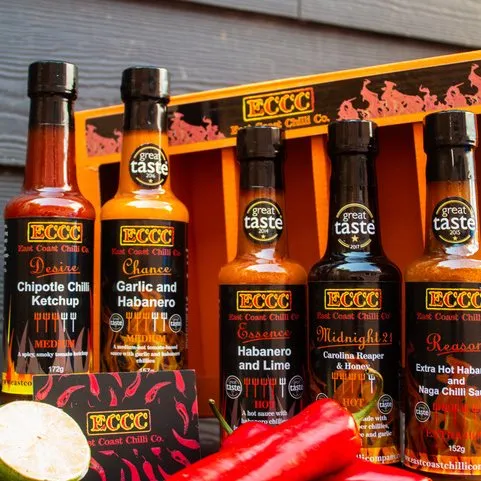
Chillies have been grown under glass in Britain for decades, but the scale and ambition of the enterprise has expanded considerably. Polytunnels and glasshouses let growers push varieties well beyond what the outdoor climate allows, producing fruits across a wide range of heat levels and flavour profiles. British chillies now appear in hot sauces, preserves and dried flakes made by small producers across England and Wales.
Vineyards are the most visible sign of broader change. English and Welsh wine is no longer a subject for gentle mockery — southward-facing slopes in southern England have been producing serious sparkling wine, and the planting map is moving north as average temperatures rise. The chalk geology in parts of the south shares more with Champagne's subsoil than is comfortable for French pride. Still wines, both white and increasingly red, are being made with varieties that would have seemed implausible here a generation ago.
Why it matters
None of this is novelty for its own sake. Each crop has found its British footing because the land genuinely suits it — or because Britain possesses infrastructure, such as those chalk stream beds, that almost nowhere else can match. The saffron story connects to a medieval agricultural past most people have forgotten. The tea gardens and vineyards reflect a climate that is measurably shifting.
What unites them is the case they make against the notion that British food is constrained by its geography. The ingredients have been here, or have become possible here, in ways that reward attention. Tracking them down — through specialist retailers, farm shops or producers who sell directly — is one of the more interesting things a curious cook can do.