A county that rewards closer looking
Staffordshire sits in the West Midlands without making much noise about itself. What it has are a handful of deeply local foods — so tied to specific towns and trades that they barely exist elsewhere, and all the more interesting for it.
The county stretches from the southern fringes of the Peak District down through market towns and industrial heritage, and its food reflects that range: working-class ingenuity in the north, quieter agricultural tradition further south.
The Staffordshire oatcake
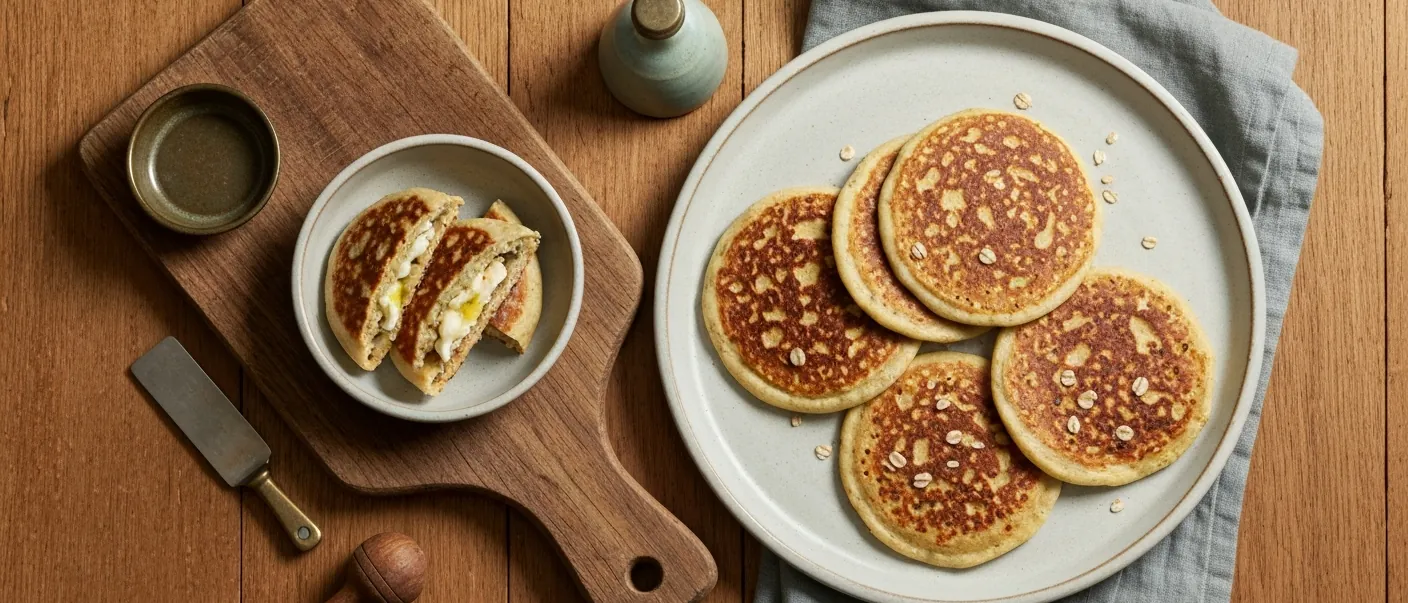
Ask anyone from the Potteries — the cluster of towns around Stoke-on-Trent — what they miss most when they leave, and the oatcake comes up almost every time. It looks, at first glance, like a large, pale pancake. But it's made with oatmeal rather than plain flour and fermented with yeast, which gives it a slightly sour, earthy depth that no description quite prepares you for.
The oatcake's origins are bound up with the ceramics industry. Long shifts at the kilns demanded something filling and portable; the oatcake, folded around bacon, cheese or egg, answered that need. Specialist oatcake shops — small, often family-run premises selling freshly made oatcakes from a hatch in the wall — were once a fixture across the Potteries, and a good number survive still. Outside Stoke, they become almost impossible to find. This is a food that has never really wanted to travel.
Traditionally eaten warm with a savoury filling, they can also take something sweet — golden syrup, say — though that's a divisive proposition in Potteries households. The texture is softer and more yielding than a crumpet, with a gentle chew from the oats, and they're best eaten the day they're made.
Staffordshire cheese
Staffordshire cheese carries PDO status — Protected Designation of Origin — which means only cheese made in the traditional way within the county can use the name. It's a semi-hard cheese made from whole cow's milk, with a mild, slightly buttery flavour that deepens as it matures. Younger versions are gentle and approachable; longer-aged examples develop a more pronounced character.
Some versions carry an annatto-coloured rind, though the interior paste tends to be pale and close-textured. It isn't a showy cheese — it lacks the sharpness of a good Cheddar or the crumble of a Cheshire. Its appeal is quieter, and it repays eating on its own terms rather than against its better-known neighbours.
PDO protection keeps production tied to the county and to methods that predate industrial cheesemaking. Producers are few, which makes tracking down a genuinely traditional Staffordshire cheese something worth doing rather than taking for granted.
Burton-on-Trent and British beer
Burton-on-Trent isn't simply a Staffordshire town that happened to make beer. Its geology fundamentally shaped what British beer tastes like — and by extension, much of the world's.
The water drawn from the wells beneath Burton is exceptionally high in calcium sulphate — hard water with high sulphate content. This mineral profile accentuates hop bitterness and produces a clean, dry finish that became the defining characteristic of pale ales and India Pale Ales. When brewers elsewhere tried to replicate Burton's celebrated ales, they had to adjust their water artificially to match it. The process is still called Burtonisation.
At its height, Burton was home to dozens of breweries producing a substantial share of Britain's entire beer output. The town's relationship with malting, coopering and the whole infrastructure of brewing ran very deep. Some of that industrial scale has gone, but Burton remains an active brewing centre, and the water that made its reputation still flows.
For anyone interested in British food and drink heritage, Burton is one of those places where a single, unremarkable-sounding natural resource — the mineral content of groundwater — turned out to matter enormously.
What connects them
Staffordshire's food story isn't about abundance or showmanship. The oatcake fed industrial workers; the cheese came from a farming county that never sought the spotlight; the brewing legacy is built on geology rather than any particular human decision. These are things that grew from the land and the lives people lived on it.