The morning after Hogmanay
Hogmanay is not a restrained affair. By the time midnight has passed and the first-footing has wound down, the last thing anyone wants on New Year's Day is a kitchen full of raw ingredients. Steak pie is the answer Scotland settled on: a deep, gravy-rich pie made — or more often ordered — before the celebrations began, needing only reheating before it lands on the table.
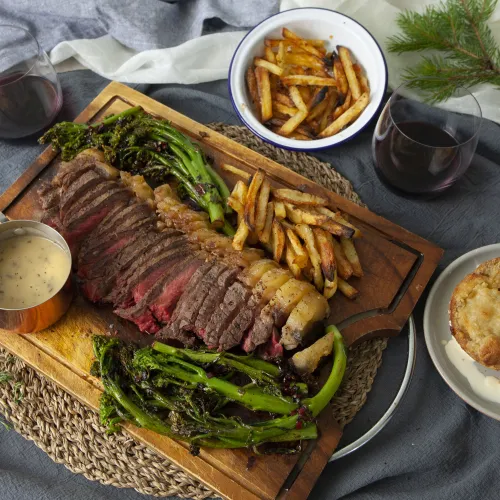
The custom is firmly embedded in the central belt and beyond. It is not a restaurant dish or a showpiece. It is the food a family eats together at a table, usually with boiled potatoes and something green, on the quietest afternoon of the year.
What goes into a steak pie
The filling is slow-cooked beef in a thick, dark gravy, sealed under a puff pastry lid that turns golden in the oven. The cut matters more than people acknowledge. Cheaper, tougher cuts — braising steak, stewing beef, sometimes skirt — are exactly what you want, because the long, slow cook that transforms them also builds flavour in the gravy. Well-marbled chuck or blade is ideal; fillet would be wasted.
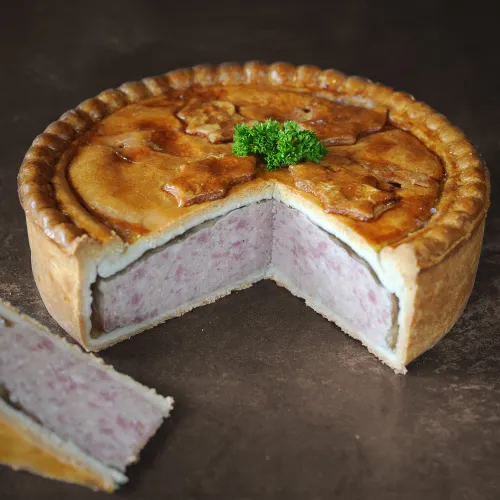
Many Scottish butchers add sausages or sausage meat to the filling. The fat enriches the gravy and adds a different texture alongside the yielding chunks of beef. Some add kidney, which gives a deeper, more mineral note. Neither is obligatory, and neither is an afterthought — they reflect the individual butcher's hand. You could eat a steak pie from a dozen shops across Scotland and find them meaningfully different from one another.
The pastry lid deserves attention. Good puff pastry should shatter slightly when you press a spoon through it, releasing a curl of steam. The underside, where it meets the filling, softens as it absorbs the gravy — that contrast between the crisp top and the yielding base is what makes the pie satisfying rather than merely filling.
Ordering from your butcher
The most important practical point about a Hogmanay steak pie is also the most commonly ignored: order in advance. Independent butchers across Scotland take orders for their New Year pies weeks ahead of the holiday, and the good ones sell out. This is not marketing pressure — it is simply the reality of a small shop making a large number of pies to order in a very short window.
Ordering from a butcher rather than buying a supermarket version is worth doing for a straightforward reason: the filling and pastry are made on the premises, usually to a recipe refined over years, and the beef is sourced in a way that a mass-produced pie cannot replicate. The difference in the gravy alone — its depth, its consistency, the way it coats the meat — tends to be significant.
Making the pie at home rather than ordering? The same principles apply as for any long braise: give the beef enough time and enough liquid, and reduce the gravy properly before the pastry lid goes on. A thin or watery filling will make the pastry soggy and the whole thing anticlimactic.
Where the steak pie fits in the Hogmanay table
Scotland has a strong tradition of celebratory foods at this time of year. Black bun — a dense, spiced fruit filling encased in pastry — has long been associated with first-footing, the custom of visiting neighbours after midnight. Clootie dumpling, a steamed fruit pudding with its own distinct history, appears at festive tables too. The steak pie occupies a different register: it is not a sweet, a gift, or a symbol. It is the meal that sustains the household after the celebration is over, plain and restorative in the way that only slow-cooked meat in pastry can be.
That pragmatic quality is probably why the tradition has lasted. Hogmanay asks a great deal of a household — the preparation, the staying up, the visitors. The steak pie, ordered in advance and waiting in the fridge, is a small act of foresight that makes the first day of the year a little easier.