
A county shaped by what it grows and catches
Northumberland runs from the Tyne to the Scottish border, and its food tells that story plainly. This is not a region that went in for fashionable reinvention — its specialities are the product of geography, hard work and long habit. The sea provides. The farms provide. The rest follows.
What makes the food culture here worth attention is how much of it remains rooted in the same places and methods that made these products notable in the first place. That consistency is rare.
Craster kippers
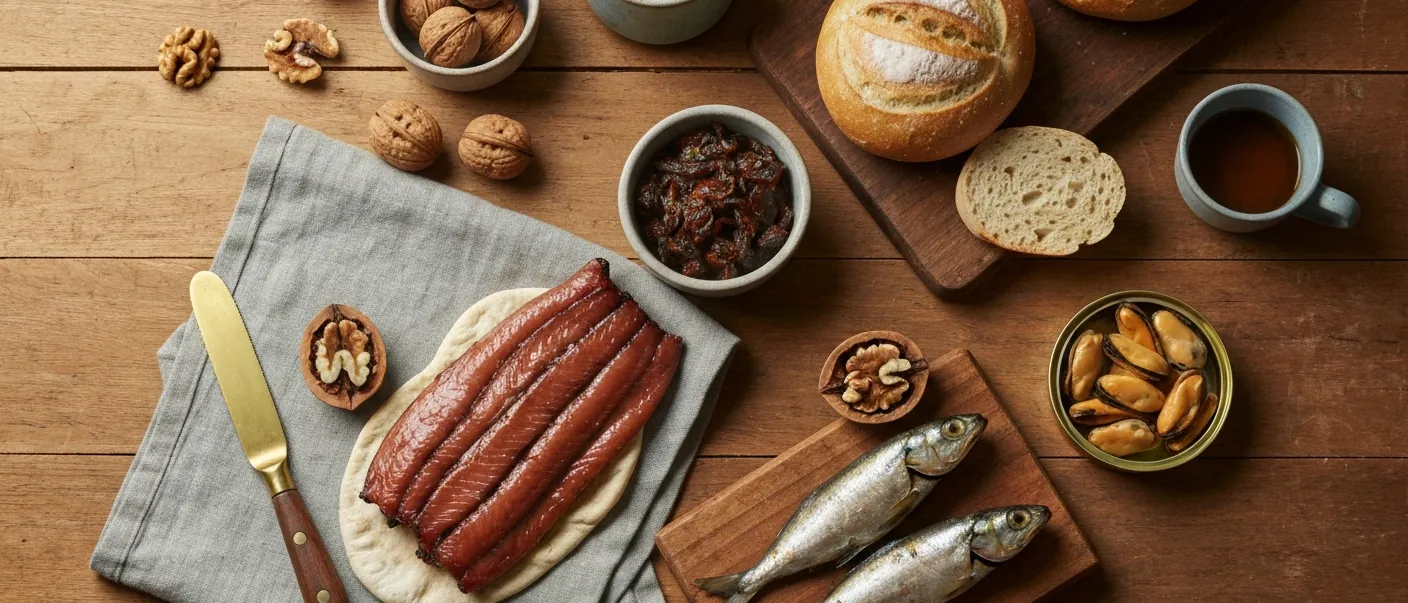
The village of Craster, on the Northumberland coast, has long been synonymous with the kipper. Herrings are cold-smoked over oak in the traditional manner, producing a fish with a deep, amber colour and a flavour that is robust but not harsh — quite different from the more aggressively smoked kippers found elsewhere. The smoking sheds have been doing this for generations, and the fish are still despatched from there to buyers across the country.
A Craster kipper is best eaten simply: grilled, with bread and butter and perhaps a squeeze of lemon. The quality of the smoking does the work, and it would be a shame to complicate it.
Stotties and pease pudding
Step into any decent bakery in the North East and you will encounter the stottie — flat, dense, doughy bread, round and heavy, baked on the bottom of the oven. The crumb is tight and slightly chewy, holding fillings well without falling apart. It is bread built for purpose, not performance.
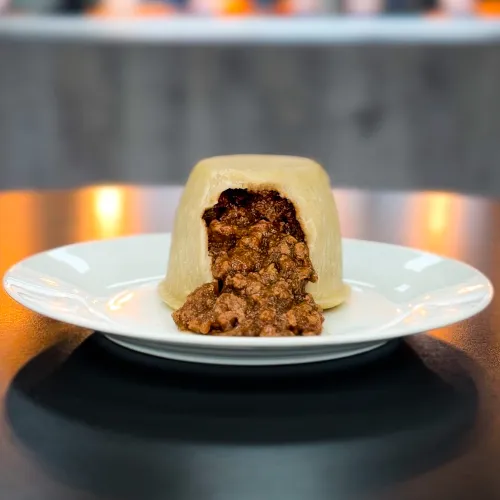
Pease pudding is its natural companion. Made from split yellow peas boiled until thick and smooth, it has been a cheap, filling staple in the North East for centuries — the sort of thing that fed working families when meat was scarce. Eaten cold from a tub or spread inside a stottie with ham, it has a mild, earthy flavour that grows on you. Together, stottie and pease pudding are as specific to this part of England as anything found in more celebrated food regions.
Lindisfarne oysters and mead
Holy Island — Lindisfarne — sits off the Northumberland coast, accessible only at low tide across a causeway. Oysters cultivated in the cold, clean waters around the island have a firm texture and a clean brine that needs no adornment, though the traditional approach is straightforward: freshly shucked and raw, with something sharp alongside.
The island also produces mead, the ancient honey-based drink that has been made here for a very long time. It varies in style from dry to sweet, carrying floral, honeyed notes with a gentle warmth. It is the kind of drink that makes complete sense on the island itself, looking out at the sea.
Doddington dairy
Inland, on a farm in north Northumberland, Doddington has built a reputation for both cheese and ice cream. The dairy draws its milk from the surrounding farmland, which gives the products a directness and freshness that is easy to taste.
The cheeses range from younger, milder options to aged varieties with more complexity. The ice cream has developed a following beyond the county — made with full-fat dairy milk rather than cream-heavy mixes, it has a clean, fresh character, with flavours that reflect what is available locally.
Doddington is a good example of how Northumberland's food culture works at its best: a single farm, doing one thing well, with produce that could only come from this particular part of the country.
A region that rewards seeking out
Northumberland does not shout about its food. There is no prominent festival circuit or marketing campaign driving these products into the mainstream — the reputation has spread through the food itself, through people tasting a Craster kipper and ordering another, or finding that a stottie from a café in Alnwick was unlike any bread they had eaten before.
These specialities have survived because they are genuinely good, not because they have been packaged and relaunched. If you are travelling through the county, seek them out in local shops, markets and fishmongers. Some — a freshly smoked kipper from Craster, an oyster on Lindisfarne — only really make sense in context.
_jpgq80.webp)