A county that earns its reputation
Leicestershire sits in the heart of the East Midlands, its rolling farmland long supporting both dairy herds and pig keeping. That agricultural foundation explains the county's food story rather than merely decorating it. The three specialities that carry legal protection all grew directly from what the land and people here were already doing. Elsewhere in England, protected food names can feel like branding exercises. In Leicestershire, they feel like history that was simply written down.
The county has been described as the rural capital of food — a claim that sounds like boosterism until you start counting what it can actually point to.
Melton Mowbray pork pies
The town of Melton Mowbray sits in the north-east of the county, and the pork pie bearing its name carries Protected Geographical Indication — the same class of protection that covers Champagne or Parma ham, now retained in UK law. A Melton Mowbray pork pie can only be called that if produced within a defined area around the town.
What distinguishes it from a generic pork pie is specific and visible. The meat must be uncured — fresh pork, not the pink, brined mixture used in many commercial versions — giving the filling a grey, coarser texture and a distinctly savoury flavour. The pastry is hot-water crust, baked free-standing rather than in a tin, which produces that characteristic bowed, slightly irregular shape rather than a straight-sided factory silhouette. A small amount of natural jelly settles between meat and pastry as the pie cools.
The pork pie is thought to have developed as a portable, self-contained food for farmers and foxhunters — the Vale of Belvoir, prime hunting country, lies just to the east. Eaten at room temperature with a sharp pickle or a piece of Red Leicester alongside, it remains one of the most satisfying things British food does.
Stilton and the PDO villages
Despite the name, Stilton cheese has never been made in the village of Stilton, which lies in Cambridgeshire. It was sold and distributed there — via a coaching inn on the Great North Road — but production has always been confined to a defined triangle of the East Midlands, a significant portion of which falls within Leicestershire.
Stilton's Protected Designation of Origin is tightly drawn. It must be made in Leicestershire, Derbyshire or Nottinghamshire, from locally produced milk, by traditional method: pasteurised, never pressed, and allowed to form its own crust. The blue variety gets its characteristic veining from Penicillium roqueforti, and needles are pushed through the maturing cheese to allow oxygen in, encouraging the blue-green mould to spread along the channels.
A white Stilton also exists — mild, crumbly, often paired with fruit. Considerably less well known, it shares the same PDO geography and minimum production standards as its blue counterpart.
Red Leicester
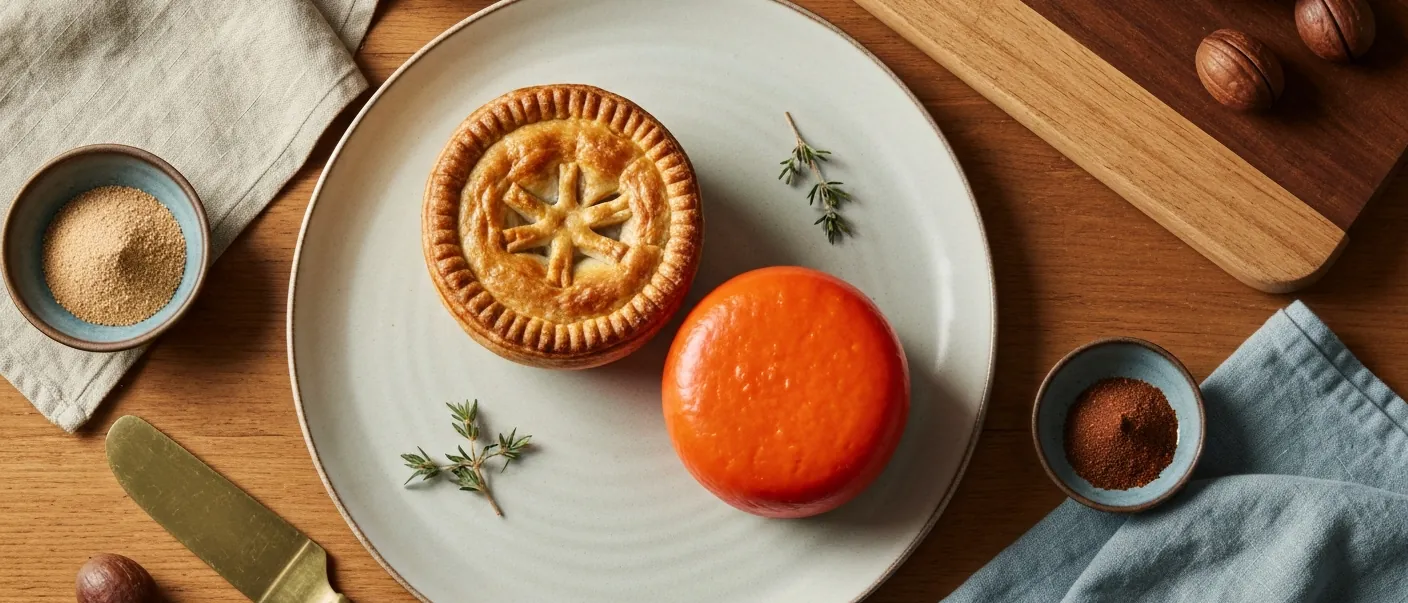
Red Leicester deserves more attention than it usually receives. This is a pressed, full-fat cow's milk cheese with a firm but open texture and a flavour somewhere between mild and a well-aged Cheddar: nuttier than the former, less sharp than the latter. Its deep orange colour comes from annatto, a natural dye derived from the seeds of the achiote tree — a practice centuries old in British cheesemaking and entirely traditional rather than cosmetic trickery.
At its best, Red Leicester has a slight sweetness and a lingering, buttery finish. It melts well, making it well suited to toasting, but it is also worth eating in the piece. The rind is typically grey-green with natural moulds, and the cheese is usually sold as a large, flat wheel or cut into wedges from one. Farmhouse Red Leicester made with raw milk and aged for several months is a markedly different proposition from the everyday supermarket block, and worth seeking out from specialist cheesemongers.
Why this matters beyond county pride
Protected food names are sometimes criticised as protectionism dressed up as heritage. The more useful way to regard them is as a guarantee of method: when you buy a Melton Mowbray pork pie or a PDO-marked Stilton, you know something specific about how that product was made and where. In a market full of imitations, that specificity has real value.
For anyone interested in British food at its most particular — things that taste of a place because they were made there, by methods that evolved there — Leicestershire is one of the most instructive counties in England. The three foods differ from one another in almost every respect, yet all belong to the same agricultural tradition of making the most of good pasture and good pigs.