A county defined by what it produces
Lancashire sits in the North West of England, between the Irish Sea coast and the moorland fringes of the Pennines. That geography — saltmarsh and pasture, wet upland and estuary — shaped what people grew, reared and preserved here over generations. The specialities that survive today are not marketing inventions. They grew out of real conditions: cold waters, hardy cattle, working towns with hungry populations.
What makes Lancashire unusual is the breadth of what it can claim. Cheese, charcuterie, seafood, pastry — few English counties can field a credible spread across all four.
Beacon Fell traditional Lancashire cheese
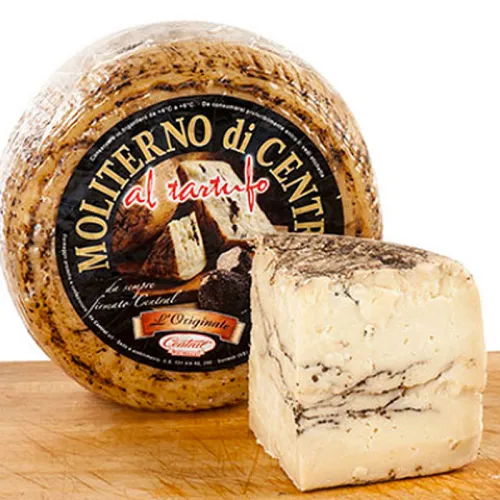
Lancashire cheese holds Protected Designation of Origin status — specifically the Beacon Fell variety, named after the Bowland fell that dominates the county's middle ground. PDO protection means the cheese must be made within a defined area using traditional methods; no amount of marketing makes a version produced elsewhere the genuine article.
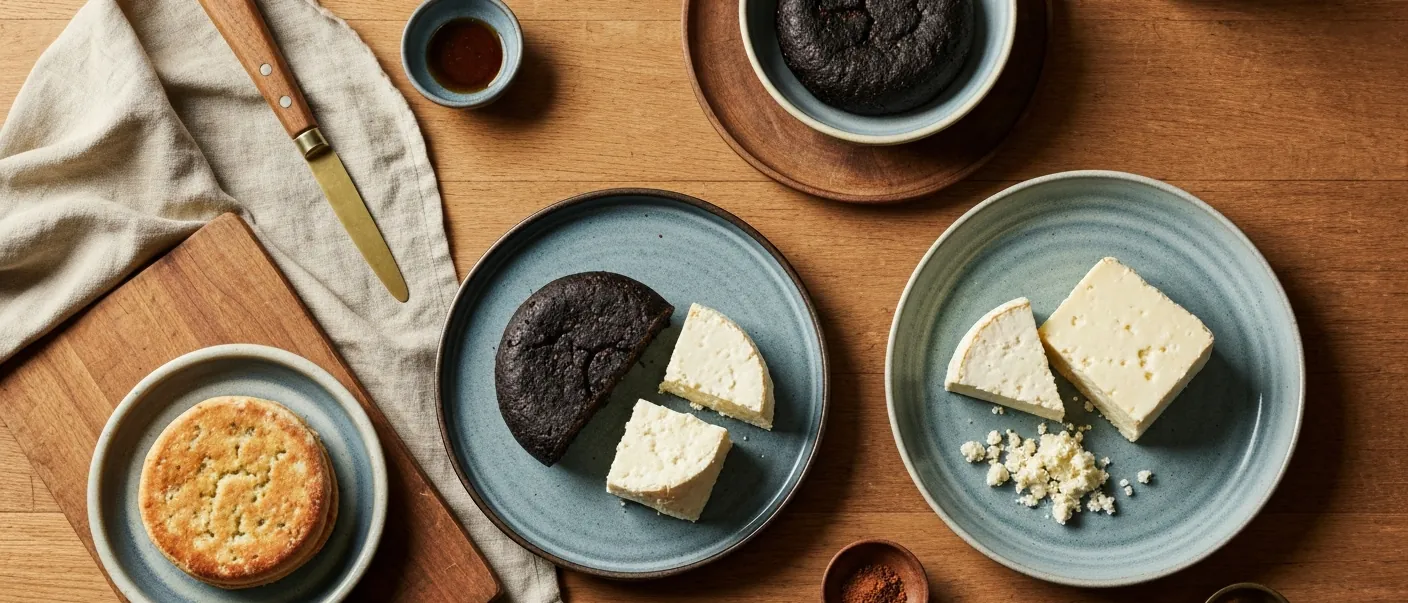
The cheese is made from cow's milk and comes in three distinct styles: Creamy, Tasty and Crumbly, each reflecting a different stage of maturation. Creamy Lancashire is young and mild, almost butter-soft. Tasty has had longer to develop its characteristic tang. Crumbly breaks apart cleanly and has a slightly sharper edge. All three differ fundamentally from the compressed, rubbery block cheese that fills most supermarket shelves — the texture comes from a traditional double-curd method that traps moisture and creates a layered, slightly flaky structure.
It works on a ploughman's, melts brilliantly over potatoes, and holds its own on any British cheeseboard without needing to shout.
Bury black pudding
Bury sits just over the county boundary into Greater Manchester today, but its black pudding tradition is bound up entirely with Lancashire's food culture. Bury Market has been the spiritual home of this particular black pudding for generations, and the product made there is widely regarded as the benchmark against which other British black puddings are measured.
A good Bury black pudding balances pig's blood, fat, oatmeal and spicing — producing something moist and deeply savoury rather than dry and dense. It is typically eaten sliced and griddled, sometimes served cold straight from the market stall, occasionally alongside a proper northern breakfast. It has none of the pretension that sometimes attaches to artisan charcuterie; it is simply an honest, well-made thing.
Morecambe Bay potted shrimps
The brown shrimps fished from Morecambe Bay are small, sweet and faintly nutty — quite different from the prawns most people picture when they think of British seafood. They are potted in spiced butter, a method of preservation that has never really needed improving. When the butter sets around the shrimps, it carries its own flavour: warming spice, a hint of mace, the richness of good butter.
Spread thickly on brown toast, the butter softened just slightly by the warmth of the bread — that is all they need. Morecambe Bay potted shrimps are still landed and potted on a small scale, and finding a producer who sources from the bay itself is worth the effort; the flavour is noticeably better than generic versions.
Lancashire hotpot and Eccles cakes
Lancashire hotpot is less a precise recipe than a philosophy: slow-cooked mutton or lamb beneath a lid of sliced potatoes, cooked low and long until the meat falls apart and the potato top crisps and browns. It was designed for households where the pot could be left on the range while people worked. Pickled red cabbage alongside is traditional and still widely observed, cutting through the richness of the lamb fat with sharp brine.
Eccles cakes sit technically within Greater Manchester, but their story is inseparable from the broader Lancashire food culture of the region's mill towns. The cake is a round of flaky pastry enclosing dark, sticky currants — simple, intensely sweet and oddly compelling. Eaten with a slice of Lancashire cheese, as local tradition has it, the combination of sweet dried fruit and sharp, crumbly dairy is hard to argue against.
These are not foods that need reinvention. The hotpot and the Eccles cake have both outlasted every culinary trend of the past two centuries, which suggests they had the right idea from the start.