The sea comes first
Ask anyone who has eaten on Skye what they remember, and the answer is almost always seafood. The waters around the Inner Hebrides — running cold and clear between Skye, Mull, Islay, Jura and the smaller islands — produce langoustines, scallops, oysters, crab and mussels that have long attracted buyers on the continent. For much of recent history, the better part of the catch was loaded onto lorries and sent to France, Spain and beyond rather than served locally. That pattern is shifting. More shellfish now reaches island restaurants, farm shops and direct-to-consumer boxes, giving visitors a genuine chance of eating what was caught the previous day.
Langoustines are the flagship. Fished from sea lochs and deeper offshore channels, they are at their best simply cooked — the flavour needs no assistance. Scallops from these waters are dense and sweet in a way that reflects the slow growth rates of colder seas. Hand-dived scallops, which avoid the seabed damage caused by dredging, are worth seeking out; some producers label them as such.
Oysters and mussels tend to come from rope or trestle cultivation in sheltered sea lochs, where tidal flow keeps the water clean and food-rich. Mull and Skye both have working shellfish operations, and buying direct from a farm — where possible — gives you shellfish at their freshest and cuts out considerable road miles.
Beef, lamb, and thin grazing
The land tells a harder story. Soils across the Inner Hebrides are thin, wet and often acidic — conditions that rule out arable farming almost entirely but suit hardy livestock that can convert rough grazing into good meat. Highland cattle and Blackface sheep are the dominant breeds. Neither grows fast. Both develop a depth of flavour that more intensively reared animals rarely match, partly because they move constantly over varied terrain and partly because slower growth allows fat to distribute through the muscle rather than sitting only around it.
Blackface lamb from island grazing is leaner than lowland equivalents, with a pronounced savouriness that reflects a diet of heather, coarse grass and wild herbs. Highland beef has a stronger character than supermarket standard — worth bearing in mind when sourcing it, because the flavour can surprise those used to blander product.
Freight is the structural constraint that shapes everything on the land side. Getting livestock or meat off an island involves ferry schedules, refrigeration logistics and costs that smaller producers absorb in ways mainland competitors do not. It is one reason island-reared meat can be harder to find than island seafood, and why direct relationships with producers — through box schemes or island butchers — matter more here than almost anywhere else in Britain.
Smokehouses and island larder
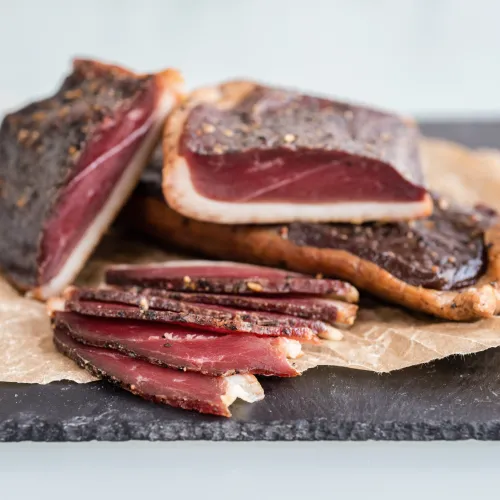
Smoking has practical roots in island life: a way of preserving fish and meat when refrigeration was unavailable and supply chains were unreliable. The tradition persists, now more as craft than necessity. Several producers across Skye and the neighbouring islands smoke salmon, trout, scallops, and occasionally lamb or venison over local hardwoods or peat. The peat-smoked versions carry a flavour that is difficult to describe without simply saying they taste of the place they came from.
Cheese is a smaller but growing part of the story. A handful of artisan dairies — working with cow's and sheep's milk — produce cheeses shaped by the same logic as the meat: slow, small-scale, defined by local conditions. Supply is often limited and seasonally variable, which is worth knowing before making a special journey.
Islay and whisky
No account of Inner Hebridean food and drink can sidestep Islay. The island is home to a cluster of distilleries producing heavily peated single malts unlike anything made elsewhere in Scotland — the peat here has a coastal, almost medicinal character that divides opinion sharply and inspires fierce loyalty in equal measure. We cover the geography and character of Scottish whisky regions in a separate article, worth reading alongside this one for the fuller picture. Distilling on Islay is not a recent lifestyle project: it is an industry with deep roots in the island's economy, and spent grain has long fed local livestock in a closed loop that makes straightforward agricultural sense.
Jura, immediately to the north of Islay, has its own distillery producing a lighter, less peated style — a useful reminder that island whisky is not a single category even within a short stretch of water.
Buying and seasonality
Availability fluctuates more than on the mainland. Ferries are cancelled in bad weather. Small producers sell out. Shellfish seasons have natural peaks. Visiting in summer gives the broadest spread of options; some smaller operations close or reduce hours off-season. If you are travelling specifically to eat well, contact producers directly before you go rather than assuming everything will be on hand at arrival.
A number of Skye and island producers now ship direct to the mainland — particularly shellfish and smoked goods — though lead times and minimum orders vary. Our companion piece on the Outer Hebrides covers the islands to the north and west, where a related but distinct food culture developed along slightly different lines.