The pig's pluck, not the chop
Buying a pig's pluck — the liver, heart and lungs pulled together in one cheap bundle — was not a matter of curiosity but of economic necessity. Faggots and pease pudding are what that necessity produced, and both have outlasted the poverty that shaped them.
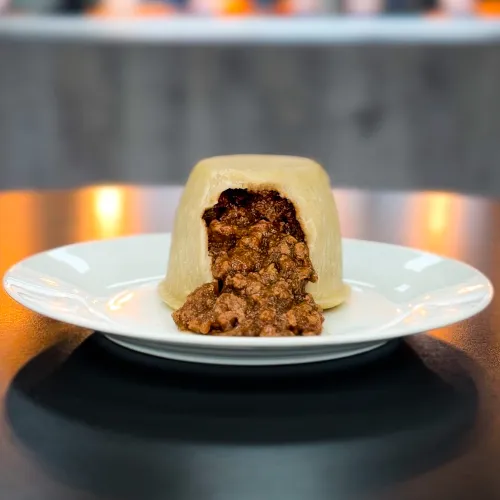
Faggots are a forcemeat of offal: liver and heart are the constants, belly pork adds fat and richness, and the whole is seasoned, bound with breadcrumbs and onion, then shaped into rounds. The defining feature is the wrapping — caul fat, the fine lacy membrane from around the pig's stomach, which bastes the faggot as it cooks, holding the shape and giving the surface an almost lacquered quality. Served with mushy peas and a dark, well-reduced gravy, they belong above all to the Midlands and south Wales, though versions existed wherever pigs were kept and money was short.
Pease pudding takes a different route to the same philosophy. Dried split peas — one of the oldest preserved foods in the British store cupboard — are soaked, then cooked long and slow until they collapse into a thick, savoury paste, somewhere between a purée and a set terrine depending on how much liquid remains. In the north-east it is a constant, sold by the tub from butchers and delicatessens, eaten cold from a stottie or alongside boiled ham. The colour is an unashamed yellow-green. The flavour, properly made, is earthy and gentle, with a back note the long cook draws from the peas themselves.
Why caul fat matters
Caul fat almost disappeared from British butchery and is only now returning. For faggots it is structural rather than decorative. As it renders, it moistens the meat from outside, preventing lean offal from drying and tightening. The result is a faggot that holds together cleanly when sliced but gives way with little pressure. Without it, faggots become denser and need more breadcrumb to compensate, which shifts the balance of the dish.
Getting hold of caul fat requires a conversation with a butcher who breaks down whole animals. That conversation is, increasingly, possible again.
Offal's quiet return
For several decades, offal was something British food largely pretended not to do. Liver, kidney, heart, sweetbreads — the cuts that had sustained whole communities — retreated to a small corner of old-fashioned restaurant menus. The reasons were partly generational, partly a food culture built around prime cuts and the notion that the best of an animal was also the leanest.
That is shifting. Independent butchers who know their suppliers and can name the farm are bringing offal back to the counter because the demand is there. Restaurant menus across Britain now carry at least one offal dish as a matter of course, and not always in a retro framing. Faggots sit within that broader movement, though they predate it by generations.
Pease pudding involves no offal, but it belongs to the same tradition of making something genuinely satisfying from very little. The north-east's attachment to it speaks to a regional food culture that never needed to apologise for eating well on simple ingredients.
Buying and eating both
Faggots worth eating come from butchers who make them in-house or from producers who name their pork suppliers. The caul fat wrapping is a reasonable indicator of care — mass-produced versions often omit it. Gravy made from the cooking juices and a dark stock is the right accompaniment; the peas alongside should be mushy, their starch dissolved into something that melds with the gravy rather than sitting apart.
Pease pudding is best bought from a north-east butcher or deli that makes it regularly. Texture varies considerably — from almost spreadable to firm enough to slice, and both are legitimate. Cold in a stottie (the flat, chewy bread roll that is itself a north-east institution) or warm alongside boiled or roasted gammon, it needs no embellishment.
These dishes sit alongside other British pork traditions — Bath chaps, the cured cheeks of the pig, and black pudding, which turns blood into one of the country's most complex breakfast ingredients — in a lineage that valued the whole animal long before it was fashionable to say so. What connects them is a coherent logic: that flavour and satisfaction do not require expensive cuts, and that skill in the kitchen was once measured by what you could do with what everyone else overlooked.