A county shaped by its landscape
County Down sits in the north-east of Ireland, its eastern edge pressed against the Irish Sea and its southern reaches rising into the Mourne Mountains. That variety of terrain — coastal, lowland, upland — means the county produces several completely different food specialities, each rooted in the specific conditions of its corner of the county.
These aren't generic regional products dressed up in heritage branding. The soils around Comber are genuinely unlike soils elsewhere. The waters of Strangford Lough behave in ways that shape what lives in them. The Mournes are high and exposed enough to produce lamb with a character that reflects every bit of that exposure.
Comber Earlies and the lightness of the soil
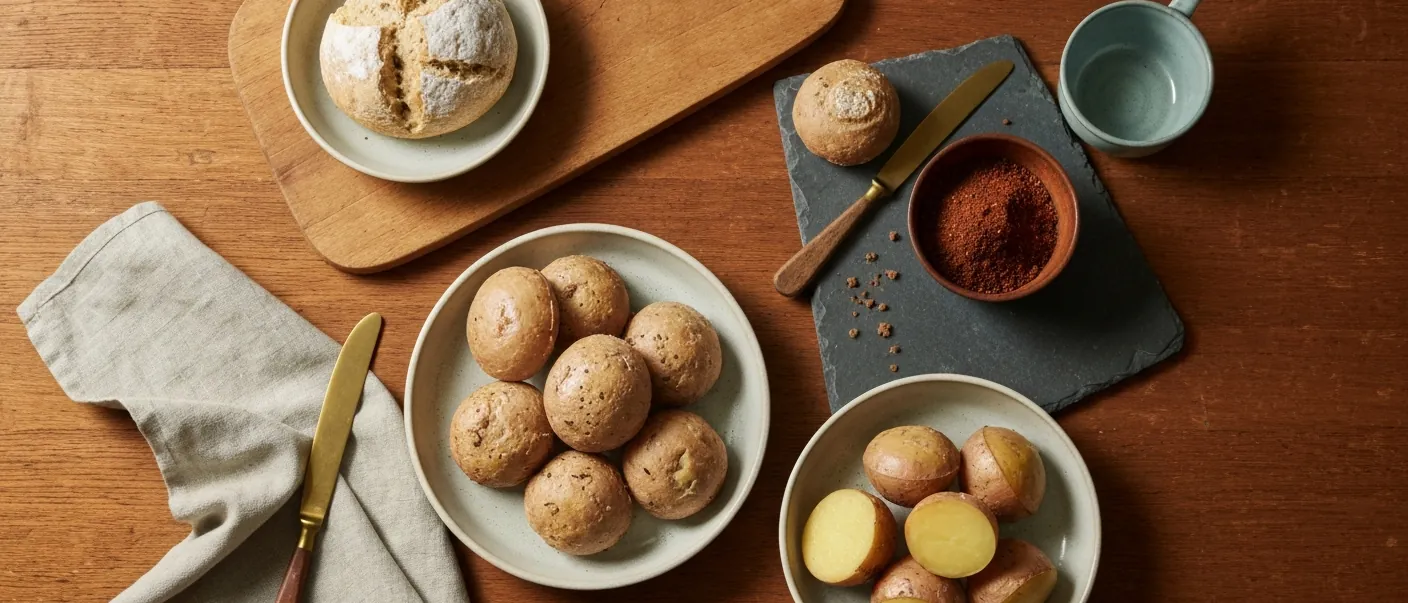
The most formally recognised of County Down's specialities is the Comber Early potato, which carries PGI status — Protected Geographical Indication — meaning it can only bear that name if grown in the area around Comber, a small market town a few miles south-east of Belfast. The soil there is genuinely unusual: a light, free-draining glacial loam that warms quickly in spring, letting the potatoes develop fast with a thin skin and a clean, slightly sweet flavour that heavier soils don't produce.
Comber Earlies are a new-season potato — harvested young, before the skin has set, and at their best eaten simply with butter while still warm. The season is short. Once it passes, you wait another year, which is precisely what gives them their standing among people who pay attention to what they eat.
Strangford Lough and its shellfish
Strangford Lough is one of the largest sea loughs in Britain and Ireland. A narrow strait at its northern end pushes an enormous volume of water in and out twice a day, keeping the lough exceptionally clean and rich in nutrients — and making it highly productive shellfish habitat.
Oysters from the lough have the briny, mineral quality that cold, clean tidal water produces: flavoursome without being sharp, with a finish that lingers. The mussels are plump and sweet, fed by the same nutrient-rich currents. Both are harvested by small-scale producers working within the constraints of the lough's designation as a Special Area of Conservation, which limits what can be done there and, in doing so, protects the quality of what comes out of it.
The lough's shellfish reach Belfast's St George's Market, the Victorian covered market that draws much of its fresh produce and seafood from County Down's coastline and fishing communities. For anyone visiting Belfast and wanting a direct connection to what the county produces, St George's is a reliable place to find it.
Mourne mountain lamb
The Mourne Mountains occupy the southern part of County Down — a compact range of granite peaks that feel genuinely remote despite being relatively accessible. Sheep grazing across open moorland, rough grass and heather produce lamb with a depth of flavour that reflects both breed and terrain. Upland grazing on wild vegetation tends to develop more complex, slightly gamey notes than lowland lamb, and Mourne mountain lamb is no exception.
It's meat that stands up to bold treatment but doesn't require it. Slow-roasted, it rewards patience. The fat carries flavour in a way that commercially reared lamb often doesn't, and the texture is firmer — a consequence of animals that move across difficult ground rather than grazing in flat, sheltered fields. The Mournes have a long tradition of upland farming, and this lamb is a product of that continuity rather than any recent rediscovery.
How these foods reach the table
County Down's produce doesn't stay in County Down. St George's Market in Belfast is a significant distribution point for much of it, and for shellfish in particular it's often the most direct route between the lough and the consumer.
Comber Earlies appear in specialist greengrocers and some supermarkets during their short season; Mourne lamb is found through butchers and farm shops across Northern Ireland. The PGI status of the Comber Early means consistent labelling, making it easier to know what you're getting. With the shellfish and the lamb, provenance is a matter of asking — a good fishmonger or butcher will usually tell you.