The colour has a name
Ask at almost any cheese counter why Red Leicester is orange and the answer is annatto. It's a natural dye extracted from the waxy coating of seeds inside the pod of the achiote tree, a tropical plant cultivated across Central and South America. The seeds are brick-red, and the pigment they yield — stirred into milk at the vat — produces that characteristic amber-to-orange hue. No synthetic colourant. Annatto has been used in British cheesemaking for centuries.
The dye is flavourless at the concentrations used in cheese. Whatever you imagine when you look at a deeply orange slice of Double Gloucester — something richer, more buttery than a pale Cheshire — that's your eyes talking, not your tongue.
Where the tradition came from
Cows grazing on fresh spring and summer pasture produce milk carrying natural carotene from the grass. That carotene tints the butterfat — which is why good summer butter can be almost golden — and it tints cheese too. Cheese made in peak season, from well-grazed cows, was naturally warmer in colour than cheese made in winter on hay and stored feed.
Colour became a shorthand for quality. Buyers at market had no way to verify where a cheese had come from or how it had been made; they could see immediately whether it was golden or wan. A naturally coloured summer cheese commanded more confidence, and more money. So when makers were working with winter milk — paler, lower in carotene — or with milk that had been partially skimmed, they reached for annatto to bring the colour up to expectations. The dye preserved the signal even when the underlying conditions had changed.
Whether this was honest depends on how you look at it. The flavour and texture of a well-made cheese were unaffected. But colour had become a proxy for richness, and annatto was being used to maintain that proxy when the richness itself had shifted. It sits somewhere between craft tradition and early food marketing, and it's been running for a very long time.
Why some cheeses use it and others don't
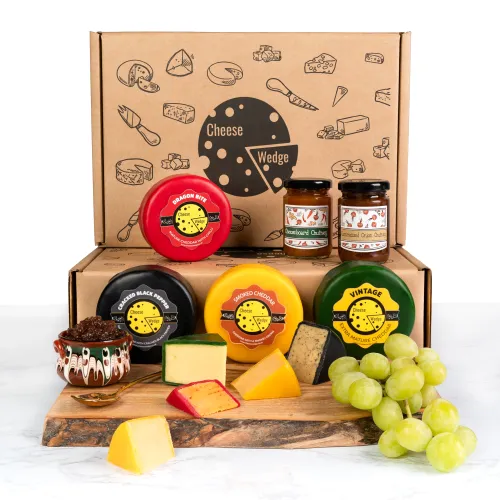
The geography of orange cheese in Britain is fairly consistent. Red Leicester is always orange; it's part of what defines the cheese visually, alongside its firm, slightly flaky texture and the flat, wide shape a traditional wheel produces. Double Gloucester is orange too — considerably larger and richer in character than its Single counterpart. Both are East Midlands cheeses with long histories tied to regional dairy farming.
Cheshire complicates the picture usefully. The same base recipe produces a white version, a red version coloured with annatto, and a blue. The difference between white and red Cheshire is purely cosmetic — same milk, same cultures, same process, different colour. Annatto is doing one job only: signalling a tradition.
Many British cheeses have always been made without any colouring. Cheddar, in its traditional form, is pale yellow to ivory. Wensleydale is white. Lancashire is off-white. Their makers weren't working in a tradition where colour had been established as the primary quality cue, so tinting never arose in the same way.
What it means at the cheese counter today
Understanding annatto changes how you read a cheeseboard. The orange in a well-aged Red Leicester isn't evidence of anything stronger or more intensely flavoured than a pale equivalent — it's a regional and historical convention, preserved because it has become part of the cheese's identity. Strip the colour from Red Leicester and you'd have something that looked unrecognisable even if it tasted identical.
For shoppers with particular sensitivities, annatto appears on ingredient labels — usually as E160b — and is occasionally linked to reactions in people sensitive to natural colourants. It's a rare issue but a real one, and most specialist cheesemongers can point you to an uncoloured version of a similar style if needed.
Colour in cheese is almost never about flavour. It's about history, convention, and the visual language that makers and buyers developed long before anyone had a laboratory to test milk composition. A wedge of orange Leicester, understood properly, becomes more interesting for it.