The mould that does the work
The colour comes from a single species: Penicillium roqueforti, a mould that produces blue-green pigmentation as it grows. It isn't introduced by accident. Cheesemakers add it deliberately, either by blending the spores into the curd during making or by introducing them to the milk at an early stage. Without oxygen, though, the mould stays dormant. That's where the cheesemaker's most distinctive tool comes in.
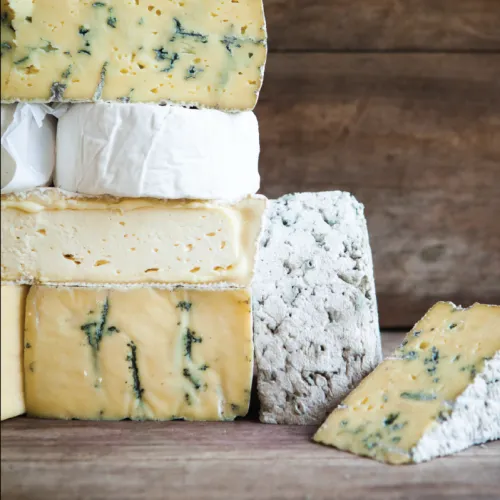
At a specific point in the maturing process, the wheels are pierced from top to bottom with long needles — sometimes hundreds of punctures per wheel. This isn't decorative. Each hole becomes a channel through which air can travel into the heart of the cheese, feeding the mould and allowing it to germinate and spread outward along the natural fissures in the paste. The pattern of the veins you see when you cut a blue cheese open is a map of where air found a path.
What young and aged blues actually taste like
A blue cheese sold young — before significant ageing — tends to be pale, dense and comparatively mild. The paste is creamy, sometimes almost spreadable, and the blue flavour is present but restrained. There's often a milky sweetness underneath, with the sharpness arriving only at the finish.
Leave that same cheese to age and almost everything changes. The moisture continues to leave the wheel; the texture tightens and eventually becomes crumbly, breaking into rough irregular pieces rather than slicing cleanly. More importantly, the enzymes in the mould have more time to break down the fats and proteins in the milk — a process called lipolysis and proteolysis — which generates the peppery, sharp, sometimes almost metallic intensity that experienced blue-cheese eaters seek out. The older the cheese, the more fully those flavours have developed.
This is why a young gorgonzola dolce (soft, white, very gentle) and a well-aged Stilton (amber-crusted, crumbling, assertive) can seem like entirely different categories of food, even though both are blue cheeses made by the same fundamental method.
Why the rind matters too
The outer surface of a blue cheese is rarely inert. Most wheels develop a natural rind during maturing — a rough, sometimes powdery coat that helps regulate how quickly moisture leaves the cheese and how the interior environment develops. Cheesemakers make deliberate decisions about how much to protect or expose that rind, and those decisions ripple through to what you taste. A heavily wrapped blue will retain moisture and stay creamy longer; one left to breathe and form a thicker crust will move towards the crumbly, intense end of the spectrum more quickly.
Some blues are foil-wrapped at a young stage expressly to halt that drying process. Others are left open to cellars with carefully controlled humidity. The needle-piercing happens within this broader programme of decisions — it isn't one isolated step, but part of a sequence that the cheesemaker uses to steer the cheese towards a particular outcome.
How this changes the way you eat it
Understanding the texture-to-intensity relationship is genuinely useful at a cheeseboard. A soft, pale blue suits fruit — fresh pear, fig, the light sweetness of a good honey — because it needs something to meet its gentleness rather than overwhelm it. A hard, aged blue can hold its own against something robust: dark rye bread, a small glass of something fortified or sweet, or even good dark chocolate, where the bitterness and the sharpness of the cheese push against each other productively.
Temperature matters more with blues than with most other cheeses. Served straight from the fridge, the fat is firm and the flavour is compressed. Brought to room temperature for an hour before eating, the same wedge opens up considerably — the creaminess returns even in a crumbly cheese, and the aromatic compounds that carry the characteristic sharpness become far more perceptible. It's one of those small adjustments that makes a noticeable difference without requiring any extra effort.