A grade with teeth
Extra virgin is not a style or a suggestion. It is a legal classification requiring three hard conditions simultaneously: the oil must be extracted by purely mechanical means at cold temperatures, its free acidity must fall below a strict threshold, and it must pass a sensory panel test with zero detectable defects. Fail any one, and the oil cannot legally carry the name.
That last requirement — the taste panel — is what separates extra virgin from a chemistry test. Trained assessors evaluate the oil blind for off-flavours: rancidity, mustiness, a winey or vinegary note, anything that signals poor fruit, damaged olives, or sloppy processing. An oil can hit the acidity target and still be rejected. The palate has the final say.
Why cold extraction matters
The "cold" in cold extraction means the olive paste is never heated above a tightly controlled temperature during pressing or centrifugation. Heat increases yield — which is why cheaper producers use it — but degrades the volatile aromatic compounds and polyphenols that give good oil its character. Cold extraction preserves both.
The "first" in the old phrase "first cold pressing" is now essentially obsolete. Modern mills use continuous centrifuge systems, so there is only ever one extraction. You will still see the phrase on labels, largely for tradition's sake, but what counts is temperature control, not pressing sequence.
That peppery catch in the throat
If a fresh oil makes you cough at the back of the throat, that is not a flaw. It is a polyphenol called oleocanthalin doing exactly what it should. The compound is most concentrated in newly harvested oil and diminishes as the oil ages. A strong peppery finish is, counterintuitively, a marker of freshness and relatively high phenolic content — a quality signal that cheap, old or adulterated oil cannot fake.
The intensity also depends on olive variety and harvest timing. Oil pressed from slightly underripe fruit carries more bitterness and pepper than oil from fully ripe olives, which runs softer and more buttery. Neither profile is wrong; they suit different uses and different palates.
Reading the label properly
Most bottles show a best-before date but not a harvest date. An oil bottled shortly after pressing with an 18-month or two-year shelf life could legally still be on the shelf long past its best. The best-before date gives you the legal minimum; the harvest date tells you where you actually are in the oil's life.
Producers who are confident in their oil print the harvest date clearly — often as a campaign year or specific season. If a bottle carries only a best-before date with no indication of when the olives were picked, that absence is itself informative. Look for bottles where the harvest date falls within the last year, ideally less. Oil from the most recent autumn campaign, bought the following spring or summer, is likely at or near its peak.
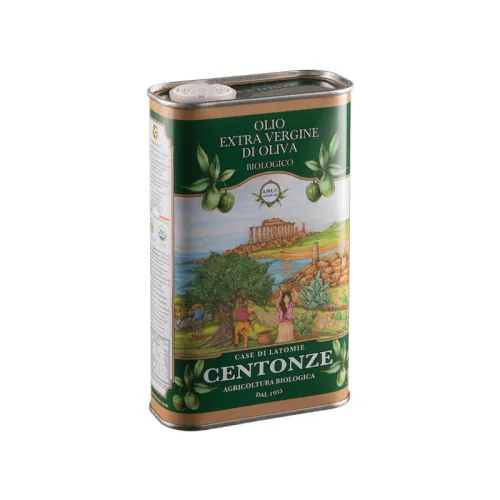
Dark glass or opaque tin packaging is not an affectation. Light degrades oil quickly, accelerating oxidation and stripping the compounds that justify the extra virgin grade. A producer who has gone to the trouble of cold extraction and rigorous tasting should want their oil arriving at your kitchen in the same condition it left theirs.
What the grade cannot tell you
Extra virgin sets a floor, not a ceiling. Two oils can both qualify and taste entirely different — one flat and generic, the other complex and specific to a single grove and variety. The classification screens out the worst; it does not rank the rest.
Country and region of origin, olive cultivar, harvest timing, and the care taken between tree and mill all shape what ends up in the bottle far more than the grade alone. A single-estate oil from a named harvest, with a traceable variety on the label, gives you far more information than a blended bottle that technically meets every legal requirement. Extra virgin is where the conversation starts, not where it ends.