The bones of the recipe
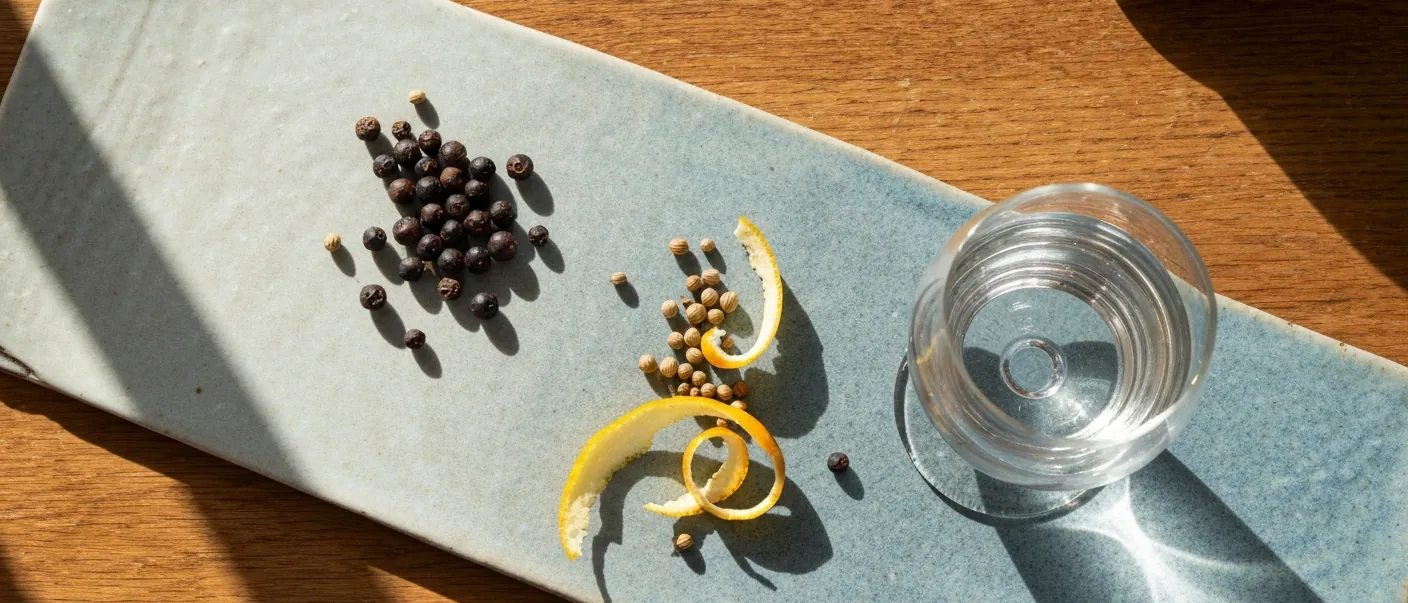
Gin is neutral spirit flavoured with botanicals and redistilled. The law requires juniper to dominate — without it, you don't have gin — but beyond that, the botanical bill is almost entirely at the distiller's discretion. Most British gins share a loose backbone: juniper for a resinous, piney core; coriander seed for dry, slightly citrusy brightness; and angelica root, which contributes earthy depth and helps bind the other flavours together in the spirit.
Then there is orris root — the dried rhizome of a particular iris species — which most drinkers have never encountered but almost certainly taste regularly. It adds a faint floral, slightly powdery quality, and its primary job is as a fixative, helping more volatile aromas persist long after they would otherwise fade. Dried citrus peel brings lift and clarity. These five ingredients appear in some form across a remarkable number of British gins, and understanding what each does makes for considerably more perceptive tasting.
How spirit and plants meet
Two broad approaches to botanical infusion exist, and the choice between them has a significant effect on the character of the finished gin.
In steeping — sometimes called maceration — the botanicals sit directly in the base spirit before distillation begins. Alcohol draws out flavour compounds over hours or days, and the whole mixture then goes into the still together. The result tends to be richer and more integrated, with a depth that can make a gin feel almost chewy.
Vapour infusion works differently. The spirit distils first, and the rising vapour passes through a basket holding the botanicals rather than making direct liquid contact with them. The extraction is gentler and more selective — certain delicate aromatic compounds come across well this way, while heavier, earthier notes are largely left behind. Gins made this way often have a lighter, more aromatic quality. Neither method is inherently superior; some distillers steep the robust botanicals and vapour-infuse the more fragile ones within the same run.
Why small distillers reach for what grows nearby
The craft distilling revival in Britain has brought genuine enthusiasm for local and seasonal botanicals — and not simply as a marketing angle. A distiller working with foraged hedgerow elderflower, coastal samphire or Scottish heather is working with flavour compounds specific to a place and a moment in the year. Elderflower picked fresh will taste different from the same flower dried and imported, and different again from what grows three counties over.
Small stills suit this kind of work. A large continuous operation demands consistency above all else. A pot still running small batches can accommodate a botanical bill that shifts slightly with the season — adjusting the quantity of one foraged ingredient, substituting when something isn't at its best. That flexibility is what allows a small British distillery to make a gin that tastes, however obliquely, of somewhere specific.
Sea buckthorn, gorse flower, wild thyme, Douglas fir — these are the additions that give regionally-focused British gins their particular character. They don't replace the classic backbone; they pull it in a direction a standard London Dry would never go. The best feel coherent rather than experimental, as though the foraged element was always supposed to be there.
Reading a botanical bill
Distillers are not required to list every botanical, and many don't. When you do have a list, it rewards attention. A long bill — fifteen or twenty botanicals — is not necessarily more complex in the glass than a short one; the additions can cancel each other out or blur into a generalised aromatic warmth. Some of the most precise British gins are built on five or six ingredients chosen with care.
Look for what sits beyond the standard backbone. Specific, named local botanicals usually suggest a distiller who has thought carefully about geography and season. A single foraged ingredient, used well, can define a gin as clearly as any other choice the distiller makes. Orris root anchors; citrus peel lifts; juniper grounds everything. The botanicals in between are where a distiller's character comes through.