The term nobody has defined
There is no legal or regulatory definition of 'small batch' in British food and drink. Any producer can print it on any label without meeting a single measurable standard. That alone should make the careful shopper pause — but dismissing it entirely would be a mistake, because for certain crafts, batch size genuinely changes the physics and chemistry of what's happening in the pan or still.
The honest answer is that it depends almost entirely on what's being made. In some processes, scaling up changes what's possible. In others, it's cosmetic — the same method, just a smaller run.
Where batch size changes the craft
Three areas stand out where small quantities produce outcomes that larger production cannot easily replicate.
Pan-boiled preserves. A wide copper preserving pan holds a fraction of what a commercial vat does, and that matters. Jam and marmalade made in a small, open pan lose moisture quickly through vigorous, rapid boiling — the result is fresher flavour and a looser, more varied set than the uniform gel from pectin-corrected, large-batch production. You're tasting fruit that was cooked once, fast, rather than held, adjusted and re-processed.
Hand-stirred confectionery. Caramel is a clear example. A small copper pot allows a maker to watch colour and temperature with full attention — to pull from the heat at exactly the right moment, to stir by feel. In a large automated batch, that judgement is replaced by timers and sensors. Both can produce consistent results, but the small-batch maker's consistency comes from accumulated craft rather than machinery, and the margin for individual adjustment is real.
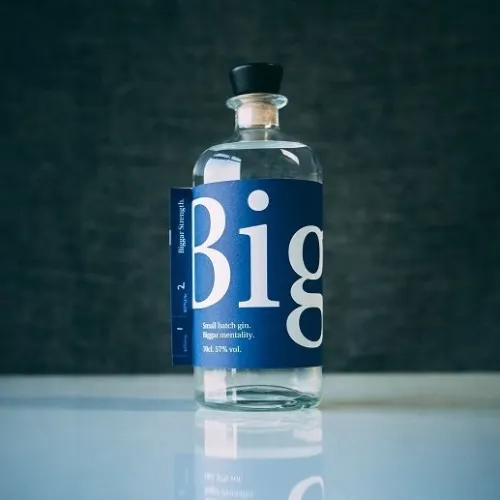
Pot-still spirits. This is where 'small batch' carries the most technical weight. A pot still distils one batch at a time, and the character of that batch — the particular grain, the precise timing of the cuts between heads, heart and tails — carries through to the final spirit. Column distillation, which enables continuous large-scale production, simply doesn't work the same way. The pot-still method requires individual attention for every run. Whisky and gin producers using pot stills aren't just marketing small quantities; they're using a process that structurally limits what 'large' can even mean.
Where it's mostly a label
Bread is an interesting case. A small artisan bakery working with long ferments and hand-shaping produces something genuinely different from an industrial loaf. But the meaningful variables are time, temperature and technique — not batch size. A bakery could scale up considerably and maintain quality, as long as those core practices hold. 'Small batch' on a bread wrapper tells you relatively little.
The same is broadly true of dried goods — spice blends, granola, tea mixes. Where the process is essentially mixing and perhaps gentle toasting, a smaller batch doesn't transform the chemistry. A producer might use the term to imply freshness or attentiveness, and those things may well be real, but they're not a consequence of batch size itself.
Coffee roasting sits somewhere between the two. A skilled roaster working a small drum has more control over each batch's development, and single-origin small roasts allow adjustments that a large blended industrial roast cannot accommodate. But the skill is in the roasting, not purely in how much is roasted at once.
The question worth asking
Rather than treating 'small batch' as a quality signal in itself, ask what the small batch is actually doing in the specific process. For a pot-still distillery, it's load-bearing — the process demands it. For a caramel maker stirring by hand, it's the difference between craft and factory output. For a jar of dried herbs, it may mean very little.
Good producers tend to be specific. They'll tell you the still size, the pan capacity, the number of jars in a cook. When a brand uses 'small batch' without any supporting detail, that absence is itself informative. Makers who work at genuinely constrained scales usually know exactly why it matters to their product — and are glad to explain it.
The most reliable shorthand is not the label but the explanation behind it. Look for producers who answer the question before you think to ask.