A word without a definition
Walk into any independent food shop and you'll see 'raw' on honey labels alongside reassuring language about nature and purity. What you won't find is a legal standard underpinning it. In the UK, 'raw' is not a regulated term for honey. Any producer can print it on a jar without meeting defined conditions. That doesn't make it meaningless — it just means the work of understanding what you're buying falls to you.
The distinction that matters is simpler than the marketing suggests. Honey that has not been significantly heated and has been left unfiltered — or only lightly strained to remove wax and debris — retains what the hive put into it. Honey that has been heat-treated and passed through fine filtration has had much of that removed, often deliberately, to extend shelf life and keep it pourable for longer.
What heating and filtering actually remove
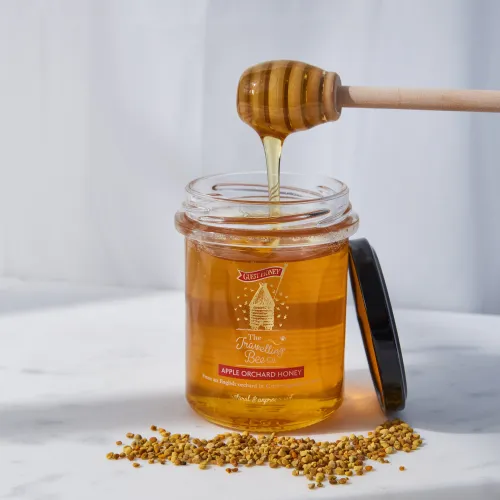
Pollen is the clearest casualty. In genuinely unprocessed honey, pollen grains from the flowers the bees visited survive into the jar, and they carry the character of a specific place. The difference between a heather honey from the Scottish uplands and a wildflower honey from the Somerset Levels is legible in the pollen. Fine commercial filtration strips most of this out, producing a cleaner, more uniform product with a longer stable shelf life.
Heat treatment compounds the effect. Warming honey beyond the gentle warmth of the hive makes it easier to pump and filter, and slows crystallisation on the shelf. It also softens the aromatic compounds and enzymatic activity that give fresh honey its complexity. The result pours beautifully — whether it tastes of anything particular is another question.
Commercial blends add a further layer of distance. A jar labelled 'produce of EU and non-EU countries' may contain honeys from dozens of sources, standardised for colour, viscosity and sweetness. There is nothing unsafe about this, but there is very little that is local, traceable or specific.
On crystallisation
A persistent misconception is that crystallisation signals age or spoilage. It signals neither. All raw honey will eventually crystallise — this is a natural property of a high-sugar solution. Speed varies with flower source: oilseed rape sets very quickly and firmly, while acacia tends to stay liquid far longer. A jar that has gone solid in the cupboard is not past its best; warm it gently in a bowl of warm water and it will return to a more liquid state without damaging its character.
Commercially processed honey is often fine-filtered partly to delay this. Removing the particles that seed crystallisation — pollen, beeswax fragments, tiny air bubbles — keeps it liquid on a supermarket shelf for much longer. That clarity is a processing signal as much as a quality one.
How to buy raw honey
The most reliable route is the most direct: buy from a beekeeper. At a farmers' market, a farm shop, or through a local beekeeping association, you can ask how the honey was handled after extraction. Most small-scale producers use a coarse strainer rather than a fine filter and do not heat their honey beyond the temperature of the hive. They can tell you which flowers their bees were working, roughly when the honey was extracted, and where the hives were kept. None of that information fits on a label.
A number of small British producers also sell direct online. The better ones are specific about their methods and their apiaries — look for descriptions that mention straining rather than filtering, that describe the forage the bees had access to, and that are honest about crystallisation being likely. Vagueness about process is worth noticing.
Price is a rough guide, though not a reliable one. Genuine small-batch British honey, extracted without industrial processing, costs more to produce than a blended import. If a jar is priced at supermarket own-label levels, it is worth asking why.
What you are actually getting
Unprocessed honey from a local beekeeper carries the character of a specific place and season. Heather honey tastes nothing like borage honey; early-summer honey from the same hives tastes different to the late-summer batch. This variability is the point. It is also why raw honey tends to taste more intensely of something — more floral, more waxy, sometimes sharper — than the mild sweetness of a heavily processed blend.
The case for buying traceable, minimally processed honey is straightforward: it tastes better, you know what is in it, and the money goes to a beekeeper rather than a blending facility. The label that says 'raw' might be telling you something true. The beekeeper who can explain exactly what they did — that is the one worth finding.