Not pear cider
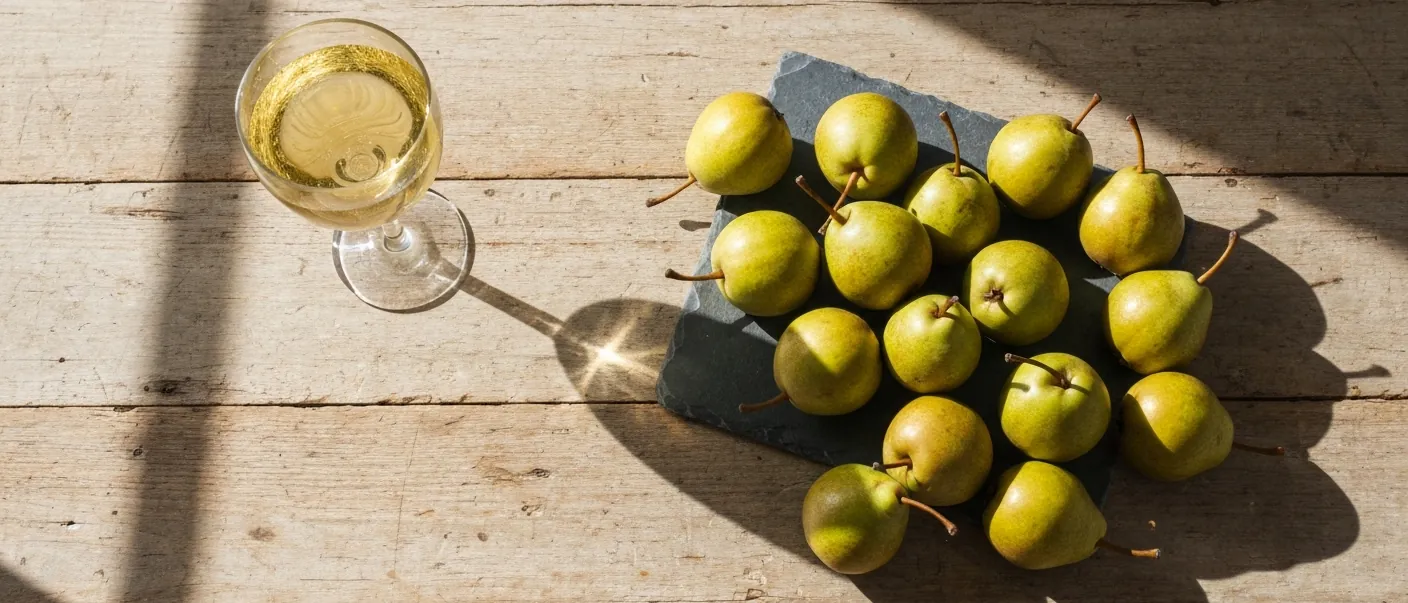
The confusion is understandable but worth clearing up. Perry is not pear cider. Pear cider — the fizzy, often luridly sweet product found in mainstream pubs — is typically made from culinary or dessert pears, or from pear concentrate, and bears about as much relation to real perry as supermarket grape juice does to a glass of Burgundy. Perry is fermented from perry pears specifically: small, frequently misshapen fruits you would never eat raw and that have no use beyond the glass.
The distinction matters because perry pears are extraordinary. High in tannins, rich in a fermentable sugar called sorbitol, and often mouth-puckeringly astringent straight from the tree, they produce a drink of genuine complexity — floral, sometimes mineral, sometimes faintly spiced — that has nothing to do with the flavoured alcohol masquerading under a similar name.
Where perry pears actually grow
Perry pear varieties are not widely cultivated. They grow in a tight cluster of counties spanning the English-Welsh border — Herefordshire, Gloucestershire and Worcestershire are the heartland — and some individual varieties are native to just a few parishes, or even a single valley.
The trees themselves reinforce this specificity. Perry pear trees can live for centuries, growing to a size that dwarfs most orchard trees, and old specimens are often tied to particular farms where they have stood for generations. Replanting is not straightforward: perry pears are slow to bear fruit, slow to mature and fussy about soil and microclimate. Lose a grove of old trees and you may lose a variety that cannot be sourced elsewhere.
Some varieties have been grown so long that their origins are effectively undocumented. They carry local names — often connected to the farm or village where they were found — and their character can shift noticeably from one site to another, even within the same county. This sensitivity to place makes perry about as terroir-driven as any British drink gets.
Why it is so hard to make well
Perry makers speak of the drink with a mix of affection and exasperation. Fermentation is notoriously unpredictable. The sorbitol in perry pears does not fully ferment, which affects both sweetness and body in ways that are difficult to control. The drink is also prone to secondary fermentation in the bottle, so carbonation can be erratic — a bottle opened at the wrong moment may be almost flat, or emphatically not.
Tannin levels vary dramatically between varieties and between harvests of the same tree. Get the blending wrong and the result is harsh or thin. Get it right and the tannins give perry a structure that lifts it far above simple sweetness — a gentle grip that carries the flavour longer than you might expect from something so pale and seemingly fragile in the glass.
Traditional perry is often lightly sparkling, bone dry or off-dry, and relatively low in alcohol compared to cider. Serve it cool rather than cold, which allows the aromatics room to open. The comparison to certain light white wines is not facile: the better examples share that quality of seeming simple on first sip and then revealing something more considered as you continue.
Why it matters now
Perry has never been a commercial proposition in the way that cider has. The geographic constraints alone make volume production almost impossible, and the difficulty of fermentation puts off producers looking for consistency at scale. What survives is largely in the hands of small, independent orchardists — people who tend old trees and make perry in quantities that rarely travel far from where it was pressed.
That fragility is an argument for paying attention. Old perry pear orchards are part of a working landscape that requires active maintenance to survive. Trees that are not harvested, not valued, not connected to a market eventually get grubbed up. The drink and the landscape sustain each other, which means that drinking real perry — made from named varieties grown on border soil — is one of the more direct ways to support something genuinely irreplaceable.
Perry does not need to carry the weight of an ecological mission to justify a glass. It is worth drinking because it is delicious and unlike anything else. But it helps to know what you are holding.