Two oysters, two stories
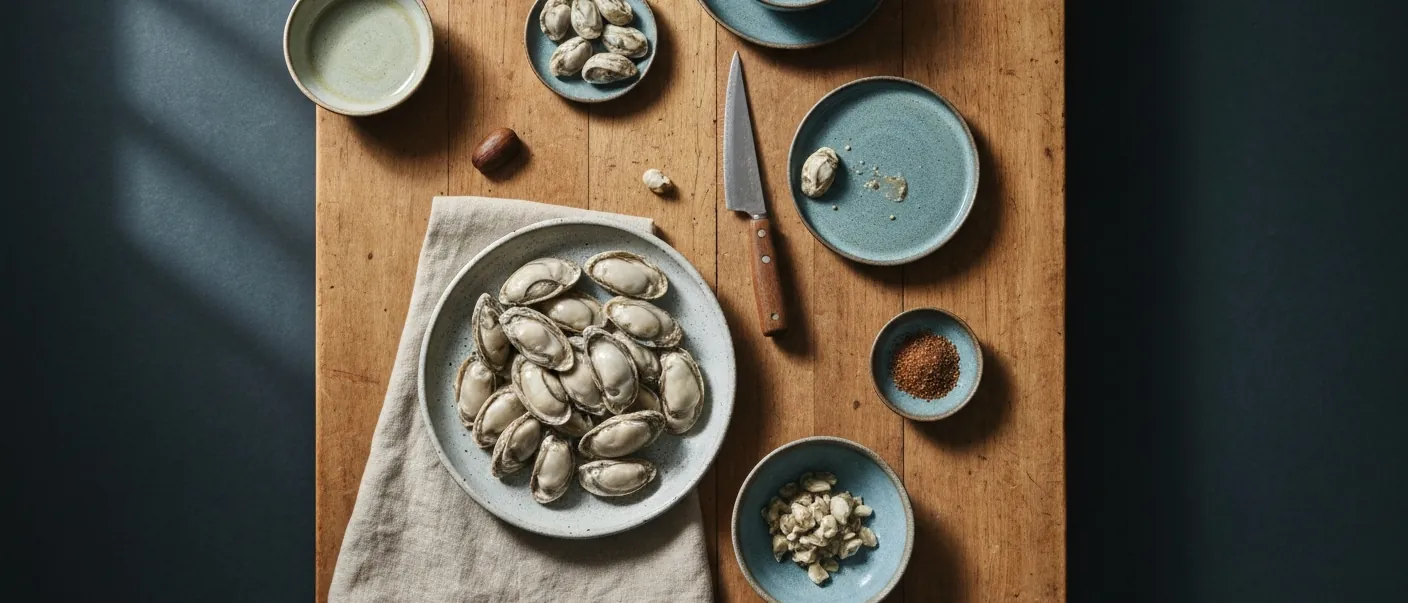
Walk into any decent fishmonger and you will likely find both: the rugged, ridged Pacific rock oyster and, if you are lucky, the flatter, rounder native. They are sold alongside one another, often shucked to order, yet the similarity ends at the shell.
The native flat oyster (Ostrea edulis) is Britain's original, gathered from estuaries and inshore beds for thousands of years. The Pacific rock oyster (Crassostrea gigas), sometimes called the Portuguese oyster, arrived from the Pacific Rim and became the dominant farmed species across Britain and much of Europe. It is hardier, faster-growing, and easier to produce at scale — which is precisely why it took over.
The matter of seasons
Natives are traditionally sold only in months containing the letter R: September through to April. That rule is not arbitrary snobbery. Over the warmer summer months, native oysters spawn, and eating a spawning oyster — milky, soft, and depleted — is a genuinely unpleasant experience. The closed season also allows beds to recover, which matters enormously given how slowly these oysters grow.
Rock oysters carry no such restriction. Farmed stocks are managed to limit or suppress spawning, so they remain in acceptable condition year-round. That reliability is a large part of their commercial appeal.
Flavour: the real distinction
A native flat oyster is briny and complex. The initial hit of the sea gives way to something more mineral, almost metallic, with a long finish. The texture is firm and dense — there is real substance to it. Different growing beds produce noticeably different characters: an oyster from one estuary will taste quite distinct from one pulled a hundred miles up the coast, shaped by the salinity, temperature, and plankton of its specific water.
Rock oysters tend towards a cleaner, fresher brine — creamier and milder. For many people that approachability is a virtue; they are the oyster you might eat six of without much deliberation. That is not a criticism. It reflects a genuinely different eating experience, not an inferior one.
The simplest way to understand the gap is to eat them side by side. Order both at a good oyster bar and you will taste the difference immediately. Neither needs embellishment beyond a squeeze of lemon or a mignonette, though purists argue for nothing at all.
Why natives are the rarer find
Native flat oysters grow slowly — several years to reach marketable size, compared to roughly a year or two for a well-managed rock oyster. They are also far more sensitive to disease, pollution, and water temperature. Historic overfishing and a succession of harsh winters stripped many of Britain's most productive native beds, and recovery has been painstaking. Some beds that once supplied the London market in large quantities now produce only a fraction of their former yield.
Conservation projects around the British coast are working to restore native populations, with some success. Demand still considerably outstrips supply, which is reflected directly in price: natives consistently command a significant premium over rock oysters. When a fishmonger has them at all, they repay close attention.
How to buy well
For rock oysters, freshness is the main criterion. A tightly closed shell, or one that snaps shut when tapped, indicates a live oyster in good condition. Any shell that gapes and does not close should be discarded. Rock oysters are widely available through fishmongers, farmers' markets, and online suppliers who ship overnight on ice.
Natives are best sourced from a fishmonger who can tell you where they came from and when they arrived. Provenance matters more with natives than with almost any other shellfish, both for flavour and peace of mind. Outside the R-month season, if a fishmonger is offering natives, ask directly about storage and how long they have been held.
Eaten simply, with bread and good butter alongside, either oyster is one of the more honest pleasures British food has to offer. The native just happens to ask a little more of you — in patience, in cost, and in the willingness to seek it out.