A standard, not an address
Despite what the name implies, a gin labelled London Dry can be made anywhere in the world. The words refer to a method of production, tightly defined, with nothing to do with geography. A small distillery in the Scottish Highlands or rural Cornwall can legitimately use the designation; a producer on the south bank of the Thames cannot unless the spirit itself qualifies. What matters is what happens inside the still — and what doesn't happen afterwards.
What the rules actually demand
The standard rests on two core principles. First, all flavour must come from the distillation itself — specifically, from natural botanicals redistilled with the spirit. No flavouring compounds can be added once the run is finished. Second, juniper must be the dominant flavour: that resinous, piney quality is the anchor that holds everything else in place.
After distillation, almost nothing can be added. Water is permitted, to bring the spirit down to bottling strength. A very small amount of sweetening is allowed under the standard, though many producers use none at all. No colourants, no flavour drops, no finishing with fruit or spice after the fact. The restraint is the point.
The process leaves nowhere to hide. If the distiller's botanical selection is clumsy, or the base spirit is rough, the finished gin will say so plainly.
How it differs from other styles
The gin category is broader than many people realise, and the label repays careful reading. Distilled gin uses a similar redistillation process but allows flavouring to be added afterwards — giving the producer more flexibility, with looser rules around post-still additions.
Flavoured gins sit further along the spectrum. These are often made by adding natural flavours or fruit macerations to a grain spirit, without redistillation playing the central role. A sloe gin, for instance, is a flavoured spirit in this sense rather than a London Dry. They can be genuinely enjoyable, but they represent a different kind of craft. The label is the clearest signal you have: if a bottle says London Dry, the flavour in your glass came from the still, from botanicals, from the distiller's judgement about what to include and how long to run them.
Why juniper leads
The juniper requirement is not arbitrary. Gin emerged from juniper-based medicinal spirits, and the berry's distinctive character — piney, floral and slightly citrus-edged — became the flavour that defined the category. Allowing juniper to slip behind louder botanicals would produce something that might be pleasant but would not be gin in any meaningful sense.
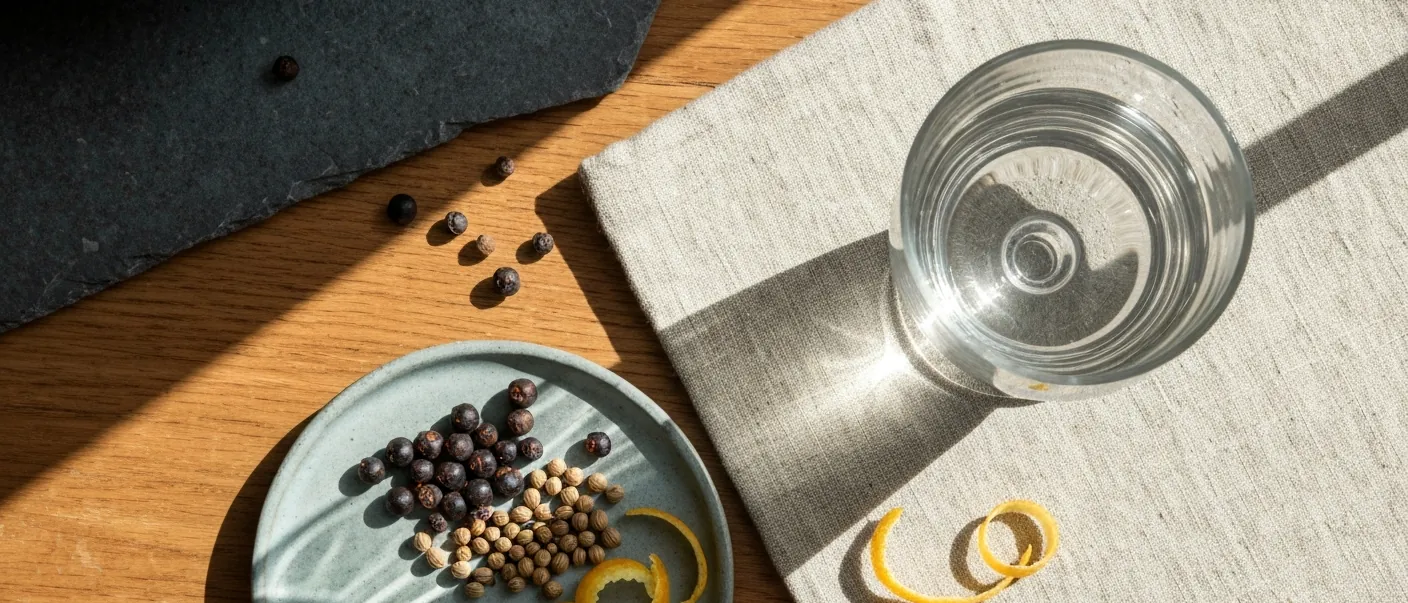
What sits beneath the juniper varies considerably. Coriander seed, angelica root and citrus peel are among the most widely used supporting botanicals, but distillers work with dozens of ingredients — some traditional, some experimental. The skill lies in building a blend where components work together rather than compete. Juniper is the thread that ties it.
Reading the bottle before you buy
The style designation is more useful than the brand name when judging what a gin will taste like. London Dry tells you the flavour is structural — distilled in rather than applied on top — and that juniper is doing genuine work. A flavoured gin may be sweeter, fruitier, built around a single dominant note. That can be exactly what you want, but it is a different product.
Independent British distillers working in the London Dry style tend to be particularly transparent about their botanical selections, often listing them on the label or their website. That openness reflects confidence in the method: when all your flavour comes from the still, you want people to understand what went into it.