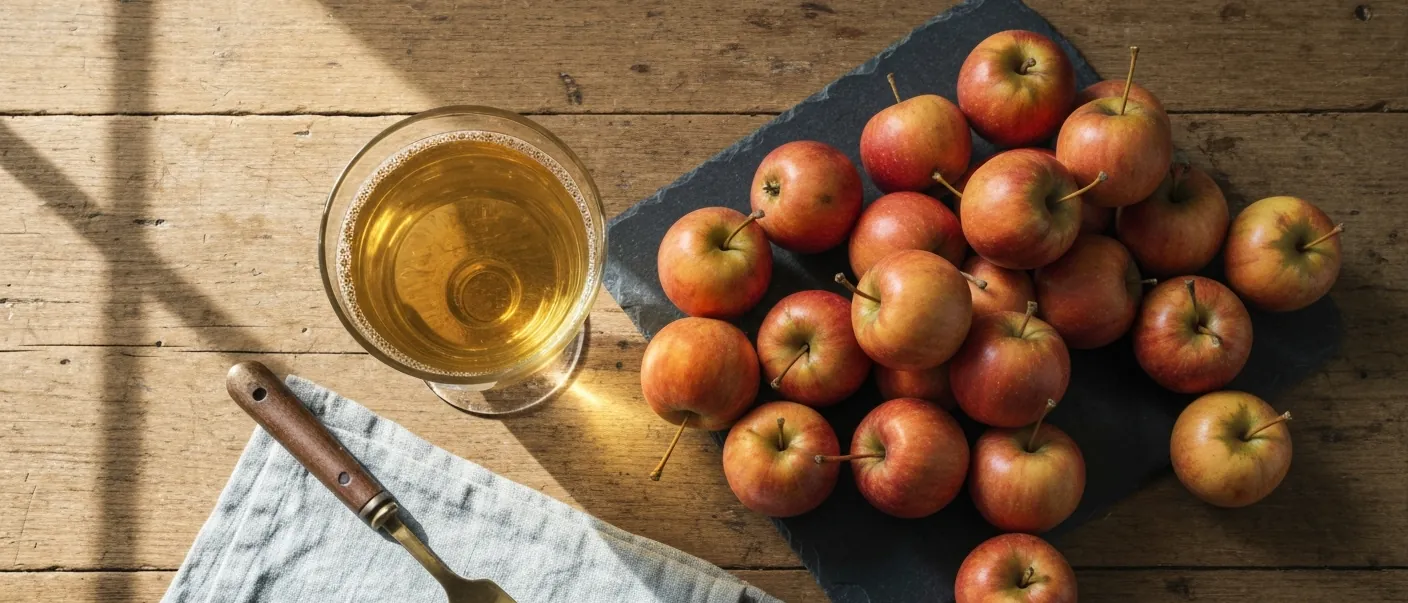
The gap between the bottle and the barn
Pick up a mainstream cider in almost any pub or supermarket and the chances are it began life not as fresh apple juice but as imported concentrate — a shelf-stable reduction reconstituted with water and fermented anywhere, regardless of season or geography. It is efficient, consistent and almost entirely disconnected from the flavour of an actual apple. Traditional cider starts with whole pressed juice from cider-apple varieties grown specifically for the purpose, and that single difference shapes everything that follows.
Cider apples are not eating apples. The varieties grown across the West Country and the Welsh borders — bittersweets, bittersharps and the occasional sharp — carry tannin levels and sugar concentrations that would make them unpleasant raw but give a well-made cider its backbone, its capacity to age and that dry, tannic finish absent from concentrate-based products. The fruit is harvested in autumn, milled to a pulp and pressed. From that point, the maker's choices begin.
Wild fermentation and what it means
Industrial cider ferments on commercial yeast strains, inoculated deliberately to work quickly and predictably. Traditional makers often do something that looks, from the outside, like nothing at all: they let the juice sit, relying on wild yeasts present on the apple skins and in the cider house to begin fermentation naturally. This is slower, less controllable and produces a more complex result. The microbial population of a Herefordshire barn or a Somerset mill room is not the same as anywhere else, and that specificity finds its way into the flavour.
Fermentation under these conditions can take weeks rather than days, after which the cider spends months maturing in vessel — traditionally large oak barrels, though many makers now use other containers — developing character gradually rather than being rushed to market. The result tends to be drier, more textured and considerably more demanding of the drinker's attention than anything produced at scale.
Keeving: the old way to natural sweetness
One technique that distinguishes traditional cider — practised by some British makers as well as those in Normandy — is keeving. It produces a naturally sweet, gently sparkling cider without adding sugar after fermentation. The process encourages a gel-like mass of proteins and pectin to form in freshly pressed juice; this rises to the surface and starves the fermenting liquid of the nutrients yeast needs to finish its work. Fermentation stalls while residual sugar remains, leaving the cider naturally sweet rather than fermented to dryness.
Keeved cider is difficult to make reliably. The juice needs fruit with the right pectin levels, the temperature must be cool enough to encourage the gel to form, and the process can fail quietly at several stages. When it works, the results are striking — a lightly sparkling, off-dry cider with genuine delicacy that sits apart from anything made by adding sweetener to a dry base.
The Three Counties and the West Country
Britain's cider traditions are concentrated in two broad regions. The West Country — Devon, Somerset, Dorset — has the highest density of traditional producers and the most deeply embedded orchard culture. Somerset is associated with the rough, deeply tannic farmhouse style: still or lightly sparkling, often aggressively dry and built for people who grew up with it rather than newcomers to the style.
The Three Counties — Herefordshire, Worcestershire and Gloucestershire — produce cider that is often a little more approachable in tannin, though no less serious in intent. The orchards here are among the most significant in England, and the region has historically supplied cider to a wide market. The named apple varieties associated with each area — some barely grown anywhere else — represent agricultural heritage as specific as any wine-grape appellation, even if they rarely receive equivalent recognition.
What connects both traditions is the insistence on whole juice, on time, and on working with the character of the fruit rather than engineering consistency around it. The ciders that result are seasonal objects: each year's harvest differs, and each year's cider reflects that. Some makers regard this as a limitation. The best ones treat it as the point.
How to approach traditional cider
Approach traditional cider as you might a natural wine: with patience and without fixed expectations about sweetness or clarity. A cloudy appearance is not a flaw. A dry, austere finish is intentional. Variation between batches is part of what you are paying for.
It is usually served at cellar temperature rather than fridge-cold, and pairs well with strong aged cheeses, cold cuts and robust, simple food — a farmhouse lunch rather than a cocktail accompaniment. Seek out producers who name their apple varieties on the label and describe their fermentation method; those details are a reasonable signal that the cider inside is the genuine article.