The same ingredients, three different outcomes
Sugar, butter, and some form of dairy. That is broadly the ingredient list for fudge, Scottish tablet, and toffee. Yet eat them side by side and you would never mistake one for another. Fudge gives under your teeth with a dense, smooth creaminess. Tablet snaps cleanly and dissolves into a coarse, intensely sweet grain on the tongue. Toffee resists everything — glassy and brittle or slow and chewy depending on how far the sugar was taken. The differences are not about flavour additions or regional flair. They are about chemistry: specifically, how sugar crystals are formed, controlled, or prevented entirely.
Temperature is the first variable
Sugar cookery is, at its core, about water. The longer a sugar syrup boils, the more water evaporates and the higher the concentration of dissolved sugar. That concentration determines what the mixture will do when it cools. Fudge and tablet are both cooked to the soft-ball stage — drop a little into cold water and it forms a pliable ball. Toffee is cooked well beyond that, to the hard-crack stage, where the same test produces a rigid, brittle thread. Almost no water remains at that point. When the toffee sets, sugar molecules lock into a glassy, amorphous structure rather than forming crystals. That is why toffee shatters rather than crumbles.
What beating does — and when you do it
Fudge and tablet share a cooking temperature, so why do they differ so sharply in texture? The answer lies in what happens after the heat goes off. Fudge is beaten vigorously as it cools. This agitation encourages crystallisation, but done at the right moment it produces very small crystals. Tiny crystals packed tightly together feel smooth; your tongue cannot detect their individual edges. The result is that characteristic melt-in-the-mouth creaminess.
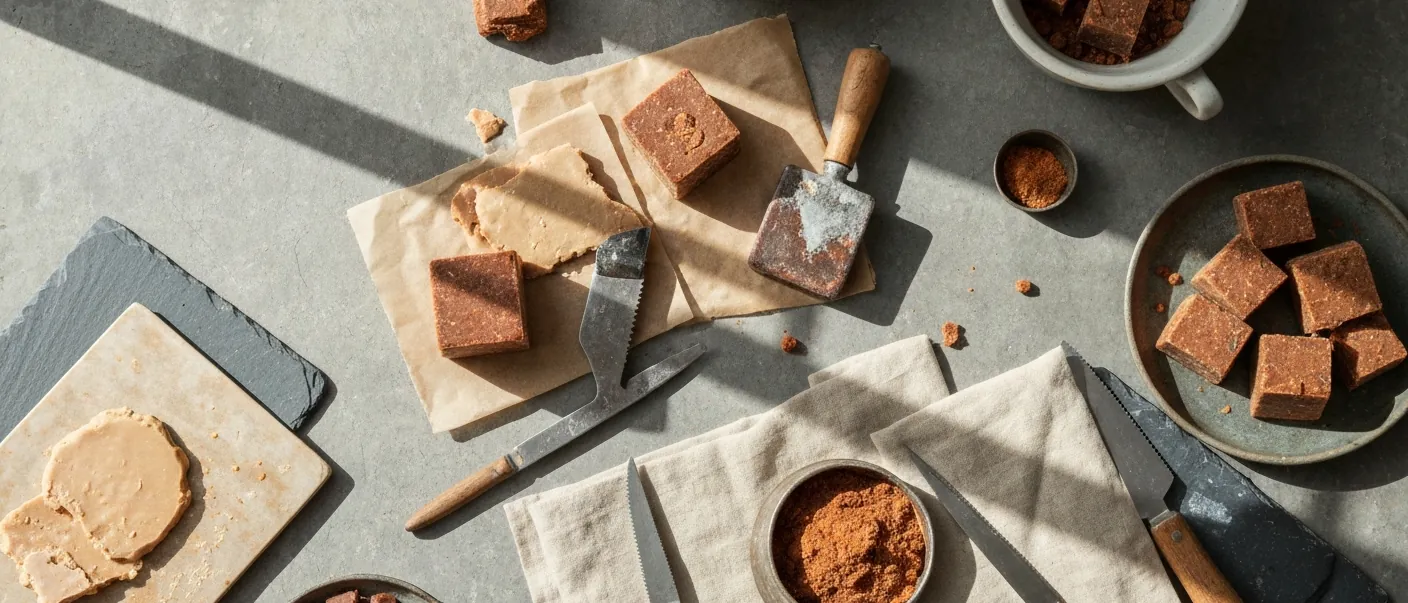
Tablet is also beaten, but the conditions differ. It contains a higher proportion of sugar and less fat, and it is beaten at a slightly different point in the cooling process. The crystals that form are larger and more distinct. That graininess is not a flaw — it is exactly what a proper tablet should be. Anyone who grew up in Scotland will tell you the slightly coarse texture is the whole point. It is a drier, more intense sweetness than fudge, holding its shape sharply rather than yielding.
Toffee, cooked to a far higher temperature, sidesteps crystallisation almost entirely. There is too little water left to facilitate an organised crystal structure. Beat it as you like; it will set hard regardless.
Tablet is not hard fudge
This is perhaps the most common misconception. Because tablet is firmer than fudge and made from similar ingredients, it is easy to assume it sits somewhere on a spectrum between the two. It does not. The textural difference is structural. Fudge's smoothness comes from a deliberate effort to produce fine crystals; tablet's graininess comes from producing coarser ones. They are not approaching the same destination by different roads — they are aiming for completely different results.
Fat content matters here too. Fudge recipes tend to use generous amounts of butter and often cream or condensed milk, which coats developing sugar crystals and limits their size. Tablet is leaner in fat relative to its sugar load, allowing larger crystals to grow. The higher sugar concentration also means tablet sets harder and snaps rather than cuts. These are not marginal differences; they are the defining characteristics of each confection.
How each is traditionally eaten
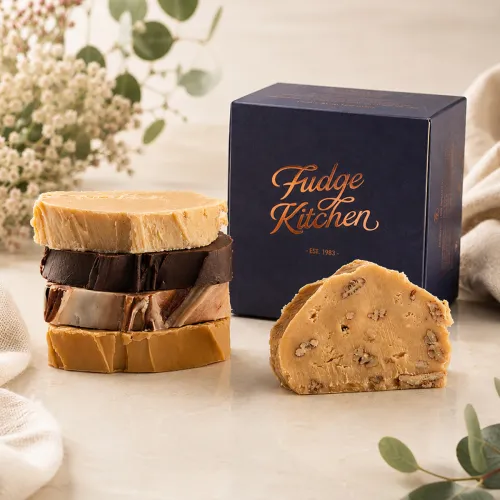
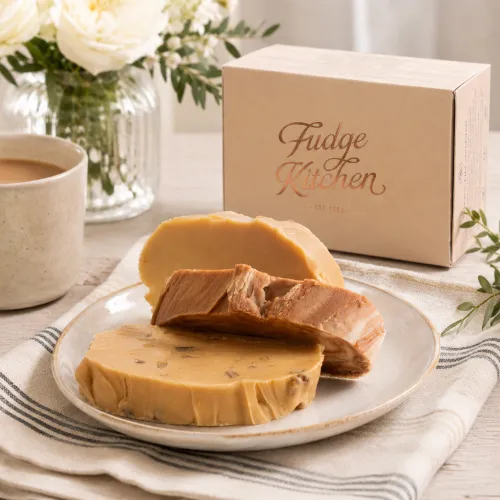
Fudge is made in thick slabs and cut into squares, soft enough to eat without effort. It is made in a wide range of flavours across Britain, from clotted cream fudge in the West Country to sea-salted varieties from smaller artisan producers. Tablet is almost exclusively associated with Scotland, sold in plain bars or flavoured with vanilla or whisky, and its correct texture is a matter of considerable regional pride. Toffee in its harder form is the stuff of bonfire night and seaside tins — made to be snapped apart and sucked slowly. Chewy toffee, cooked to a slightly lower temperature and often made with additional fat, sits between glassy brittle and something your dentist would worry about.
All three reward good ingredients. The flavour of the butter and dairy comes through clearly in confections this simple, which is why artisan versions made with local cream or high-quality cultured butter tend to taste noticeably better than mass-produced equivalents.