Global techniques, local larder
Every food culture on earth has practised fermentation — preserving, transforming and deepening flavour through microbial action. What is relatively new in Britain is the ambition of small independent producers applying Japanese, Korean and other traditions to ingredients grown on this island.
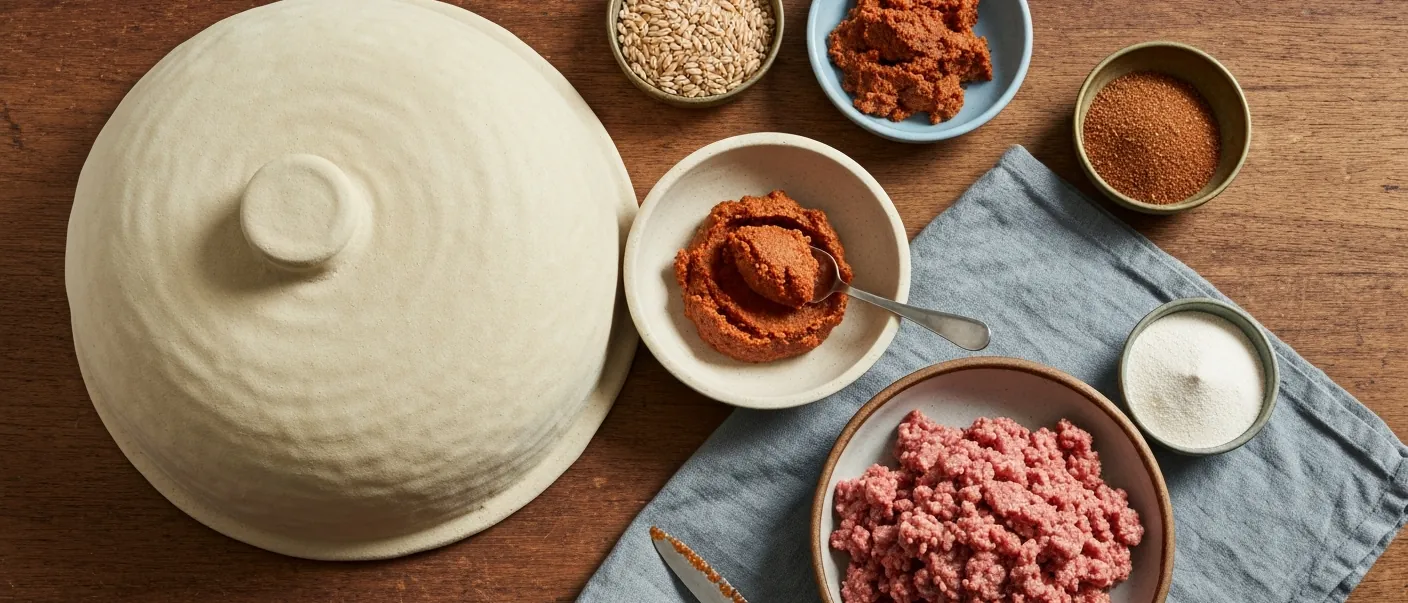
British miso is the clearest example. Traditionally made with soybeans and rice or barley in Japan, miso is, at its core, a long ferment driven by koji — a mould cultivated on grain that produces enzymes capable of breaking down proteins and starches into something savoury and complex, quite unlike the sum of its parts. A number of British producers now make miso using British-grown pulses and grains: heritage barleys, peas, fava beans. The result tastes different from Japanese miso — earthier, sometimes nuttier — because the raw ingredients are different. That is the point.
Koji itself has become a product in its own right. British producers sell koji-fermented grains and pastes to home cooks and chefs, and use them as the base for cured and aged products that sit somewhere between a traditional British potted meat and a Japanese shio koji marinade. The category is genuinely hard to classify, which is part of what makes it interesting.
Kimchi and hot sauce with a British accent
Kimchi — the Korean ferment of salted, spiced vegetables — has found enthusiastic producers across Britain. Some use imported napa cabbage and traditional gochugaru chilli, staying close to the original. Others substitute British brassicas: hispi cabbage, turnips, kohlrabi. The fermentation process is the same; the flavour shifts in subtle but real ways depending on what goes into the jar.
Fermented hot sauces have also multiplied. Fermenting chillies before blending — typically with salt, over days or weeks — produces a different kind of heat to a vinegar-heavy commercial sauce: rounder, more complex, with an acidity that comes from lactic acid bacteria rather than added vinegar. British producers are using home-grown chillies alongside imported varieties, and in some cases incorporating local aromatics — wild garlic, elderflower, hedgerow fruit — that give the sauces a distinctly regional character.
What the labels actually tell you
Two terms appear repeatedly on British fermented products, and they matter: live and unpasteurised.
Unpasteurised means the product has not been heat-treated after fermentation. Pasteurisation kills bacteria — including the lactic acid bacteria responsible for the ferment — which extends shelf life but stops fermentation entirely. An unpasteurised kimchi or hot sauce is still alive in the sense that microbial activity continues, slowly, in the jar. It needs refrigeration and will change in flavour over time, usually becoming more sour and more complex.
Live is used more loosely by producers, but generally signals the same thing: that the product contains active cultures. Some producers use it specifically to mean that the bacteria present are the strains responsible for fermentation, rather than having been reintroduced after processing. Read both terms as roughly synonymous unless the label says more.
What neither term tells you is how many active organisms are present, or whether those organisms survive digestion in meaningful quantities. The gut health claims that sometimes accompany fermented foods are a separate and more contested conversation. What is straightforwardly true is that live, unpasteurised ferments taste different — usually more interesting — than their pasteurised equivalents, and behave differently in the fridge.
How to buy and store them well
Most small-batch British ferments are sold refrigerated, either direct from the producer or through specialist food shops and farmers' markets. Because they are alive, they do not sit well at ambient temperature — treat any product on an unrefrigerated shelf with scepticism unless it has been explicitly heat-treated and labelled as such.
Once open, the pace of fermentation quickens slightly with exposure to air. A kimchi eaten within a few weeks of opening will taste brighter and fresher; the same jar left for a month or two will be sharper, funkier, better suited to cooking than eating straight. Neither state is wrong. British miso and koji pastes, being much saltier and denser, are more stable and will keep for months under refrigeration without meaningful deterioration.
Producers at farmers' markets are usually the best source of information about their own products — how long a particular batch has been fermenting, what the intended flavour profile is, whether it suits eating fresh or works better aged. That knowledge does not appear on a label.