A tale of two continents
Pick up a piece of biltong and a strip of jerky and you could be forgiven for thinking they're cousins. Both are shelf-stable, protein-dense, eaten by hand. But the processes that produce them belong to entirely different traditions, and once you understand those traditions, the difference in taste and texture stops being subtle and starts being obvious.
Biltong comes from southern Africa. Jerky is American. That geographic distance reflects a cultural one — in the methods used, the flavours sought, and the philosophy behind the cure.
How biltong is made
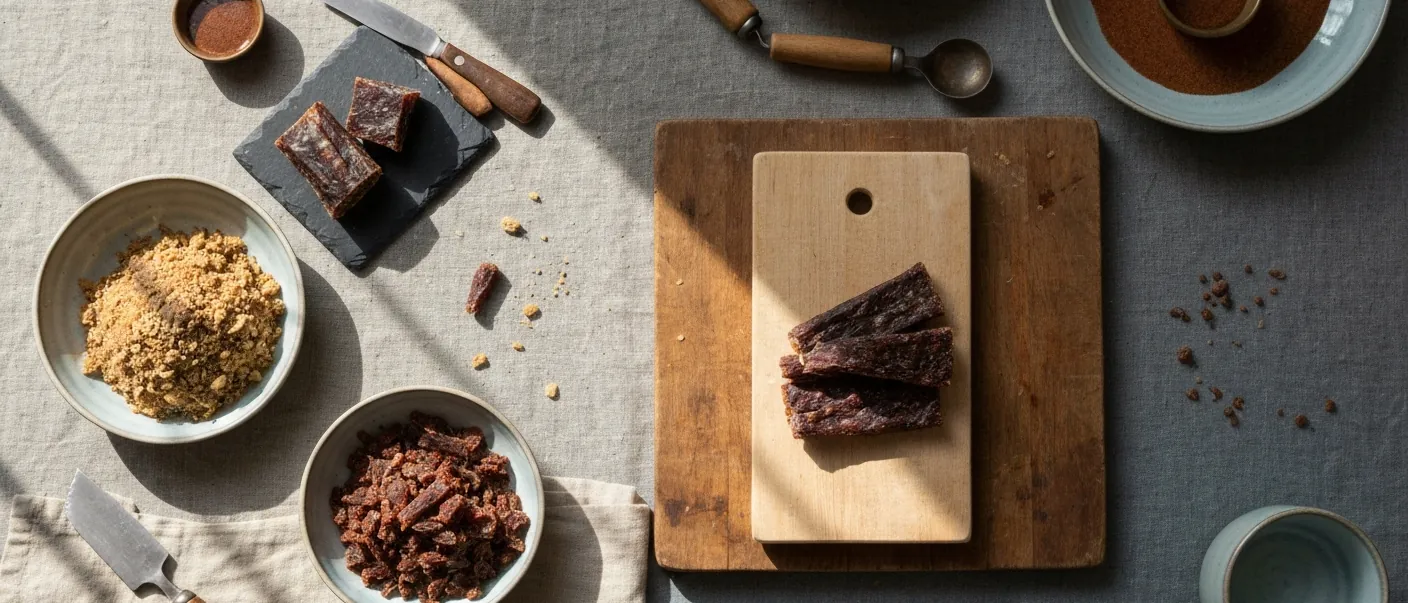
The defining move in biltong-making is the vinegar cure. Whole slabs of meat — typically beef, though game is also traditional — are soaked or doused in vinegar before drying begins. The vinegar starts to denature the surface proteins and acidifies the meat in a way that aids preservation. After that, the meat is coated in spices — coriander is almost always central, often with salt and black pepper — and hung to air-dry.
That last part matters enormously. Biltong is dried in the air, not cooked; no heat is involved in the traditional method. The meat hangs until the outside is firm and the inside reaches whatever texture the maker is after, from slightly yielding at the centre to fully dry throughout. Slicing happens only once drying is complete, which is why biltong has that distinctive cross-section — thick and meaty rather than stringy.
British producers have taken this method seriously. A number of small operations across the country now make biltong in the traditional style, using British-reared beef and keeping the process honest: vinegar, spice, air, time.
What jerky actually is
Jerky starts differently. The meat is cut into thin strips before any drying happens — already signalling a different intention. You are aiming for something uniformly light and chewy, not something with a variable interior. Those strips are then marinated, often in sweet, smoky or soy-based liquids, and cooked and dried simultaneously in an oven or dehydrator at low heat.
The cooking step is the fundamental dividing line. Jerky is a cooked product; biltong is a cured one. That distinction changes everything about how the meat tastes and feels. Jerky tends towards a firmer, drier chew with pronounced sweet or smoky notes from the marinade — the flavour is front-loaded. Biltong tastes of the meat itself, with spice and the faint sourness of the vinegar in a supporting role rather than dominating.
The texture question
This is where the difference is most felt in practice. A strip of commercial jerky can be tough — almost leathery — because the thin cut and cooking process drive out most of the moisture. Biltong sliced from a slab that has not been over-dried has softness in the middle, a give that jerky rarely achieves. Even fully dried biltong is denser and more concentrated in a different way — less fibrous, closer in character to a firm charcuterie than to dried jerky strips.
Neither texture is wrong. They are simply answers to different questions. If you want something intensely flavoured and uniformly dry, jerky makes sense. If you want something closer to a cured meat — the kind of thing you might eat alongside cheese or good bread — biltong is the more rewarding choice.
Why the distinction matters
Partly it matters because conflating the two flattens something genuinely interesting. The vinegar cure, the coriander, the air-drying — these are not arbitrary. They evolved in a specific place and climate for specific reasons and produce a specific result that deserves to be understood on its own terms.
It also matters for the buyer. If you have tried jerky and found it too sweet, too dry, or one-dimensional, that experience tells you nothing about what good biltong will be like. Biltong eaten with a cold beer, or sliced onto a board with hard cheese, is a different proposition entirely from a packet of jerky at a motorway services. Both have their place — but they are not interchangeable.