Six species, one complicated calendar
Britain is home to six wild deer species: red, roe, fallow, sika, muntjac and Chinese water deer. Each has its own character — red deer, the largest native species, yield the biggest, boldest cuts; roe are smaller and more delicate; fallow sit somewhere between the two in both size and flavour. Sika, originally from East Asia, are now well established across parts of Scotland and Ireland. Muntjac and Chinese water deer, both relatively recent arrivals, are now widespread in England, particularly in the east and Midlands.
What makes buying wild venison genuinely interesting — and occasionally confusing — is that legal open seasons differ by species, by sex, and between Scotland and England and Wales. A buck or stag shot legally in autumn may have a different season entirely from a hind taken in winter. Muntjac, whose breeding has no fixed cycle, are managed year-round in England. The upshot is that wild venison is available across much of the calendar, but availability shifts, and the cut or species on offer at any given moment depends on what the land requires. For the detail on specific open and closed windows, our game-season calendar article is the place to start.
Wild, park or farmed — the differences matter
Wild venison is culled as part of active deer management: without it, deer populations would overshoot their habitat's capacity, causing serious damage to forestry, farmland and biodiversity. The deer live entirely free, eating what the land provides, and that diet — heather, grass, woodland browse — gives the meat its depth. There is no feed conversion, no housing, no routine medication. From an environmental standpoint, it is hard to argue with.
Park deer occupy an interesting middle ground. Animals in enclosed deer parks are wild in behaviour and diet but managed more intensively, with some estates providing supplementary feed in hard winters. The meat tends to be consistent and reliably available, which is why it appears frequently in premium retail.
Farmed venison — usually red deer on enclosed hill farms — is reared much as any livestock, with scheduled feeding and predictable slaughter weights. The result is a milder, more uniformly textured product, less variable than wild, and available throughout the year. None of these is a lesser choice; they simply suit different purposes and different budgets.
Understanding the cuts
Venison's defining characteristic as a meat is that it carries very little fat. That single fact shapes every decision about how to cook it.
The haunch — the hind leg — is the most versatile of the larger cuts, suited to roasting at high heat or, when taken off the bone and diced, to slow braises. The saddle and loin are the prized quick-cook cuts: the loin especially, sliced into medallions or left as a rack, is lean, fine-grained and best served pink. The shoulder rewards patience — long, slow cooking in liquid, where the connective tissue has time to soften. It is one of the most flavoursome cuts on the animal, precisely because it has worked hard.
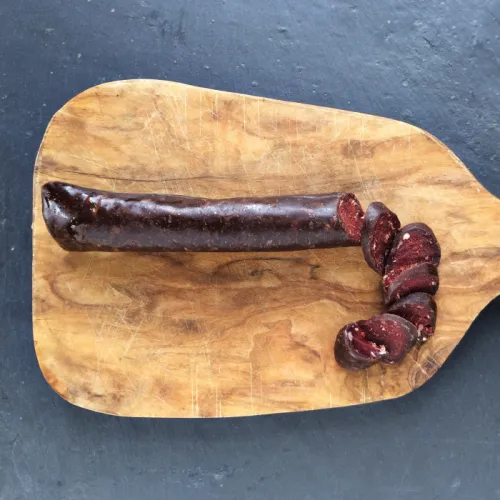
Beyond the prime joints, venison mince and sausages are increasingly easy to find, and both offer an approachable way into the meat if you are unfamiliar with it. Good venison sausages often include a proportion of pork fat to counteract the leanness — worth checking when you buy, particularly if that matters to you.
The logic of classic pairings
The flavour combinations that appear again and again with venison — juniper, red wine, redcurrant jelly, rowan jelly — are not arbitrary tradition. They work because venison's iron-rich, slightly gamey depth needs an acidic or aromatic counterpoint to keep it from feeling heavy. Juniper brings a resinous lift that echoes the deer's woodland diet. Red wine, reduced into a sauce, adds tannin and body. The sharp sweetness of redcurrant or rowan cuts through the richness of the braising liquid and balances the meat's earthiness. We cover rowan and redcurrant jellies in more detail in a separate article on classic game accompaniments.
The one principle worth keeping in mind is that venison's low fat content means it can dry out quickly if treated carelessly. Quick-cook cuts need fierce, brief heat and a generous rest. Slow-cook cuts need the opposite — low heat, plenty of liquid and time. There is not much middle ground.
Buying wild venison well
A good butcher or game dealer who can tell you the species, the sex and the rough area the animal came from is worth finding and keeping. This information is not just interesting — it tells you something about the likely flavour and texture of what you are buying. Red deer from open Scottish hillside will eat and cook differently from a fallow deer from lowland English woodland.
Wild venison is increasingly available through farmers' markets, independent butchers and specialist online suppliers, often frozen. Freezing immediately after hanging is standard practice and does not diminish quality. If you are buying fresh, check that the meat is a deep burgundy-red, not brown, and that the smell is clean rather than sour. The best wild venison smells of the outdoors — a quality that becomes rather more appealing once you understand exactly where it came from.