The blackthorn's own timetable
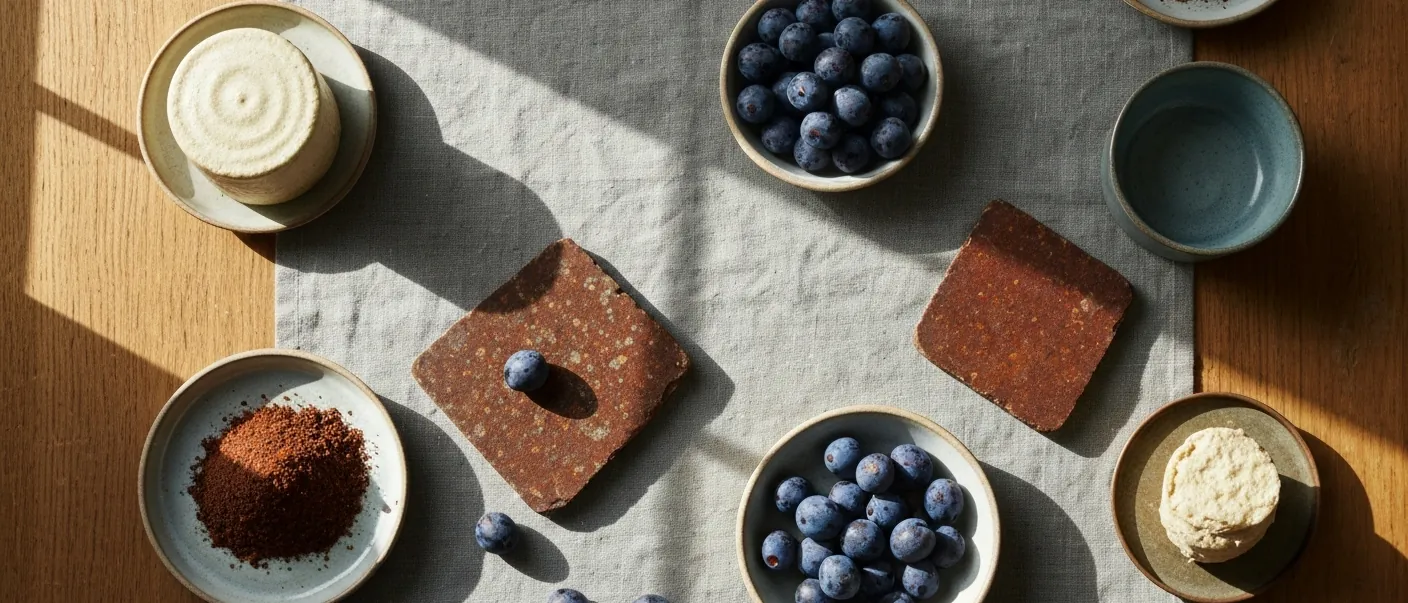
Blackthorn does everything backwards. It flowers in late winter before a single leaf has appeared — white blossom on bare black stems against a grey sky. Then it spends the rest of the year quietly making fruit. The sloes appear through summer as tight, dusty-blue spheres, easy to spot but impossible to use. At that point they are extraordinarily astringent — the kind of bitter that makes your mouth pucker as though it's trying to close itself off entirely.
The transformation happens slowly through autumn. As temperatures drop and the hedgerows lose their green, the sloes soften fractionally and their harshness begins to recede. They're still not sweet — they never will be. But the dark, almost plummy depth underneath becomes accessible.
Why the frost matters
The old rule — wait until after the first frost — has survived because it is genuinely useful. A hard frost breaks down the skin of the fruit and begins to soften the flesh, releasing more juice and making the skins more permeable. For sloe gin, that permeability is everything: the spirit needs to draw flavour through those tough little skins, and frost gives it a head start.
The difficulty is that the first frost has become less predictable. In a mild autumn it might not arrive until well into November, by which point birds will have stripped many of the best hedgerows. In a sharp autumn it can come in October. Experienced pickers read the fruit rather than the calendar. A ripe sloe should give slightly under your thumbnail, the dusty bloom still intact, the flesh darkening to a deep blue-black rather than the brighter, harder blue-purple of an unripe berry.
If you pick before frost arrives — or if you're working with fruit from a sheltered spot that frost tends to miss — freeze the sloes yourself. A night or two in the freezer replicates the effect well enough. It's not cheating; it's applied common sense.
Where to look, and how to pick
Blackthorn grows along old field boundaries, chalk downland edges, coastal scrub and the margins of ancient woodland. It's a dense, thorned shrub inclined to form impenetrable thickets, which means the fruit on the outer branches is usually easiest to reach. Those thorns are serious — stout gloves and long sleeves are not optional, particularly once you're working into the interior of a bush.
The fruit clusters along the previous year's wood, so a branch that bore heavily one season may offer less the next. A hedge that looks sparse in a good picking year probably gave generously the year before.
Bring a wide, shallow container rather than a deep bag. Sloes bruise, and bruised fruit ferments unpredictably in the bottle. If you're picking for gin, condition matters.
The long game of sloe gin
Sloe gin is not a quick project. The fruit goes into the bottle in autumn — with sugar and a decent gin, proportions adjusted to taste over the weeks — and then it waits. The steeping takes months, and most makers find the liqueur isn't at its best until the following autumn at the earliest. The sloes you pick this year are for drinking next year. That delay is the whole point: it demands an engagement with seasonal time that most food production has abandoned.
Commercially made sloe gin can be genuinely good, but it rarely captures the variation that comes from fruit picked in a specific place in a specific year. A cold, dry autumn produces different sloes than a wet, mild one. That specificity — the particular bitterness of a particular hedgerow — is what home-made sloe gin carries in a way that scaled production simply cannot.
Beyond the bottle
Sloe gin is the obvious destination for the harvest, but not the only one. Sloe jelly, made with crab apples to supply the pectin that sloes lack, is sharp and deeply coloured — good with cold lamb or strong cheese. The fruit has also been used to flavour vinegar and, in some traditions, to make a simple country wine.
Whatever the end use, the principle stays the same: the sloe gives on its own terms. Pick too early and nothing works. Rush the steeping and the result is thin. The season runs to the blackthorn's schedule, not yours — and the fruit is better for it.