The month that rewards patience
November is the season that punishes cooks who only shop by colour. The hedgerows are bare and the salad days are firmly over, but what remains is some of the most flavoursome produce of the year. Cold nights concentrate sugars in roots and brassicas, game is at its most plentiful, and the storecupboard starts to earn its keep. This is the month to cook low, slow, and with purpose.
Roots, brassicas, and the frost effect
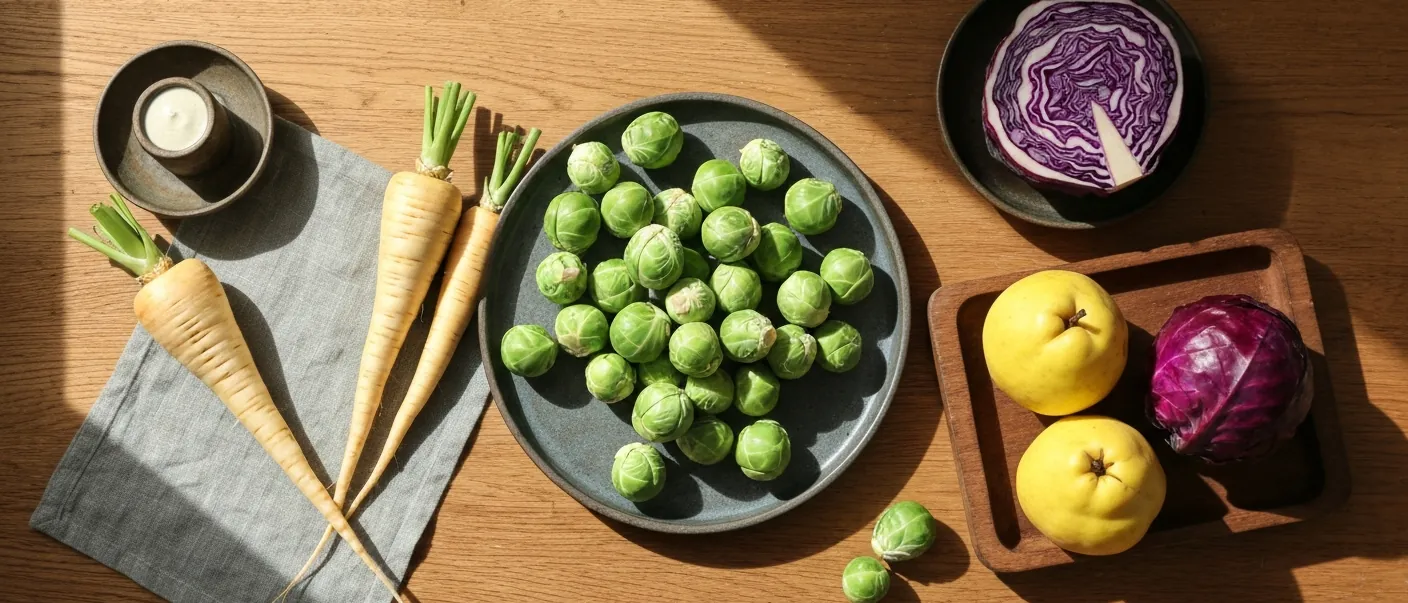
Parsnips, celeriac, beetroot, turnips, swede — these are November's engine room. Parsnips in particular come into their own once the ground has had a cold snap; the chill converts some of their starches to sugar, which is why a hard frost is considered good news by anyone who grows them. The same principle applies to Brussels sprouts, which have a reputation built almost entirely on being eaten before they're ready. Picked after frost, a properly grown sprout is nutty and sweet rather than sulphurous. If yours are travelling a short distance from field to pot, the difference is noticeable.
Cauliflower and kale are both holding strong. Cavolo nero, in particular, seems almost designed for November cooking — the leaves toughen up in cold weather rather than wilting, and they take well to long, gentle heat. Red cabbage is another staple of the month, braised slowly with apple and spice in the way British cooks have done for generations.
Game in full swing
Britain's game season is in full stride through November. Pheasant is the most widely available, sold through butchers, farm shops, and a growing number of online suppliers, often as a brace. Partridge, woodcock, and teal are also in season for those who seek them out. Game is genuinely sustainable protein — low food miles, no intensive rearing — and it suits the kind of cooking November calls for: braises, roasts, slow-cooked pots with root vegetables and a splash of something robust.
If you haven't cooked pheasant before, the main thing to understand is that it is a lean bird and dries out quickly over high heat. Low and slow, or a quick roast with plenty of fat and a watchful eye, are both reliable approaches. Most good butchers will be happy to advise on hanging time and preparation.
Stored fruit and the last of the quinces
The apple and pear harvest is over, but well-stored varieties keep for weeks into winter. Cox, Russet, and Bramley apples are all still on shelves and worth buying. British-grown Conference and Comice pears are also available from cold storage, and they're worth choosing over imported alternatives at this time of year.
Quinces are the fruit that most people associate with October, but they linger into November if you know where to look. Hard, fragrant, and inedible raw, they transform dramatically with heat — turning from pale yellow to a deep, burnished rose. They appear in farm shops, some greengrocers, and occasionally at farmers' markets; once spotted, they're worth buying in quantity. They keep well and they pair naturally with lamb, pork, and membrillo-style preserves.
Forced chicory — the pale, tightly furled kind grown in darkness to remove bitterness — starts to appear properly in November. It has a clean, slightly bitter edge that cuts through the richness of this month's cooking well, and it's one of the few genuinely crisp things available in a season otherwise given over to soft, cooked textures.
Stir-up Sunday and the storecupboard
The last Sunday before Advent is known as Stir-up Sunday — the traditional day for making Christmas pudding, a date that has been observed in British households for well over a century. The timing isn't arbitrary: a Christmas pudding needs weeks to mature, its flavours deepening as the dried fruit, spice, and alcohol settle together. Making it now rather than in a panic in December makes a genuine difference to the result.
It is also the moment to check the storecupboard more broadly. Dried fruits, nuts, spices, good stock — November is when these things start to matter. A well-stocked larder carries you through the weeks ahead with considerably less stress than the alternative.
_cd5y-ai_pngq80.webp)