The hungry gap, briefly explained
From roughly January through to late April, British growers face what's long been called the hungry gap: the point in the year when winter stores are exhausted and spring crops haven't yet arrived. It's a genuine low point for anyone trying to eat well from these islands. May ends it. Not dramatically, not all at once, but unmistakably — the market stalls start to look different, and the quality of what's on them shifts upward fast.
Understanding the gap makes May taste better. What arrives now doesn't just arrive; it arrives after a wait.
Asparagus, the crop that defines the month
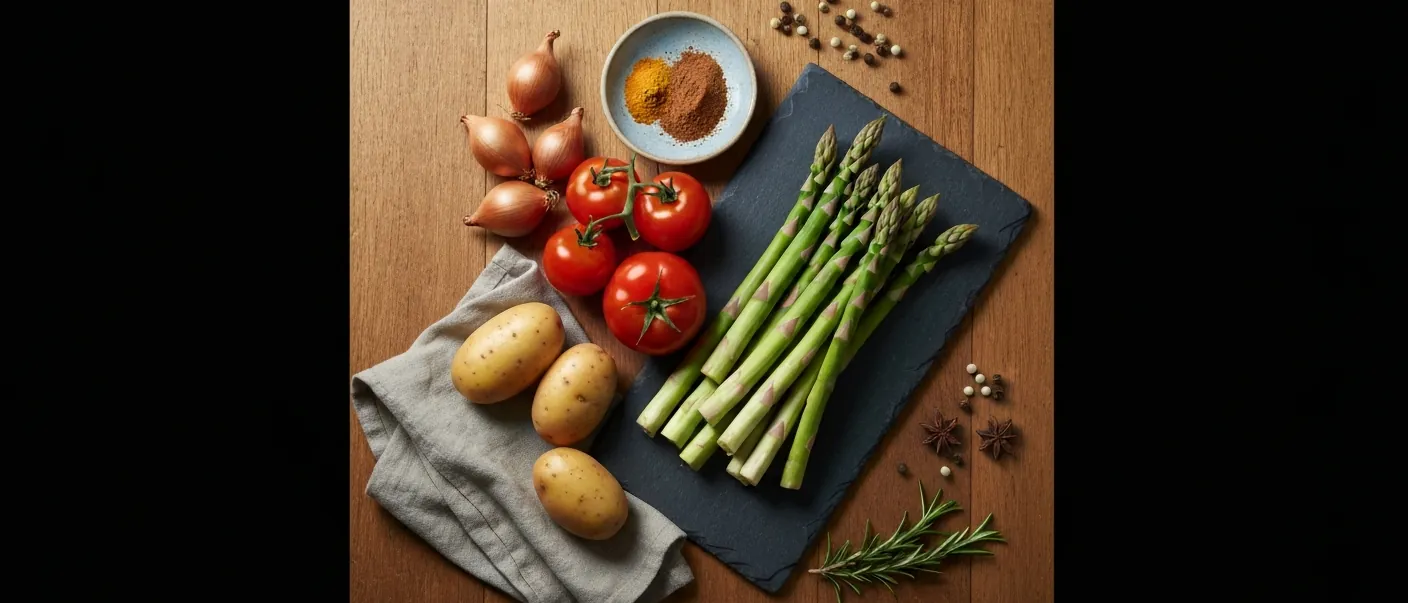
No British ingredient is more closely tied to a single season than asparagus, and May is its moment. The harvest typically runs from late April into June, but May is when the beds are producing at full pace. British asparagus has a particular character — earthier and more mineral than much of what's imported during the rest of the year — and that difference is most pronounced when the spears are very fresh, ideally cut the same day they're sold.
The classic approach is also the right one: eaten simply, with good butter or a soft-boiled egg alongside. The point is the asparagus itself, not what's done to it. Look for firm, tightly closed tips and cut ends that haven't dried out. A stall or farm shop close to where it's grown will almost always beat a supermarket for freshness, and in May, freshness is everything.
New potatoes worth travelling for
Jersey Royals are perhaps the most specific thing on this list — a variety grown only in Jersey, shaped by the island's granite-rich soil and the vraic seaweed traditionally used to fertilise the fields. That combination gives them their particular sweetness and a thin, flaking skin that doesn't need peeling. They arrive in the shops from spring onwards, and May tends to be the month when supply is most reliable and the flavour most concentrated.
Pembrokeshire earlies are the mainland equivalent — grown along the south-west Welsh coast, where the mild maritime climate lets growers get a head start on the season. They're less celebrated than Jerseys but worth seeking out if you're buying at a Welsh farmers' market or from a Welsh supplier. Both varieties reward being eaten while very fresh, dressed simply and served warm.
Elderflower and the first strawberries
Towards the end of May, elder trees begin to flower across hedgerows, roadsides and woodland edges throughout Britain. The flowers are short-lived — a matter of weeks — and their season varies depending on how warm the spring has been, so it pays to keep an eye on local hedgerows rather than assuming a fixed date. The flavour is floral without being perfumed, delicate in a way that dries out quickly once the flowers are picked. Cordial made from fresh elderflower heads is the most common use, though the flowers also appear in fritters, lemonades and light desserts. Small-batch producers often release their elderflower products in late spring; if you find a good one, it's worth stocking up.
The first British strawberries also appear in May, though usually from protected growing — polytunnels or glasshouses rather than open fields. Open-field strawberries come later, typically from June. Early-season fruit grown under cover tends to be less intensely sweet than the height-of-summer crop, but the gap in quality between these and imported fruit sold throughout the year is still significant. If you find a pick-your-own that's opened early, or a farm shop selling local fruit from polytunnel beds, it's worth a visit.
Spring herbs and what to do with them
May is also the point at which soft herbs hit their stride. Chives, chervil, tarragon and flat-leaf parsley are all growing strongly, and many of these are available from specialist growers, kitchen garden nurseries or simply from pots on a windowsill. Fresh herbs at this time of year have a brightness that dried or imported equivalents rarely match — chervil in particular, which loses its anise edge very quickly after cutting and is almost never worth buying unless it's genuinely fresh.
These herbs work naturally alongside the other produce of the month. Chives with new potatoes, tarragon with asparagus, chervil scattered over a simple salad. The combinations suggest themselves partly because they all arrive together, and there's usually a good reason for that.