Why these two belong to the fifth
Bonfire Night has its own larder. Parkin — that dense, gingered oat cake with its own regional traditions (covered in our separate piece) — sits on the table indoors. Outside, round the fire, the sweets are treacle toffee and toffee apples. Both involve boiling sugar to a precise physical state, and both taste like almost nothing else across the rest of the year. That seasonal confinement is part of what makes them feel significant.
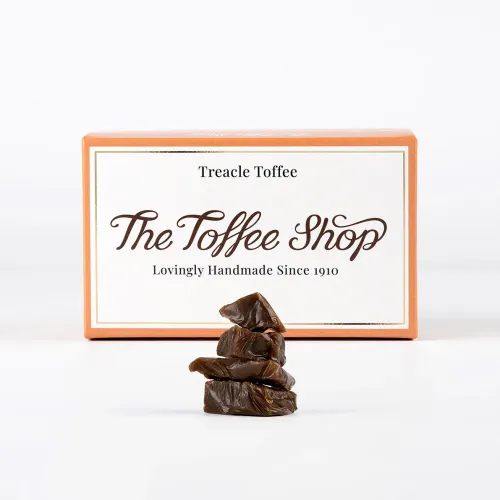
Treacle toffee is dark, hard, and faintly bitter. Where most toffees are golden and yielding, bonfire toffee is almost black — the colour of wet coal — and shatters rather than bends. The traditional way to serve it is in shards, cracked from a set tray with a hammer or the back of a spoon. Toffee apples are its bright counterpart: a small, firm apple on a stick, dipped in hard sugar syrup, often dyed a deep red that catches the firelight.
The science behind hard crack
Both sweets depend on reaching what confectioners call the hard-crack stage — the point at which nearly all the water has been driven out of a boiling sugar syrup and the remaining mass sets rigid and glass-like as it cools. Fall short of that and you get something that looks like toffee but behaves like adhesive: sticky, chewy, and liable to pull fillings out. The difference between a successful batch and a failed one is almost entirely a matter of how far the sugar was taken.
Sugar passes through distinct stages as it concentrates — thread, soft ball, firm ball, hard ball, soft crack, and finally hard crack — each reflecting how much water remains and how the sugar will behave once cool. Treacle toffee and toffee apple coatings both need to reach that final stage to achieve the brittle, snapping texture that defines them. Our piece on sugar work covers those stages in detail; the particular character that black treacle and golden syrup bring to boiled confections is covered in the articles on each of those ingredients.
Black treacle is what separates bonfire toffee from every other toffee on the shelf. It contributes a deep, slightly sulphurous bitterness — intensely savoury at the edges — that cuts through the sweetness in a way golden syrup alone cannot, producing something genuinely complex rather than simply sweet.
Choosing the right apple
For toffee apples, the fruit matters as much as the syrup. Small apples are important: a large apple is unwieldy and heavy for the stick to support. Firm flesh is essential because a soft apple bruises on handling and the coating separates from any surface that gives. Tart varieties work better than sweet ones — the sharpness of the fruit against the brittle coating is the whole point of the contrast. A dessert apple that is already sweet and soft produces something cloying.
The most overlooked factor is the skin. The coating must grip the apple, and it will only do so on a completely dry, grease-free surface. Any wax coating or residual moisture gives the toffee nothing to hold onto, and the result slides or pools at the base. Washing the apples and drying them thoroughly — leaving them in the air until the skin feels matt rather than slick — makes a real difference to how cleanly the coating sets.
Storing treacle toffee
Set treacle toffee is hygroscopic: it draws moisture from the air. Left uncovered, it will gradually soften from glassy to tacky — not a safety concern, but a textural disappointment after the effort of making it. Store it in an airtight tin with greaseproof paper between layers to prevent the shards fusing together. Toffee apples are a different matter; the apple begins to sweat beneath the coating almost immediately, so make them and eat them the same day.
Bonfire toffee goes by different names in different parts of the north of England and beyond — the names vary enough by locality that no single one can be called standard. The sweet itself is consistent even where the language is not.
The place they hold
Neither treacle toffee nor toffee apples are complicated in concept. What they demand is attention — to the state of the sugar, to the condition of the fruit. That attentiveness is probably why making them still feels like a considered act rather than an afterthought. Along with parkin, they form a trio that belongs specifically to early November in a way that resists the year-round supermarket shelf, and that specificity is worth preserving.