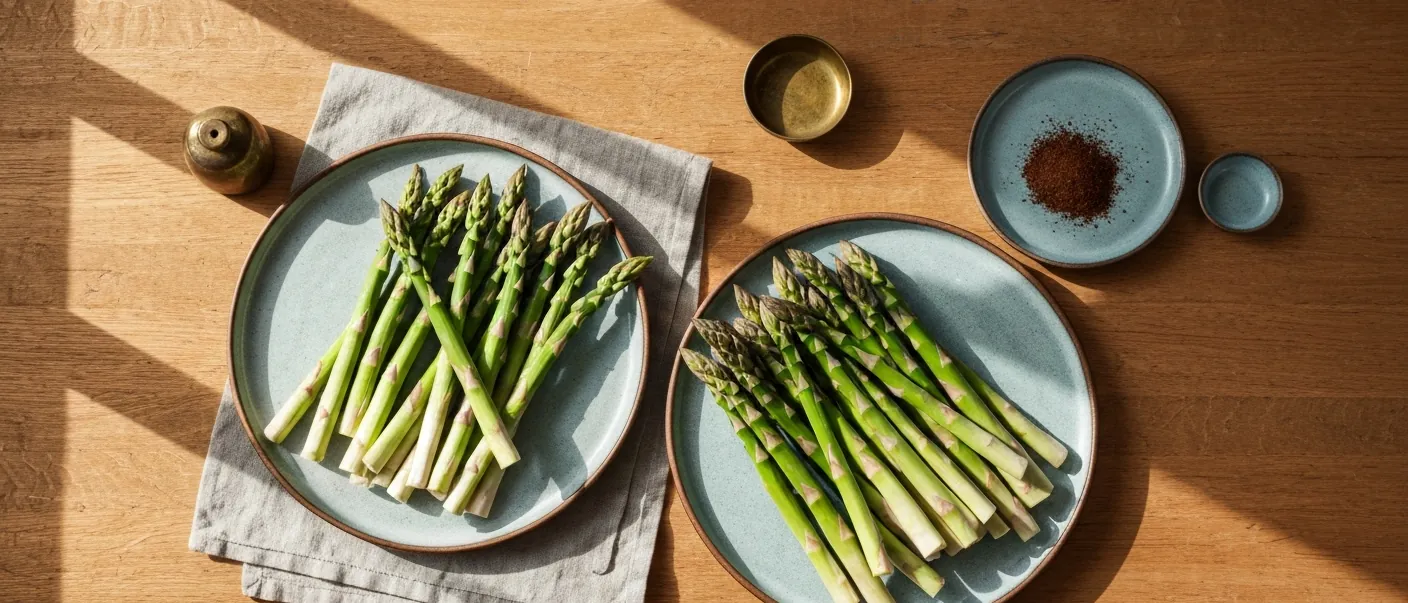
Why the dates matter
The British asparagus season runs, by tradition, from the 23rd of April — St George's Day — to Midsummer Day on the 24th of June. Roughly eight weeks. Not eight months, not a rolling year-round supply flown in from Peru or Morocco. Eight weeks, and then it's over.
Those fixed points are not arbitrary. They reflect something practical about how asparagus grows and what the plant needs to survive long-term. Growers who respect the traditional cut-off are protecting next year's harvest, not performing nostalgia.
What happens underground
Asparagus is a perennial crop, grown from root structures called crowns that can, if well tended, produce for two decades or more. Every spear cut represents energy the crown has spent. Allow the plant to keep sending up shoots indefinitely and you exhaust it; the following season's yield will be thin and the crowns weakened.
Once the harvest window closes, the spears that emerge are left to grow into the feathery foliage visible in fields through late summer. That fern-like growth is the plant photosynthesising, building reserves it needs to push through again in spring. Cut too late and you rob it of recovery time. The traditional Midsummer cut-off is essentially enforced, deliberate rest — and growers who want their beds to last observe it.
Freshness that air freight cannot replicate
Asparagus begins converting its sugars to starch the moment it is cut. Within twenty-four hours at ambient temperature, a spear that tasted sweet and tender at harvest has lost a noticeable amount of that quality. Within a few days, the difference between a freshly cut British spear and one that has travelled across a continent becomes obvious on the plate.
British-grown asparagus bought from a farm shop, a good greengrocer, or a farmers' market can realistically have been cut that morning. That is simply not possible with air-freighted imports, however carefully handled. The cold chain slows deterioration but does not stop it. Proximity wins every time. Growing regions in the Vale of Evesham, the sandy soils of East Anglia, and parts of Lincolnshire and Hampshire are well placed to get spears to market fast.
Soil type matters too. Asparagus prefers free-draining, sandy ground, and Britain has stretches of it well suited to producing spears with the sweetness and snap that make the vegetable worth the fuss. The terroir — to borrow the word from wine — is real.
How to make the most of it
Because the window is short, there is no such thing as a casual week spent meaning to get around to it. If you see good spears, buy them and eat them soon — ideally the same day.
Traditionally, British asparagus is eaten simply: steamed or briefly boiled until just tender, then served with butter, hollandaise, or a soft-boiled egg. The spear should still have a little resistance at the stem end. Over-cooking is the one reliable way to undo what the grower spent months achieving.
Thicker spears and thinner ones behave differently. Thicker stems tend to come from more mature crowns and carry a robust, earthy flavour; the thinner ones — sometimes called sprue — are more delicate and cook faster. Neither is inferior; they suit different dishes.
Eating seasonally, actually
Seasonal eating can sound like an instruction or a lifestyle position. With British asparagus it is neither — it is the logical response to a vegetable that is measurably better within its natural window and unavailable from British soil at any other point in the year.
The season's brevity is part of what gives it weight. A food that arrives in late April and is gone by late June concentrates attention. You notice it, plan around it, look forward to it. That rhythm — anticipation, enjoyment, absence — is something year-round imported produce cannot replicate.
When the season closes and the fields are left to fern, there is something satisfying about knowing the land is resting too.