Why February matters
The period from mid-winter to early spring has long been known as the hungry gap — that difficult stretch when last autumn's stored crops are spent and new-season growth is barely underway. For anyone trying to eat British produce, it's a genuine problem. Purple sprouting broccoli is the exception.
From roughly February through to April, it comes into its own. The plant overwinters in the ground, enduring frosts that would flatten most brassicas, and it's precisely that cold exposure that draws sugars into the stems and florets. What emerges in late winter is noticeably sweeter and more complex than the heading broccoli — the tight, pale-green domes — that sits on supermarket shelves year-round.
A different thing entirely
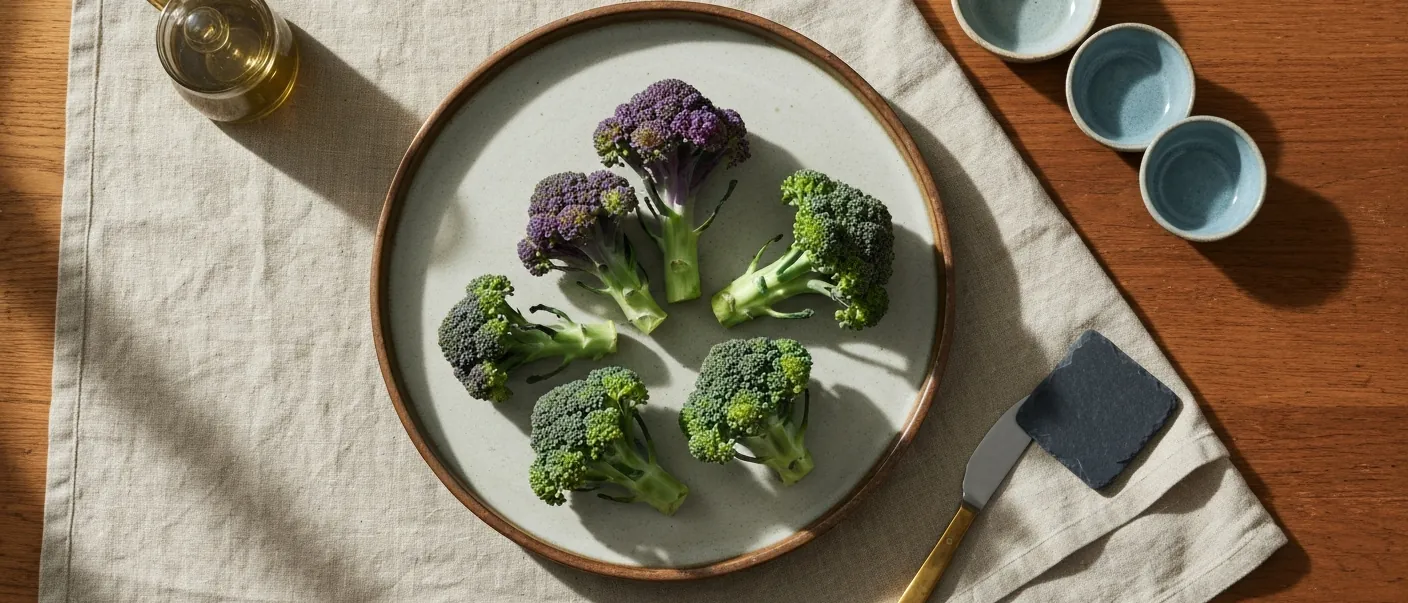
Purple sprouting broccoli and its year-round supermarket cousin share a family name and not much else. The sprouting variety sends up multiple loose stems, each topped with a small, deep-purple or violet floret, harvested by hand over several weeks as each new shoot matures. That repeated picking is part of why it's relatively rare in large-scale retail — it doesn't lend itself to the single-cut, mechanised harvest that makes year-round broccoli economically straightforward.
The colour largely disappears with heat. Raw, the stems are a striking blue-purple; cooked, they turn the same dark green as any other brassica. The flavour survives, though. There's an earthiness that holds up well, and the stems — worth eating, not discarding — have a slightly different texture to the florets: more substantial, almost asparagus-like.
What to look for at the shops
Fresh purple sprouting broccoli should have firm, straight stems that snap rather than bend, and florets tightly furled with no yellowing at the edges. Any hint of flowering — tiny yellow buds opening out — means the plant has bolted and the flavour will be sharper and more sulphurous. Yellowing is the single most reliable sign of age.
Farm shops and weekly markets are usually the best places to find it during the season, often cut that morning or the day before. Independent greengrocers tend to carry it more reliably than supermarkets, and when they do, the quality is generally better — faster turnover, shorter supply chains. If you're buying from a market stall, ask when it was picked; growers selling their own produce will usually know exactly.
The British growing tradition
Purple sprouting broccoli suits the British climate in a way that many brassicas do not. The south-west and parts of Wales have particularly strong traditions of growing it, where mild, wet winters allow plants to overwinter without the ground freezing solid for extended periods. It's grown across much of England too, and the range of the season — February in milder years, stretching into April in cooler ones — reflects how much regional and annual variation shapes the British growing calendar.
There's something satisfying about a vegetable defined by its resistance to the worst of winter. It asks nothing of the grower beyond patience, and it rewards the cook with produce already seasoned by the weather.
How it's traditionally eaten
At its simplest, purple sprouting broccoli needs very little intervention. The British habit of briefly boiling or steaming it and serving it with butter is not unsophisticated — it's an acknowledgement that the flavour needs no gilding. The stems and florets cook at slightly different rates, so it's worth paying attention rather than walking away from the pan.
It also has a long association with strongly flavoured accompaniments: anchovies, aged hard cheeses, good olive oil, chilli. These aren't there to mask the brassica; they're there because the sweetness of frost-kissed stems is robust enough to stand up to something assertive alongside it. A vegetable that rewards bold thinking, without requiring it.