Where the rule comes from
The idea that you should only eat oysters in months containing the letter R — September through to April — has been around long enough to feel like superstition. It isn't. For the native flat oyster, Ostrea edulis, those summer months are when spawning happens. The animal devotes its energy to reproduction, its flesh turns soft and milky, and the flavour suffers noticeably. Eating them then isn't dangerous so much as disappointing, and it puts pressure on stocks that are already fragile across much of the British coastline.
The rule also carried a practical food-safety logic before refrigeration existed. Warm weather, slow transport, no cold chain — an oyster past its best could do real harm. That particular concern has largely been engineered away by modern handling, but the seasonal biology hasn't changed at all.
Native versus rock
The oyster you're most likely to encounter in a supermarket or at a fishmonger's outside the R months is the Pacific rock oyster, Crassostrea gigas. It was introduced to British waters as a farmed species and is now cultivated widely around the coast, from the Helford river in Cornwall to the sea lochs of Scotland. Rock oysters spawn in warmer water than our summers reliably provide, which means they remain firm and marketable through July and August without any meaningful welfare or flavour compromise.
This distinction matters more than most people realise. When a menu or a fishmonger simply says "oyster" in midsummer, it will almost always be a rock oyster — and there's nothing wrong with that. But if you're seeking the rounder, more mineral, intensely saline flavour of a native flat, you will need to wait. The two species are genuinely different eating experiences, not interchangeable options at different price points.
What makes a native worth the wait
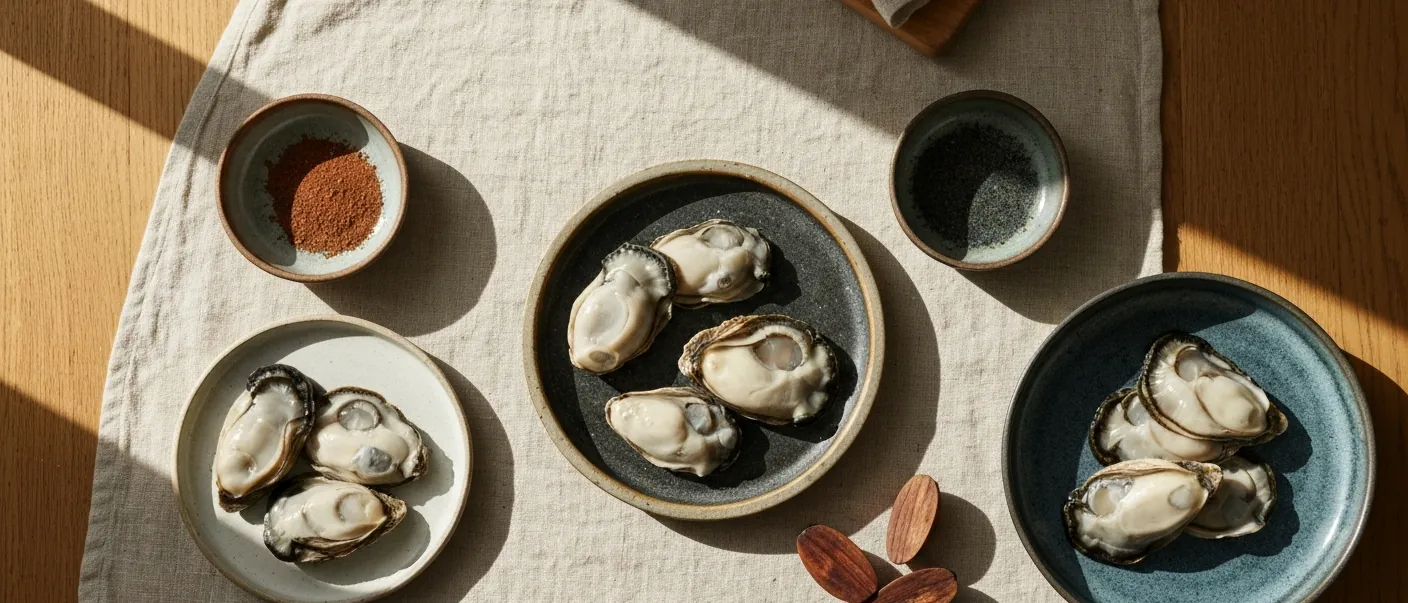
Native flat oysters have a complexity that's harder to pin down than the cleaner brine of a rock oyster. Depending on where they've grown — the particular estuary, the depth, the tidal flow — they can carry notes of copper, seaweed, or a faint sweetness that lingers after the initial salinity. The shell is flat and almost circular, quite different from the deeply cupped, jagged rock oyster. Traditionally they're eaten raw, with nothing more than a squeeze of lemon or a little shallot vinegar, because the point is the flavour of a specific place expressed through a single shellfish.
Populations of native oysters in British waters have declined significantly over the past century due to a combination of overfishing, disease, and habitat loss. Several conservation and restoration projects are working to rebuild them in estuaries around England and Wales, which is part of why the seasonal protection still carries real weight — it isn't just tradition preserving a preference, it's a closed season protecting a genuinely vulnerable species.
How to think about the season
September is the traditional opening of the native oyster season, and in some parts of the country it's marked with local festivals and ceremonial first tastings — check what's happening near you in early autumn, as dates vary each year. The best of the season, many would argue, runs from October through to February, when the water is cold and the oysters have had time to recover condition after spawning.
Rock oysters don't require the same consideration, but they too have a rhythm. Cold water produces firmer, more flavourful shellfish, and a rock oyster eaten in January from a well-managed Scottish loch will often outperform one from the same source in August. Year-round availability doesn't mean year-round uniformity.
Whether you're buying from a fishmonger, ordering at a restaurant, or picking them up at a coastal market stall, it's worth asking which species you're getting and where they've come from. A good supplier will know both answers without hesitation. That information tells you something about how the oysters were handled as well as where they grew.
Eating them well
The convention for natives is to eat them cold, freshly opened, and unadorned — or close to it. A few drops of lemon juice, a small amount of a sharp mignonette made with shallots and vinegar, or simply the liquor already in the shell. Cooking is more common with rock oysters, which hold up well to brief heat, though even then the raw version has its advocates. What both share is a dependence on freshness that very few foods match: an oyster should smell of the sea, not of fish, and the shell should be tightly closed before opening.