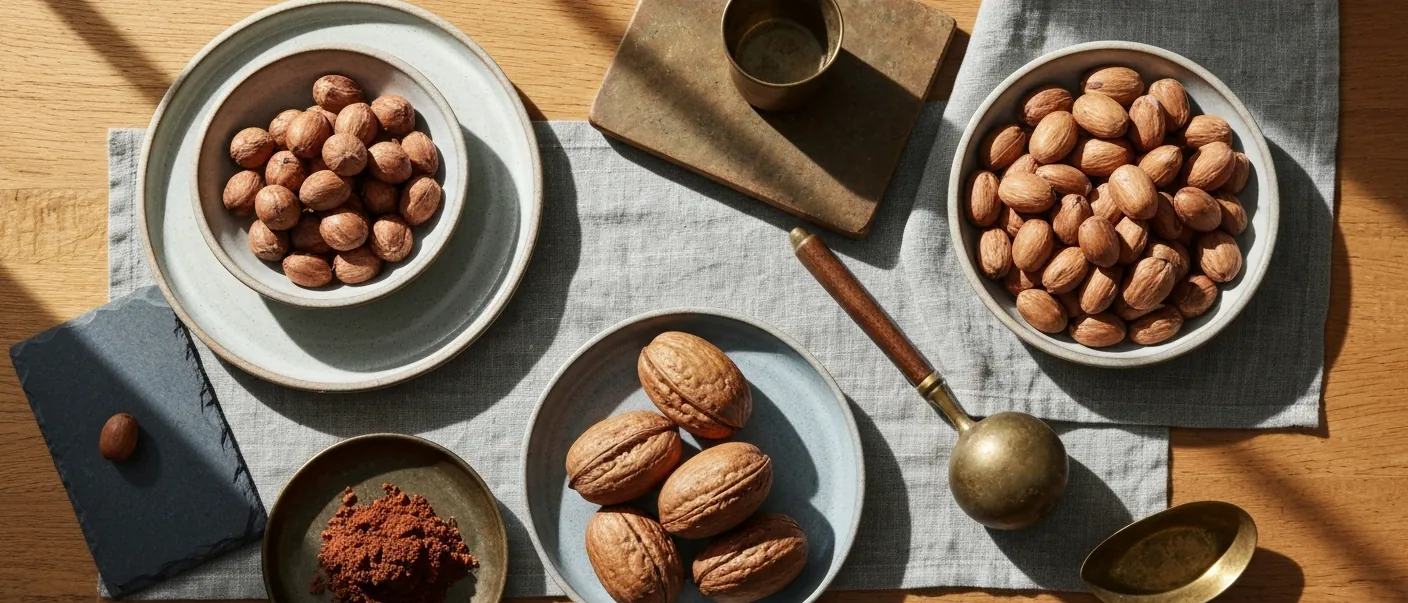
Fresh nuts are a different thing entirely
Most of us encounter nuts in their dried, shelf-stable form — shrunken, concentrated, occasionally stale. The nuts that arrive in Britain's orchards and hedgerows from late summer onwards are something else: plump with moisture, mild in flavour, deeply perishable. They will not keep. That brevity is precisely the point.
Two varieties define the British fresh nut season: the Kentish cobnut, a cultivated hazelnut with its own distinct growers' tradition, and the wet walnut, a fleeting autumn pleasure that most people have never tried.
The Kentish cobnut
Cobnuts are cultivated hazelnuts, and the Kentish cobnut is a specific variety grown in orchards — known locally as plats — across Kent. The county's heavy clay soils and relatively mild climate suit them well, and the tradition of growing them on a managed commercial scale is essentially unique to this corner of England.
From late August, the first cobnuts arrive still in their leafy green husks, the nuts themselves ivory-white inside and tasting faintly of fresh milk and green vegetation. This is the wet stage, and it is the most prized. As the season moves into September and October, the husks brown and the nut dries slightly, developing a richer, more conventionally nutty flavour. Both stages have their advocates; the early wet cobnut, though, has no equivalent elsewhere.
They are traditionally eaten raw — cracked at the table and eaten straight, sometimes with a little salt, sometimes alongside a ripe cheese or soft unsalted butter. The craft is entirely in the growing.
Wet walnuts: even more fleeting
Wet walnuts follow later in the season, before the harvest is dried for storage. A freshly harvested walnut, shell still slightly soft and kernel pale and almost creamy, bears little resemblance to the dried walnut sold in bags. The flavour is gentler and less tannic, with a faint bitterness that feels like a counterpoint rather than an edge.
British-grown wet walnuts do exist, though not on the same organised commercial scale as cobnuts. They are worth asking after at good farm shops and specialist greengrocers in the autumn months. The window is short: once harvested, wet walnuts deteriorate within weeks even under refrigeration.
Like cobnuts, they are best eaten simply — broken open fresh, or paired with strong cheese and something sweetly acidic, such as quince paste or pickled fruit.
Where to find them
Kentish cobnuts are increasingly available beyond Kent, though supply stays limited and seasonal. Farm shops across the South East tend to stock them first; specialist greengrocers and some farmers' markets follow. Ordering direct from Kent growers is increasingly practical, though given how quickly fresh nuts deteriorate, buying from the closest possible source is always sensible.
Wet walnuts are harder to find — worth asking for specifically rather than hoping to spot them. A good cheesemonger or a farm shop with strong local supplier relationships is usually the most reliable source. Both nuts appear at autumn food festivals and farmers' markets during their respective seasons. If you see them, buy them; there will not be another chance until next year.
Why this season matters
The appeal is partly about flavour, but also about eating something that cannot be imported, stockpiled or approximated. Dried hazelnuts from abroad — which make up the vast majority of what Britain consumes — are an entirely different product from a freshly picked Kentish cobnut. Neither is inferior; they are simply not the same food.
Paying attention to the cobnut and wet walnut seasons is a modest means of staying connected to what Britain's land actually produces and when. The season is short. It rewards the people who notice it.
_9e2b-71_pngq80.webp)